Hengrui Sheng , Leo N.Y. Cao , Yurui Shang , Chengyu Li , Zhuyu Zhou , Yang Jiang , Yanshuo Sun , Wei Tang , Baodong Chen , Wenxi Guo , Zijie Xu , Zhong Lin Wang
{"title":"保形自供电高信噪比仿生原位飞机表面湍流测绘系统","authors":"Hengrui Sheng , Leo N.Y. Cao , Yurui Shang , Chengyu Li , Zhuyu Zhou , Yang Jiang , Yanshuo Sun , Wei Tang , Baodong Chen , Wenxi Guo , Zijie Xu , Zhong Lin Wang","doi":"10.1016/j.nanoen.2025.110694","DOIUrl":null,"url":null,"abstract":"<div><div>Turbulence, a state of disordered and random air hydrodynamic phenomenon, constantly pits it against flight safety during aviation. In the interplay between safe flight and turbulence, the challenge of real-time in situ monitoring of the surface airflow state on aircraft has become a difficult but crucial challenge. However, due to constraints in materials science and technological advancements, a flawless solution for mapping the surface airflow of aircraft has not yet been developed. Herein, based on the strong conformability, strong positive tribomaterial silk fibroin and fluid dynamics biomimetic design, a self-powered, high signal-to-noise ratio in-situ aircraft surface turbulence mapping system has been developed based on the principle of triboelectric nanogenerators (TENGs). On one hand, the system functions as a vortex generator during normal flight; on the other hand, the system can swiftly detect the degree of stall and enhance flight safety when the aircraft suffers airflow separation due to a high angle of attack. The backend signal of the system is transmitted by a self-developed wireless transmitter, suitable for various fixed-wing aircraft.</div></div>","PeriodicalId":394,"journal":{"name":"Nano Energy","volume":"136 ","pages":"Article 110694"},"PeriodicalIF":17.1000,"publicationDate":"2025-04-01","publicationTypes":"Journal Article","fieldsOfStudy":null,"isOpenAccess":false,"openAccessPdf":"","citationCount":"0","resultStr":"{\"title\":\"Conformal self-powered high signal-to-noise ratio biomimetic in-situ aircraft surface turbulence mapping system\",\"authors\":\"Hengrui Sheng , Leo N.Y. Cao , Yurui Shang , Chengyu Li , Zhuyu Zhou , Yang Jiang , Yanshuo Sun , Wei Tang , Baodong Chen , Wenxi Guo , Zijie Xu , Zhong Lin Wang\",\"doi\":\"10.1016/j.nanoen.2025.110694\",\"DOIUrl\":null,\"url\":null,\"abstract\":\"<div><div>Turbulence, a state of disordered and random air hydrodynamic phenomenon, constantly pits it against flight safety during aviation. In the interplay between safe flight and turbulence, the challenge of real-time in situ monitoring of the surface airflow state on aircraft has become a difficult but crucial challenge. However, due to constraints in materials science and technological advancements, a flawless solution for mapping the surface airflow of aircraft has not yet been developed. Herein, based on the strong conformability, strong positive tribomaterial silk fibroin and fluid dynamics biomimetic design, a self-powered, high signal-to-noise ratio in-situ aircraft surface turbulence mapping system has been developed based on the principle of triboelectric nanogenerators (TENGs). On one hand, the system functions as a vortex generator during normal flight; on the other hand, the system can swiftly detect the degree of stall and enhance flight safety when the aircraft suffers airflow separation due to a high angle of attack. The backend signal of the system is transmitted by a self-developed wireless transmitter, suitable for various fixed-wing aircraft.</div></div>\",\"PeriodicalId\":394,\"journal\":{\"name\":\"Nano Energy\",\"volume\":\"136 \",\"pages\":\"Article 110694\"},\"PeriodicalIF\":17.1000,\"publicationDate\":\"2025-04-01\",\"publicationTypes\":\"Journal Article\",\"fieldsOfStudy\":null,\"isOpenAccess\":false,\"openAccessPdf\":\"\",\"citationCount\":\"0\",\"resultStr\":null,\"platform\":\"Semanticscholar\",\"paperid\":null,\"PeriodicalName\":\"Nano Energy\",\"FirstCategoryId\":\"88\",\"ListUrlMain\":\"https://www.sciencedirect.com/science/article/pii/S2211285525000539\",\"RegionNum\":1,\"RegionCategory\":\"材料科学\",\"ArticlePicture\":[],\"TitleCN\":null,\"AbstractTextCN\":null,\"PMCID\":null,\"EPubDate\":\"2025/1/24 0:00:00\",\"PubModel\":\"Epub\",\"JCR\":\"Q1\",\"JCRName\":\"CHEMISTRY, PHYSICAL\",\"Score\":null,\"Total\":0}","platform":"Semanticscholar","paperid":null,"PeriodicalName":"Nano Energy","FirstCategoryId":"88","ListUrlMain":"https://www.sciencedirect.com/science/article/pii/S2211285525000539","RegionNum":1,"RegionCategory":"材料科学","ArticlePicture":[],"TitleCN":null,"AbstractTextCN":null,"PMCID":null,"EPubDate":"2025/1/24 0:00:00","PubModel":"Epub","JCR":"Q1","JCRName":"CHEMISTRY, PHYSICAL","Score":null,"Total":0}
Conformal self-powered high signal-to-noise ratio biomimetic in-situ aircraft surface turbulence mapping system
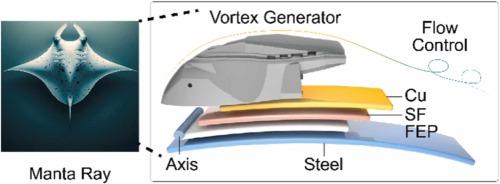
Turbulence, a state of disordered and random air hydrodynamic phenomenon, constantly pits it against flight safety during aviation. In the interplay between safe flight and turbulence, the challenge of real-time in situ monitoring of the surface airflow state on aircraft has become a difficult but crucial challenge. However, due to constraints in materials science and technological advancements, a flawless solution for mapping the surface airflow of aircraft has not yet been developed. Herein, based on the strong conformability, strong positive tribomaterial silk fibroin and fluid dynamics biomimetic design, a self-powered, high signal-to-noise ratio in-situ aircraft surface turbulence mapping system has been developed based on the principle of triboelectric nanogenerators (TENGs). On one hand, the system functions as a vortex generator during normal flight; on the other hand, the system can swiftly detect the degree of stall and enhance flight safety when the aircraft suffers airflow separation due to a high angle of attack. The backend signal of the system is transmitted by a self-developed wireless transmitter, suitable for various fixed-wing aircraft.
期刊介绍:
Nano Energy is a multidisciplinary, rapid-publication forum of original peer-reviewed contributions on the science and engineering of nanomaterials and nanodevices used in all forms of energy harvesting, conversion, storage, utilization and policy. Through its mixture of articles, reviews, communications, research news, and information on key developments, Nano Energy provides a comprehensive coverage of this exciting and dynamic field which joins nanoscience and nanotechnology with energy science. The journal is relevant to all those who are interested in nanomaterials solutions to the energy problem.
Nano Energy publishes original experimental and theoretical research on all aspects of energy-related research which utilizes nanomaterials and nanotechnology. Manuscripts of four types are considered: review articles which inform readers of the latest research and advances in energy science; rapid communications which feature exciting research breakthroughs in the field; full-length articles which report comprehensive research developments; and news and opinions which comment on topical issues or express views on the developments in related fields.




 京公网安备 11010802042870号
京ICP备2023020795号-1
京公网安备 11010802042870号
京ICP备2023020795号-1

 分享
分享
 求助内容:
求助内容: 应助结果提醒方式:
 扫码关注我们
