Fengrong Wang , Qun Zhao , Wenting Liu , Dayan Zhang , Xuejing Dai , Weiming Zhou , Xiaoli Zeng , Yan Zhang , Liansheng Cheng , Guodong Shen , Yanting Gu
{"title":"人源化anti-b7h3×4-1BB双特异性抗体通过激活先天免疫和适应性免疫发挥有效的抗肿瘤作用。","authors":"Fengrong Wang , Qun Zhao , Wenting Liu , Dayan Zhang , Xuejing Dai , Weiming Zhou , Xiaoli Zeng , Yan Zhang , Liansheng Cheng , Guodong Shen , Yanting Gu","doi":"10.1016/j.bbrc.2025.151347","DOIUrl":null,"url":null,"abstract":"<div><div>Agonistic monoclonal antibodies targeting 4-1BB have shown much preclinical promise, but their clinical development has been limited by obvious toxicity or unremarkable efficacy. Here, we generated two humanized anti-B7H3 × 4-1BB bsAbs (HK056-001/002) by fusing an anti-4-1BB scFv to the C-terminus of an anti-B7H3 with an intact Fc fragment from human IgG1 or IgG4. The two bsAbs were able to stimulate the 4-1BB signaling pathway, which was strictly dependent on B7H3 expression. In particular, HK056-001 retained Fc function and induced an ADCC effect in tumor cells, whereas HK056-002 did not. Strikingly, HK056-001 showed superior antitumour activity to HK056-002 both in vitro and in vivo. HK056-001 enhanced antitumour immunity and induced lasting antigen-specific immune memory to prevent tumor regrowth upon rechallenge, even at a dose as low as 2 mg/kg. Furthermore, HK056-001 did not induce nonspecific production of proinflammatory cytokines and had no apparent ability to induce ADA production. In addition, HK056-001 has no significant liver toxicity in human 4-1BB-KI BALB/c mice bearing CT26-B7H3 tumors. The optimal anti-B7H3 × 4-1BB bsAb HK056-001 exhibited synergistic antitumour effects by inducing an ADCC effect (innate immunity) and activating the 4-1BB signaling pathway (adaptive immunity) upon cross-bridging with B7H3 with no obvious toxicity, which could potentially provide a better therapeutic window compared to what is seen with 4-1BB agonists.</div></div>","PeriodicalId":8779,"journal":{"name":"Biochemical and biophysical research communications","volume":"749 ","pages":"Article 151347"},"PeriodicalIF":2.2000,"publicationDate":"2025-02-16","publicationTypes":"Journal Article","fieldsOfStudy":null,"isOpenAccess":false,"openAccessPdf":"","citationCount":"0","resultStr":"{\"title\":\"A humanized anti-b7h3×4-1BB bispecific antibody exerts potent antitumour effects through the activation of innate and adaptive immunity\",\"authors\":\"Fengrong Wang , Qun Zhao , Wenting Liu , Dayan Zhang , Xuejing Dai , Weiming Zhou , Xiaoli Zeng , Yan Zhang , Liansheng Cheng , Guodong Shen , Yanting Gu\",\"doi\":\"10.1016/j.bbrc.2025.151347\",\"DOIUrl\":null,\"url\":null,\"abstract\":\"<div><div>Agonistic monoclonal antibodies targeting 4-1BB have shown much preclinical promise, but their clinical development has been limited by obvious toxicity or unremarkable efficacy. Here, we generated two humanized anti-B7H3 × 4-1BB bsAbs (HK056-001/002) by fusing an anti-4-1BB scFv to the C-terminus of an anti-B7H3 with an intact Fc fragment from human IgG1 or IgG4. The two bsAbs were able to stimulate the 4-1BB signaling pathway, which was strictly dependent on B7H3 expression. In particular, HK056-001 retained Fc function and induced an ADCC effect in tumor cells, whereas HK056-002 did not. Strikingly, HK056-001 showed superior antitumour activity to HK056-002 both in vitro and in vivo. HK056-001 enhanced antitumour immunity and induced lasting antigen-specific immune memory to prevent tumor regrowth upon rechallenge, even at a dose as low as 2 mg/kg. Furthermore, HK056-001 did not induce nonspecific production of proinflammatory cytokines and had no apparent ability to induce ADA production. In addition, HK056-001 has no significant liver toxicity in human 4-1BB-KI BALB/c mice bearing CT26-B7H3 tumors. The optimal anti-B7H3 × 4-1BB bsAb HK056-001 exhibited synergistic antitumour effects by inducing an ADCC effect (innate immunity) and activating the 4-1BB signaling pathway (adaptive immunity) upon cross-bridging with B7H3 with no obvious toxicity, which could potentially provide a better therapeutic window compared to what is seen with 4-1BB agonists.</div></div>\",\"PeriodicalId\":8779,\"journal\":{\"name\":\"Biochemical and biophysical research communications\",\"volume\":\"749 \",\"pages\":\"Article 151347\"},\"PeriodicalIF\":2.2000,\"publicationDate\":\"2025-02-16\",\"publicationTypes\":\"Journal Article\",\"fieldsOfStudy\":null,\"isOpenAccess\":false,\"openAccessPdf\":\"\",\"citationCount\":\"0\",\"resultStr\":null,\"platform\":\"Semanticscholar\",\"paperid\":null,\"PeriodicalName\":\"Biochemical and biophysical research communications\",\"FirstCategoryId\":\"99\",\"ListUrlMain\":\"https://www.sciencedirect.com/science/article/pii/S0006291X25000610\",\"RegionNum\":3,\"RegionCategory\":\"生物学\",\"ArticlePicture\":[],\"TitleCN\":null,\"AbstractTextCN\":null,\"PMCID\":null,\"EPubDate\":\"2025/1/16 0:00:00\",\"PubModel\":\"Epub\",\"JCR\":\"Q3\",\"JCRName\":\"BIOCHEMISTRY & MOLECULAR BIOLOGY\",\"Score\":null,\"Total\":0}","platform":"Semanticscholar","paperid":null,"PeriodicalName":"Biochemical and biophysical research communications","FirstCategoryId":"99","ListUrlMain":"https://www.sciencedirect.com/science/article/pii/S0006291X25000610","RegionNum":3,"RegionCategory":"生物学","ArticlePicture":[],"TitleCN":null,"AbstractTextCN":null,"PMCID":null,"EPubDate":"2025/1/16 0:00:00","PubModel":"Epub","JCR":"Q3","JCRName":"BIOCHEMISTRY & MOLECULAR BIOLOGY","Score":null,"Total":0}
A humanized anti-b7h3×4-1BB bispecific antibody exerts potent antitumour effects through the activation of innate and adaptive immunity
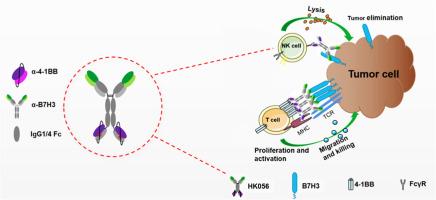
Agonistic monoclonal antibodies targeting 4-1BB have shown much preclinical promise, but their clinical development has been limited by obvious toxicity or unremarkable efficacy. Here, we generated two humanized anti-B7H3 × 4-1BB bsAbs (HK056-001/002) by fusing an anti-4-1BB scFv to the C-terminus of an anti-B7H3 with an intact Fc fragment from human IgG1 or IgG4. The two bsAbs were able to stimulate the 4-1BB signaling pathway, which was strictly dependent on B7H3 expression. In particular, HK056-001 retained Fc function and induced an ADCC effect in tumor cells, whereas HK056-002 did not. Strikingly, HK056-001 showed superior antitumour activity to HK056-002 both in vitro and in vivo. HK056-001 enhanced antitumour immunity and induced lasting antigen-specific immune memory to prevent tumor regrowth upon rechallenge, even at a dose as low as 2 mg/kg. Furthermore, HK056-001 did not induce nonspecific production of proinflammatory cytokines and had no apparent ability to induce ADA production. In addition, HK056-001 has no significant liver toxicity in human 4-1BB-KI BALB/c mice bearing CT26-B7H3 tumors. The optimal anti-B7H3 × 4-1BB bsAb HK056-001 exhibited synergistic antitumour effects by inducing an ADCC effect (innate immunity) and activating the 4-1BB signaling pathway (adaptive immunity) upon cross-bridging with B7H3 with no obvious toxicity, which could potentially provide a better therapeutic window compared to what is seen with 4-1BB agonists.
期刊介绍:
Biochemical and Biophysical Research Communications is the premier international journal devoted to the very rapid dissemination of timely and significant experimental results in diverse fields of biological research. The development of the "Breakthroughs and Views" section brings the minireview format to the journal, and issues often contain collections of special interest manuscripts. BBRC is published weekly (52 issues/year).Research Areas now include: Biochemistry; biophysics; cell biology; developmental biology; immunology
; molecular biology; neurobiology; plant biology and proteomics




 京公网安备 11010802042870号
京ICP备2023020795号-1
京公网安备 11010802042870号
京ICP备2023020795号-1

 分享
分享
 求助内容:
求助内容: 应助结果提醒方式:
 扫码关注我们
