Xianling Ning, Xi Chen, Ridong Li, Yang Li, Zhiqiang Lin, Yuxin Yin
{"title":"一种诱导内质网应激和氧化应激触发肿瘤免疫原性细胞死亡的新型铜增生诱导剂的鉴定。","authors":"Xianling Ning, Xi Chen, Ridong Li, Yang Li, Zhiqiang Lin, Yuxin Yin","doi":"10.1016/j.freeradbiomed.2025.01.042","DOIUrl":null,"url":null,"abstract":"<div><div>Cuproptosis, a copper-dependent form of regulated cell death, has been implicated in the progression and treatment of various tumors. The copper ionophores, such as Disulfiram (DSF), an FDA-approved drug previously used to treat alcohol dependence, have been found to induce cuproptosis. However, the limited solubility and effectiveness of the combination of DSF and copper ion restrict its widespread application. In this study, through a random screening of our in-house compound library, we identified a novel cuproptosis inducer, <strong>YL21</strong>, comprising a naphthoquinone core substituted by two dithiocarbamate groups. The combination of <strong>YL21</strong> with copper ion induces cuproptosis by disrupting mitochondrial function and promoting the oligomerization of lipoylated protein DLAT. Further, this combination induces endoplasmic reticulum (ER) stress and oxidative stress, triggering immunogenic cell death (ICD) and subsequently promoting the activation of antitumor immune responses to suppress tumor growth in the mice breast cancer model. Notably, the combination of <strong>YL21</strong> and copper ion demonstrated improved solubility and increased antitumor activity compared to the combination of DSF and copper ion. Thus, <strong>YL21</strong> functions as a novel cuproptosis inducer and may serve as a promising candidate for antitumor immunotherapy.</div></div>","PeriodicalId":12407,"journal":{"name":"Free Radical Biology and Medicine","volume":"229 ","pages":"Pages 276-288"},"PeriodicalIF":8.2000,"publicationDate":"2025-03-01","publicationTypes":"Journal Article","fieldsOfStudy":null,"isOpenAccess":false,"openAccessPdf":"","citationCount":"0","resultStr":"{\"title\":\"Identification of a novel cuproptosis inducer that induces ER stress and oxidative stress to trigger immunogenic cell death in tumors\",\"authors\":\"Xianling Ning, Xi Chen, Ridong Li, Yang Li, Zhiqiang Lin, Yuxin Yin\",\"doi\":\"10.1016/j.freeradbiomed.2025.01.042\",\"DOIUrl\":null,\"url\":null,\"abstract\":\"<div><div>Cuproptosis, a copper-dependent form of regulated cell death, has been implicated in the progression and treatment of various tumors. The copper ionophores, such as Disulfiram (DSF), an FDA-approved drug previously used to treat alcohol dependence, have been found to induce cuproptosis. However, the limited solubility and effectiveness of the combination of DSF and copper ion restrict its widespread application. In this study, through a random screening of our in-house compound library, we identified a novel cuproptosis inducer, <strong>YL21</strong>, comprising a naphthoquinone core substituted by two dithiocarbamate groups. The combination of <strong>YL21</strong> with copper ion induces cuproptosis by disrupting mitochondrial function and promoting the oligomerization of lipoylated protein DLAT. Further, this combination induces endoplasmic reticulum (ER) stress and oxidative stress, triggering immunogenic cell death (ICD) and subsequently promoting the activation of antitumor immune responses to suppress tumor growth in the mice breast cancer model. Notably, the combination of <strong>YL21</strong> and copper ion demonstrated improved solubility and increased antitumor activity compared to the combination of DSF and copper ion. Thus, <strong>YL21</strong> functions as a novel cuproptosis inducer and may serve as a promising candidate for antitumor immunotherapy.</div></div>\",\"PeriodicalId\":12407,\"journal\":{\"name\":\"Free Radical Biology and Medicine\",\"volume\":\"229 \",\"pages\":\"Pages 276-288\"},\"PeriodicalIF\":8.2000,\"publicationDate\":\"2025-03-01\",\"publicationTypes\":\"Journal Article\",\"fieldsOfStudy\":null,\"isOpenAccess\":false,\"openAccessPdf\":\"\",\"citationCount\":\"0\",\"resultStr\":null,\"platform\":\"Semanticscholar\",\"paperid\":null,\"PeriodicalName\":\"Free Radical Biology and Medicine\",\"FirstCategoryId\":\"3\",\"ListUrlMain\":\"https://www.sciencedirect.com/science/article/pii/S0891584925000528\",\"RegionNum\":2,\"RegionCategory\":\"生物学\",\"ArticlePicture\":[],\"TitleCN\":null,\"AbstractTextCN\":null,\"PMCID\":null,\"EPubDate\":\"2025/1/21 0:00:00\",\"PubModel\":\"Epub\",\"JCR\":\"Q1\",\"JCRName\":\"BIOCHEMISTRY & MOLECULAR BIOLOGY\",\"Score\":null,\"Total\":0}","platform":"Semanticscholar","paperid":null,"PeriodicalName":"Free Radical Biology and Medicine","FirstCategoryId":"3","ListUrlMain":"https://www.sciencedirect.com/science/article/pii/S0891584925000528","RegionNum":2,"RegionCategory":"生物学","ArticlePicture":[],"TitleCN":null,"AbstractTextCN":null,"PMCID":null,"EPubDate":"2025/1/21 0:00:00","PubModel":"Epub","JCR":"Q1","JCRName":"BIOCHEMISTRY & MOLECULAR BIOLOGY","Score":null,"Total":0}
Identification of a novel cuproptosis inducer that induces ER stress and oxidative stress to trigger immunogenic cell death in tumors
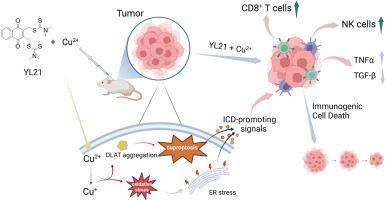
Cuproptosis, a copper-dependent form of regulated cell death, has been implicated in the progression and treatment of various tumors. The copper ionophores, such as Disulfiram (DSF), an FDA-approved drug previously used to treat alcohol dependence, have been found to induce cuproptosis. However, the limited solubility and effectiveness of the combination of DSF and copper ion restrict its widespread application. In this study, through a random screening of our in-house compound library, we identified a novel cuproptosis inducer, YL21, comprising a naphthoquinone core substituted by two dithiocarbamate groups. The combination of YL21 with copper ion induces cuproptosis by disrupting mitochondrial function and promoting the oligomerization of lipoylated protein DLAT. Further, this combination induces endoplasmic reticulum (ER) stress and oxidative stress, triggering immunogenic cell death (ICD) and subsequently promoting the activation of antitumor immune responses to suppress tumor growth in the mice breast cancer model. Notably, the combination of YL21 and copper ion demonstrated improved solubility and increased antitumor activity compared to the combination of DSF and copper ion. Thus, YL21 functions as a novel cuproptosis inducer and may serve as a promising candidate for antitumor immunotherapy.
期刊介绍:
Free Radical Biology and Medicine is a leading journal in the field of redox biology, which is the study of the role of reactive oxygen species (ROS) and other oxidizing agents in biological systems. The journal serves as a premier forum for publishing innovative and groundbreaking research that explores the redox biology of health and disease, covering a wide range of topics and disciplines. Free Radical Biology and Medicine also commissions Special Issues that highlight recent advances in both basic and clinical research, with a particular emphasis on the mechanisms underlying altered metabolism and redox signaling. These Special Issues aim to provide a focused platform for the latest research in the field, fostering collaboration and knowledge exchange among researchers and clinicians.




 京公网安备 11010802042870号
京ICP备2023020795号-1
京公网安备 11010802042870号
京ICP备2023020795号-1

 分享
分享
 求助内容:
求助内容: 应助结果提醒方式:
 扫码关注我们
