Minzheng Guo , Baochuang Qi , Zijie Pei , Haonan Ni , Junxiao Ren , Huan Luo , Hongxin Shi , Chen Meng , Yang Yu , Zhifang Tang , Yongqing Xu , Qingyun Xue , Chuan Li
{"title":"小剂量骨髓间充质干细胞负载3D微支架治疗早期股骨头坏死的疗效观察。","authors":"Minzheng Guo , Baochuang Qi , Zijie Pei , Haonan Ni , Junxiao Ren , Huan Luo , Hongxin Shi , Chen Meng , Yang Yu , Zhifang Tang , Yongqing Xu , Qingyun Xue , Chuan Li","doi":"10.1016/j.mtbio.2024.101426","DOIUrl":null,"url":null,"abstract":"<div><div>The early treatment of Osteonecrosis of Femoral Head (ONFH) remains a clinical challenge. Conventional Bone Marrow Mesenchymal Stem Cell (BMSC) injection methods often result in unsatisfactory outcomes due to mechanical cell damage, low cell survival and retention rates, inadequate cell matrix accumulation, and poor intercellular interaction. In this study, we employed a novel cell carrier material termed \"3D Microscaffold\" to deliver BMSCs, addressing these issues and enhancing the therapeutic effects of cell therapy for ONFH. We injected 3D microscaffold loaded with low-dose BMSCs or free high-dose BMSCs into the femoral heads of ONFH rats and assessed therapeutic effects using imaging, serology, histology, and immunohistochemistry. To understand the mechanism of efficacy, we established a co-culture model of human osteoblasts and BMSCs, followed by cell proliferation and activity detection, flow cytometry analysis, Quantitative RT-PCR, and Western blotting. Additionally, RNA sequencing was performed on femoral head tissues. Results showed that the 3D microscaffold with low-dose BMSCs had a therapeutic effect comparable to high-dose free BMSCs. Osteoblasts in the 3D microscaffold group exhibited superior phenotypes compared to the non-3D microscaffold group. Furthermore, we have, for the first time, preliminarily validated that the low-dose BMSCs-loaded 3D microscaffolds may promote the repair of femoral head necrosis through the synergistic action of the MAPK and Hippo signaling pathways.</div></div>","PeriodicalId":18310,"journal":{"name":"Materials Today Bio","volume":"30 ","pages":"Article 101426"},"PeriodicalIF":11.0000,"publicationDate":"2025-02-01","publicationTypes":"Journal Article","fieldsOfStudy":null,"isOpenAccess":false,"openAccessPdf":"https://www.ncbi.nlm.nih.gov/pmc/articles/PMC11755031/pdf/","citationCount":"0","resultStr":"{\"title\":\"Therapeutic effect of low-dose BMSCs-Loaded 3D microscaffold on early osteonecrosis of the femoral head\",\"authors\":\"Minzheng Guo , Baochuang Qi , Zijie Pei , Haonan Ni , Junxiao Ren , Huan Luo , Hongxin Shi , Chen Meng , Yang Yu , Zhifang Tang , Yongqing Xu , Qingyun Xue , Chuan Li\",\"doi\":\"10.1016/j.mtbio.2024.101426\",\"DOIUrl\":null,\"url\":null,\"abstract\":\"<div><div>The early treatment of Osteonecrosis of Femoral Head (ONFH) remains a clinical challenge. Conventional Bone Marrow Mesenchymal Stem Cell (BMSC) injection methods often result in unsatisfactory outcomes due to mechanical cell damage, low cell survival and retention rates, inadequate cell matrix accumulation, and poor intercellular interaction. In this study, we employed a novel cell carrier material termed \\\"3D Microscaffold\\\" to deliver BMSCs, addressing these issues and enhancing the therapeutic effects of cell therapy for ONFH. We injected 3D microscaffold loaded with low-dose BMSCs or free high-dose BMSCs into the femoral heads of ONFH rats and assessed therapeutic effects using imaging, serology, histology, and immunohistochemistry. To understand the mechanism of efficacy, we established a co-culture model of human osteoblasts and BMSCs, followed by cell proliferation and activity detection, flow cytometry analysis, Quantitative RT-PCR, and Western blotting. Additionally, RNA sequencing was performed on femoral head tissues. Results showed that the 3D microscaffold with low-dose BMSCs had a therapeutic effect comparable to high-dose free BMSCs. Osteoblasts in the 3D microscaffold group exhibited superior phenotypes compared to the non-3D microscaffold group. Furthermore, we have, for the first time, preliminarily validated that the low-dose BMSCs-loaded 3D microscaffolds may promote the repair of femoral head necrosis through the synergistic action of the MAPK and Hippo signaling pathways.</div></div>\",\"PeriodicalId\":18310,\"journal\":{\"name\":\"Materials Today Bio\",\"volume\":\"30 \",\"pages\":\"Article 101426\"},\"PeriodicalIF\":11.0000,\"publicationDate\":\"2025-02-01\",\"publicationTypes\":\"Journal Article\",\"fieldsOfStudy\":null,\"isOpenAccess\":false,\"openAccessPdf\":\"https://www.ncbi.nlm.nih.gov/pmc/articles/PMC11755031/pdf/\",\"citationCount\":\"0\",\"resultStr\":null,\"platform\":\"Semanticscholar\",\"paperid\":null,\"PeriodicalName\":\"Materials Today Bio\",\"FirstCategoryId\":\"5\",\"ListUrlMain\":\"https://www.sciencedirect.com/science/article/pii/S2590006424004873\",\"RegionNum\":1,\"RegionCategory\":\"医学\",\"ArticlePicture\":[],\"TitleCN\":null,\"AbstractTextCN\":null,\"PMCID\":null,\"EPubDate\":\"2024/12/24 0:00:00\",\"PubModel\":\"Epub\",\"JCR\":\"Q1\",\"JCRName\":\"ENGINEERING, BIOMEDICAL\",\"Score\":null,\"Total\":0}","platform":"Semanticscholar","paperid":null,"PeriodicalName":"Materials Today Bio","FirstCategoryId":"5","ListUrlMain":"https://www.sciencedirect.com/science/article/pii/S2590006424004873","RegionNum":1,"RegionCategory":"医学","ArticlePicture":[],"TitleCN":null,"AbstractTextCN":null,"PMCID":null,"EPubDate":"2024/12/24 0:00:00","PubModel":"Epub","JCR":"Q1","JCRName":"ENGINEERING, BIOMEDICAL","Score":null,"Total":0}
Therapeutic effect of low-dose BMSCs-Loaded 3D microscaffold on early osteonecrosis of the femoral head
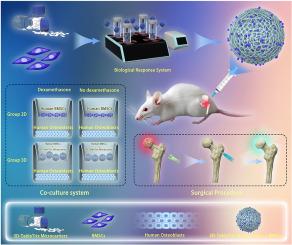
The early treatment of Osteonecrosis of Femoral Head (ONFH) remains a clinical challenge. Conventional Bone Marrow Mesenchymal Stem Cell (BMSC) injection methods often result in unsatisfactory outcomes due to mechanical cell damage, low cell survival and retention rates, inadequate cell matrix accumulation, and poor intercellular interaction. In this study, we employed a novel cell carrier material termed "3D Microscaffold" to deliver BMSCs, addressing these issues and enhancing the therapeutic effects of cell therapy for ONFH. We injected 3D microscaffold loaded with low-dose BMSCs or free high-dose BMSCs into the femoral heads of ONFH rats and assessed therapeutic effects using imaging, serology, histology, and immunohistochemistry. To understand the mechanism of efficacy, we established a co-culture model of human osteoblasts and BMSCs, followed by cell proliferation and activity detection, flow cytometry analysis, Quantitative RT-PCR, and Western blotting. Additionally, RNA sequencing was performed on femoral head tissues. Results showed that the 3D microscaffold with low-dose BMSCs had a therapeutic effect comparable to high-dose free BMSCs. Osteoblasts in the 3D microscaffold group exhibited superior phenotypes compared to the non-3D microscaffold group. Furthermore, we have, for the first time, preliminarily validated that the low-dose BMSCs-loaded 3D microscaffolds may promote the repair of femoral head necrosis through the synergistic action of the MAPK and Hippo signaling pathways.
期刊介绍:
Materials Today Bio is a multidisciplinary journal that specializes in the intersection between biology and materials science, chemistry, physics, engineering, and medicine. It covers various aspects such as the design and assembly of new structures, their interaction with biological systems, functionalization, bioimaging, therapies, and diagnostics in healthcare. The journal aims to showcase the most significant advancements and discoveries in this field. As part of the Materials Today family, Materials Today Bio provides rigorous peer review, quick decision-making, and high visibility for authors. It is indexed in Scopus, PubMed Central, Emerging Sources, Citation Index (ESCI), and Directory of Open Access Journals (DOAJ).




 京公网安备 11010802042870号
京ICP备2023020795号-1
京公网安备 11010802042870号
京ICP备2023020795号-1

 分享
分享
 求助内容:
求助内容: 应助结果提醒方式:
 扫码关注我们
