Rodney Ahdoot, Trista M Benítez, Chien-Wei Wang, Kevin C Chung
{"title":"整形外科随机对照试验中的逆向脆弱性指数。","authors":"Rodney Ahdoot, Trista M Benítez, Chien-Wei Wang, Kevin C Chung","doi":"10.1097/GOX.0000000000006456","DOIUrl":null,"url":null,"abstract":"<p><strong>Background: </strong>The reverse fragility index (RFI) is a measure used to evaluate the neutrality of statistically nonsignificant findings in randomized controlled trials (RCTs). The RFI represents the minimum number of events needed to reverse a statistically nonsignificant result into a significant one. This study applied the RFI to examine the robustness of statistically nonsignificant RCTs in plastic surgery.</p><p><strong>Methods: </strong>A systematic literature search of the 10 highest impact journals covering plastic and reconstructive surgery topics was conducted to identify RCTs published between January 2000 and March 2023. The Fisher exact test was used to calculate the RFI for each primary outcome. Bivariate analysis was performed to investigate the association of trial characteristics with the RFI.</p><p><strong>Results: </strong>Forty RCTs that yielded 65 primary outcomes were included in the analysis with a median sample size of 76 participants (interquartile range [IQR], 49-129) and a median of 10 events (IQR, 3-22). The median RFI was 4 (IQR, 3-5), indicating that statistical significance would have been achieved if 4 participants had a change in event status. The median RFQ was 0.053 (IQR, 0.038-0.08). Most studies (21 of 40) did not perform statistical power analysis. Twelve of 40 RCTs did not report or clearly indicate loss to follow-up.</p><p><strong>Conclusions: </strong>The findings of RCTs in the plastic surgery literature demonstrate fragility as the preservation of nonsignificant results rested on a small number of events. The RFI is a useful measure to complement the <i>P</i> value and examine the neutrality of null clinical trials.</p>","PeriodicalId":20149,"journal":{"name":"Plastic and Reconstructive Surgery Global Open","volume":"13 1","pages":"e6456"},"PeriodicalIF":1.9000,"publicationDate":"2025-01-23","publicationTypes":"Journal Article","fieldsOfStudy":null,"isOpenAccess":false,"openAccessPdf":"https://www.ncbi.nlm.nih.gov/pmc/articles/PMC11756890/pdf/","citationCount":"0","resultStr":"{\"title\":\"Reverse Fragility Index in Plastic Surgery Randomized Controlled Trials.\",\"authors\":\"Rodney Ahdoot, Trista M Benítez, Chien-Wei Wang, Kevin C Chung\",\"doi\":\"10.1097/GOX.0000000000006456\",\"DOIUrl\":null,\"url\":null,\"abstract\":\"<p><strong>Background: </strong>The reverse fragility index (RFI) is a measure used to evaluate the neutrality of statistically nonsignificant findings in randomized controlled trials (RCTs). The RFI represents the minimum number of events needed to reverse a statistically nonsignificant result into a significant one. This study applied the RFI to examine the robustness of statistically nonsignificant RCTs in plastic surgery.</p><p><strong>Methods: </strong>A systematic literature search of the 10 highest impact journals covering plastic and reconstructive surgery topics was conducted to identify RCTs published between January 2000 and March 2023. The Fisher exact test was used to calculate the RFI for each primary outcome. Bivariate analysis was performed to investigate the association of trial characteristics with the RFI.</p><p><strong>Results: </strong>Forty RCTs that yielded 65 primary outcomes were included in the analysis with a median sample size of 76 participants (interquartile range [IQR], 49-129) and a median of 10 events (IQR, 3-22). The median RFI was 4 (IQR, 3-5), indicating that statistical significance would have been achieved if 4 participants had a change in event status. The median RFQ was 0.053 (IQR, 0.038-0.08). Most studies (21 of 40) did not perform statistical power analysis. Twelve of 40 RCTs did not report or clearly indicate loss to follow-up.</p><p><strong>Conclusions: </strong>The findings of RCTs in the plastic surgery literature demonstrate fragility as the preservation of nonsignificant results rested on a small number of events. The RFI is a useful measure to complement the <i>P</i> value and examine the neutrality of null clinical trials.</p>\",\"PeriodicalId\":20149,\"journal\":{\"name\":\"Plastic and Reconstructive Surgery Global Open\",\"volume\":\"13 1\",\"pages\":\"e6456\"},\"PeriodicalIF\":1.9000,\"publicationDate\":\"2025-01-23\",\"publicationTypes\":\"Journal Article\",\"fieldsOfStudy\":null,\"isOpenAccess\":false,\"openAccessPdf\":\"https://www.ncbi.nlm.nih.gov/pmc/articles/PMC11756890/pdf/\",\"citationCount\":\"0\",\"resultStr\":null,\"platform\":\"Semanticscholar\",\"paperid\":null,\"PeriodicalName\":\"Plastic and Reconstructive Surgery Global Open\",\"FirstCategoryId\":\"1085\",\"ListUrlMain\":\"https://doi.org/10.1097/GOX.0000000000006456\",\"RegionNum\":0,\"RegionCategory\":null,\"ArticlePicture\":[],\"TitleCN\":null,\"AbstractTextCN\":null,\"PMCID\":null,\"EPubDate\":\"2025/1/1 0:00:00\",\"PubModel\":\"eCollection\",\"JCR\":\"Q3\",\"JCRName\":\"SURGERY\",\"Score\":null,\"Total\":0}","platform":"Semanticscholar","paperid":null,"PeriodicalName":"Plastic and Reconstructive Surgery Global Open","FirstCategoryId":"1085","ListUrlMain":"https://doi.org/10.1097/GOX.0000000000006456","RegionNum":0,"RegionCategory":null,"ArticlePicture":[],"TitleCN":null,"AbstractTextCN":null,"PMCID":null,"EPubDate":"2025/1/1 0:00:00","PubModel":"eCollection","JCR":"Q3","JCRName":"SURGERY","Score":null,"Total":0}
Reverse Fragility Index in Plastic Surgery Randomized Controlled Trials.
Background: The reverse fragility index (RFI) is a measure used to evaluate the neutrality of statistically nonsignificant findings in randomized controlled trials (RCTs). The RFI represents the minimum number of events needed to reverse a statistically nonsignificant result into a significant one. This study applied the RFI to examine the robustness of statistically nonsignificant RCTs in plastic surgery.
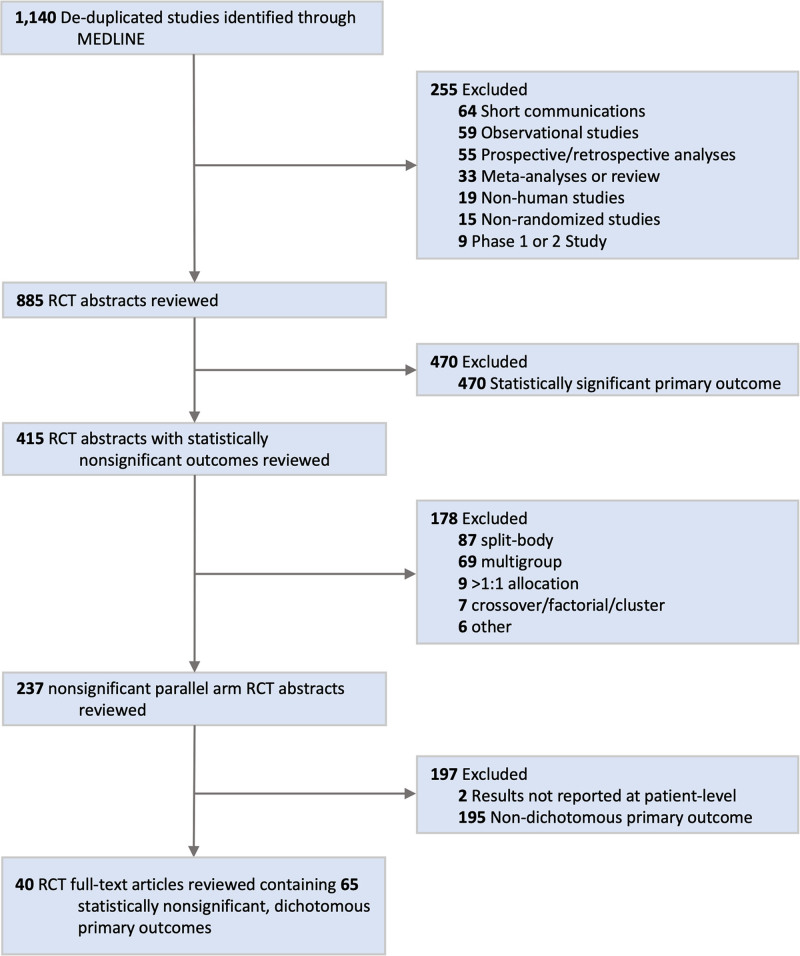
Methods: A systematic literature search of the 10 highest impact journals covering plastic and reconstructive surgery topics was conducted to identify RCTs published between January 2000 and March 2023. The Fisher exact test was used to calculate the RFI for each primary outcome. Bivariate analysis was performed to investigate the association of trial characteristics with the RFI.
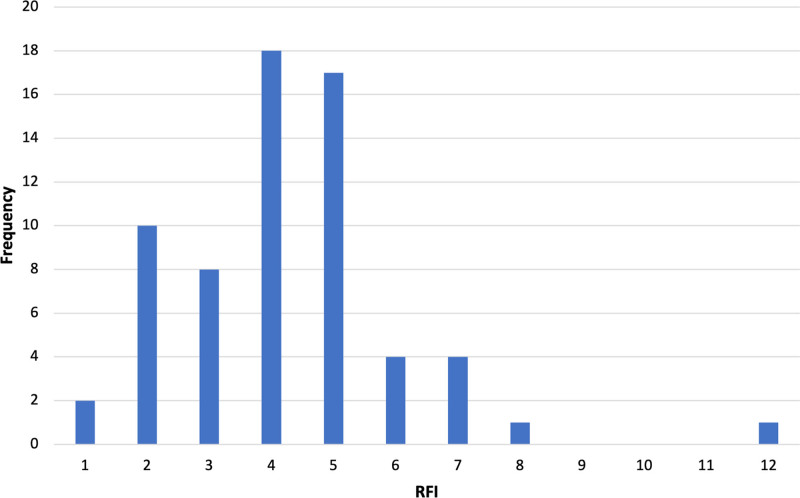
Results: Forty RCTs that yielded 65 primary outcomes were included in the analysis with a median sample size of 76 participants (interquartile range [IQR], 49-129) and a median of 10 events (IQR, 3-22). The median RFI was 4 (IQR, 3-5), indicating that statistical significance would have been achieved if 4 participants had a change in event status. The median RFQ was 0.053 (IQR, 0.038-0.08). Most studies (21 of 40) did not perform statistical power analysis. Twelve of 40 RCTs did not report or clearly indicate loss to follow-up.
Conclusions: The findings of RCTs in the plastic surgery literature demonstrate fragility as the preservation of nonsignificant results rested on a small number of events. The RFI is a useful measure to complement the P value and examine the neutrality of null clinical trials.
期刊介绍:
Plastic and Reconstructive Surgery—Global Open is an open access, peer reviewed, international journal focusing on global plastic and reconstructive surgery.Plastic and Reconstructive Surgery—Global Open publishes on all areas of plastic and reconstructive surgery, including basic science/experimental studies pertinent to the field and also clinical articles on such topics as: breast reconstruction, head and neck surgery, pediatric and craniofacial surgery, hand and microsurgery, wound healing, and cosmetic and aesthetic surgery. Clinical studies, experimental articles, ideas and innovations, and techniques and case reports are all welcome article types. Manuscript submission is open to all surgeons, researchers, and other health care providers world-wide who wish to communicate their research results on topics related to plastic and reconstructive surgery. Furthermore, Plastic and Reconstructive Surgery—Global Open, a complimentary journal to Plastic and Reconstructive Surgery, provides an open access venue for the publication of those research studies sponsored by private and public funding agencies that require open access publication of study results. Its mission is to disseminate high quality, peer reviewed research in plastic and reconstructive surgery to the widest possible global audience, through an open access platform. As an open access journal, Plastic and Reconstructive Surgery—Global Open offers its content for free to any viewer. Authors of articles retain their copyright to the materials published. Additionally, Plastic and Reconstructive Surgery—Global Open provides rapid review and publication of accepted papers.




 京公网安备 11010802042870号
京ICP备2023020795号-1
京公网安备 11010802042870号
京ICP备2023020795号-1

 分享
分享

 求助内容:
求助内容: 应助结果提醒方式:
 扫码关注我们
