{"title":"有氧和抗阻训练结合对抑郁症的影响:随机对照试验的系统回顾和荟萃分析。","authors":"Hai Wang, Qinzheng Liu, Yingxu Pan","doi":"10.1186/s13102-025-01058-w","DOIUrl":null,"url":null,"abstract":"<p><strong>Objective: </strong>To summarize the existing literature and evaluate the efficacy of combined resistance and aerobic training in alleviating depressive symptoms among individuals with depression. Subgroup analyses were conducted based on study region, age, depression severity, intervention duration, intervention frequency, and whether the intervention was supervised or unsupervised.</p><p><strong>Methods: </strong>Five databases were thoroughly examined from database establishment until August 20, 2024, to find randomized controlled trials that investigated resistance combined aerobic training impact on depression.</p><p><strong>Results: </strong>Finally, 27 eligible studies were included, involving a total of 2,342 patients with depression. The outcomes indicated that resistance combined aerobic training notably improved signs of depression in these patients (SMD=-1.39, 95%CI=-1.80 to -0.96, p = 0.000). Subgroup analysis based on study area, age, severity of depressive symptoms, and exercise prescription revealed that resistance combined aerobic training had a particularly significant effect on middle-aged and elderly patients with depression, as well as on those with moderate depression. Additionally, moderate period (9-24 weeks), moderate frequency (3-4 times per week), a total weekly duration of more than 180 min and supervised training displayed the best results.</p><p><strong>Conclusion: </strong>Resistance combined aerobic training serves as an efficient approach to relieve depression-related symptoms, particularly in middle-aged and elderly patients with depression and those with moderate depression. Moderate training intensity, duration, frequency, and total weekly duration offer the greatest benefit.</p>","PeriodicalId":48585,"journal":{"name":"BMC Sports Science Medicine and Rehabilitation","volume":"17 1","pages":"10"},"PeriodicalIF":2.8000,"publicationDate":"2025-01-23","publicationTypes":"Journal Article","fieldsOfStudy":null,"isOpenAccess":false,"openAccessPdf":"https://www.ncbi.nlm.nih.gov/pmc/articles/PMC11756182/pdf/","citationCount":"0","resultStr":"{\"title\":\"Impact of combiner aerobic and resistance training on depression: a systematic review and meta-analysis of randomized controlled trials.\",\"authors\":\"Hai Wang, Qinzheng Liu, Yingxu Pan\",\"doi\":\"10.1186/s13102-025-01058-w\",\"DOIUrl\":null,\"url\":null,\"abstract\":\"<p><strong>Objective: </strong>To summarize the existing literature and evaluate the efficacy of combined resistance and aerobic training in alleviating depressive symptoms among individuals with depression. Subgroup analyses were conducted based on study region, age, depression severity, intervention duration, intervention frequency, and whether the intervention was supervised or unsupervised.</p><p><strong>Methods: </strong>Five databases were thoroughly examined from database establishment until August 20, 2024, to find randomized controlled trials that investigated resistance combined aerobic training impact on depression.</p><p><strong>Results: </strong>Finally, 27 eligible studies were included, involving a total of 2,342 patients with depression. The outcomes indicated that resistance combined aerobic training notably improved signs of depression in these patients (SMD=-1.39, 95%CI=-1.80 to -0.96, p = 0.000). Subgroup analysis based on study area, age, severity of depressive symptoms, and exercise prescription revealed that resistance combined aerobic training had a particularly significant effect on middle-aged and elderly patients with depression, as well as on those with moderate depression. Additionally, moderate period (9-24 weeks), moderate frequency (3-4 times per week), a total weekly duration of more than 180 min and supervised training displayed the best results.</p><p><strong>Conclusion: </strong>Resistance combined aerobic training serves as an efficient approach to relieve depression-related symptoms, particularly in middle-aged and elderly patients with depression and those with moderate depression. Moderate training intensity, duration, frequency, and total weekly duration offer the greatest benefit.</p>\",\"PeriodicalId\":48585,\"journal\":{\"name\":\"BMC Sports Science Medicine and Rehabilitation\",\"volume\":\"17 1\",\"pages\":\"10\"},\"PeriodicalIF\":2.8000,\"publicationDate\":\"2025-01-23\",\"publicationTypes\":\"Journal Article\",\"fieldsOfStudy\":null,\"isOpenAccess\":false,\"openAccessPdf\":\"https://www.ncbi.nlm.nih.gov/pmc/articles/PMC11756182/pdf/\",\"citationCount\":\"0\",\"resultStr\":null,\"platform\":\"Semanticscholar\",\"paperid\":null,\"PeriodicalName\":\"BMC Sports Science Medicine and Rehabilitation\",\"FirstCategoryId\":\"3\",\"ListUrlMain\":\"https://doi.org/10.1186/s13102-025-01058-w\",\"RegionNum\":3,\"RegionCategory\":\"医学\",\"ArticlePicture\":[],\"TitleCN\":null,\"AbstractTextCN\":null,\"PMCID\":null,\"EPubDate\":\"\",\"PubModel\":\"\",\"JCR\":\"Q1\",\"JCRName\":\"REHABILITATION\",\"Score\":null,\"Total\":0}","platform":"Semanticscholar","paperid":null,"PeriodicalName":"BMC Sports Science Medicine and Rehabilitation","FirstCategoryId":"3","ListUrlMain":"https://doi.org/10.1186/s13102-025-01058-w","RegionNum":3,"RegionCategory":"医学","ArticlePicture":[],"TitleCN":null,"AbstractTextCN":null,"PMCID":null,"EPubDate":"","PubModel":"","JCR":"Q1","JCRName":"REHABILITATION","Score":null,"Total":0}
引用次数: 0
摘要
目的:总结现有文献,评价抗阻与有氧联合训练对抑郁症患者抑郁症状的缓解作用。根据研究区域、年龄、抑郁严重程度、干预持续时间、干预频率、干预是否有监督或无监督进行亚组分析。方法:从数据库建立到2024年8月20日,对5个数据库进行全面检查,寻找研究抗阻联合有氧训练对抑郁症影响的随机对照试验。结果:最终纳入了27项符合条件的研究,共涉及2342例抑郁症患者。结果表明,阻力联合有氧训练显著改善了这些患者的抑郁症状(SMD=-1.39, 95%CI=-1.80 ~ -0.96, p = 0.000)。基于研究区域、年龄、抑郁症状严重程度和运动处方的亚组分析显示,阻力联合有氧训练对中老年抑郁症患者以及中度抑郁症患者的效果尤为显著。此外,适度的时间(9-24周)、适度的频率(每周3-4次)、每周总持续时间大于180分钟和有监督的训练效果最好。结论:阻力联合有氧训练是缓解抑郁相关症状的有效方法,尤其适用于中老年抑郁症患者和中度抑郁症患者。适度的训练强度、持续时间、频率和每周总训练时间可以提供最大的好处。
Impact of combiner aerobic and resistance training on depression: a systematic review and meta-analysis of randomized controlled trials.
Objective: To summarize the existing literature and evaluate the efficacy of combined resistance and aerobic training in alleviating depressive symptoms among individuals with depression. Subgroup analyses were conducted based on study region, age, depression severity, intervention duration, intervention frequency, and whether the intervention was supervised or unsupervised.
Methods: Five databases were thoroughly examined from database establishment until August 20, 2024, to find randomized controlled trials that investigated resistance combined aerobic training impact on depression.
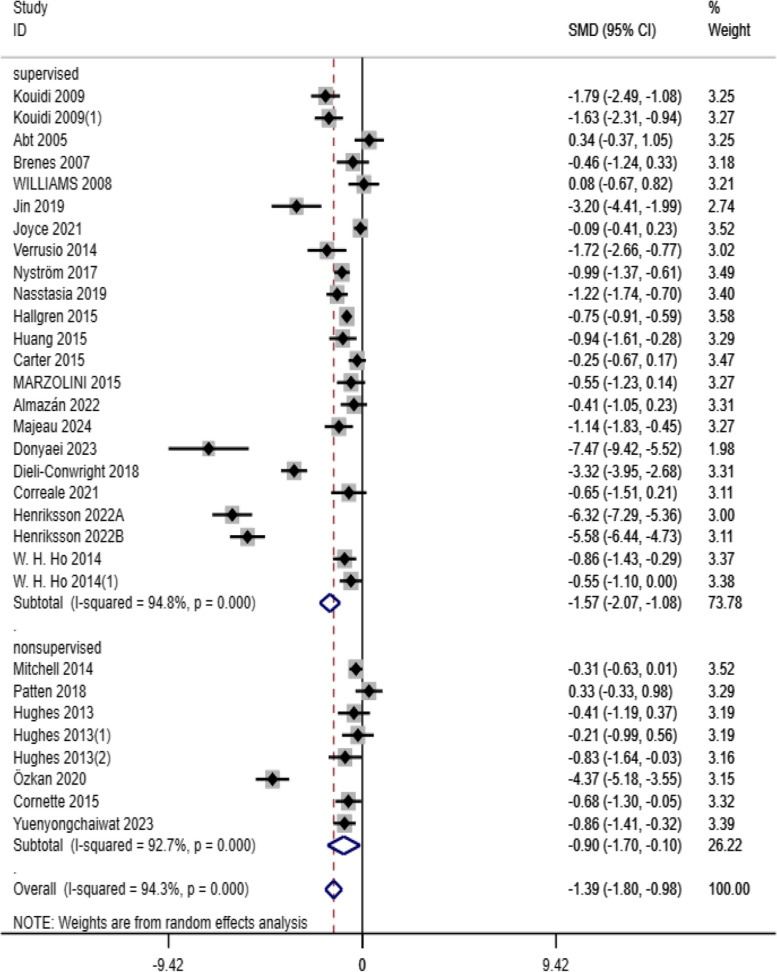
Results: Finally, 27 eligible studies were included, involving a total of 2,342 patients with depression. The outcomes indicated that resistance combined aerobic training notably improved signs of depression in these patients (SMD=-1.39, 95%CI=-1.80 to -0.96, p = 0.000). Subgroup analysis based on study area, age, severity of depressive symptoms, and exercise prescription revealed that resistance combined aerobic training had a particularly significant effect on middle-aged and elderly patients with depression, as well as on those with moderate depression. Additionally, moderate period (9-24 weeks), moderate frequency (3-4 times per week), a total weekly duration of more than 180 min and supervised training displayed the best results.
Conclusion: Resistance combined aerobic training serves as an efficient approach to relieve depression-related symptoms, particularly in middle-aged and elderly patients with depression and those with moderate depression. Moderate training intensity, duration, frequency, and total weekly duration offer the greatest benefit.
期刊介绍:
BMC Sports Science, Medicine and Rehabilitation is an open access, peer reviewed journal that considers articles on all aspects of sports medicine and the exercise sciences, including rehabilitation, traumatology, cardiology, physiology, and nutrition.






 京公网安备 11010802042870号
京ICP备2023020795号-1
京公网安备 11010802042870号
京ICP备2023020795号-1

 分享
分享
 求助内容:
求助内容: 应助结果提醒方式:
 扫码关注我们
