Christoph Sperber, Laura Gallucci, Marcel Arnold, Roza M Umarova
{"title":"长期中风预后预测的挑战和统计相关性并不意味着预测价值。","authors":"Christoph Sperber, Laura Gallucci, Marcel Arnold, Roza M Umarova","doi":"10.1093/braincomms/fcaf003","DOIUrl":null,"url":null,"abstract":"<p><p>Personalized prediction of stroke outcome using lesion imaging markers is still too imprecise to make a breakthrough in clinical practice. We performed a combined prediction and brain mapping study on topographic and connectomic lesion imaging data to evaluate (i) the relationship between lesion-deficit associations and their predictive value and (ii) the influence of time since stroke. In patients with first-ever ischaemic stroke, we first applied high-dimensional machine learning models on lesion topographies or structural disconnection data to model stroke severity (National Institutes of Health Stroke Scale 24 h/3 months) and functional outcome (modified Rankin Scale 3 months) in cross-validation. Second, we mapped the topographic and connectomic lesion impact on both clinical measures. We retrospectively included 685 patients [age 67.4 ± 15.1, National Institutes of Health Stroke Scale 24 h median(IQR) = 3(1; 6), modified Rankin Scale 3 months = 1(0; 2), National Institutes of Health Stroke Scale 3 months = 0(0; 2)]. <i>Predictions</i> for acute stroke severity (National Institutes of Health Stroke Scale 24 h) were better with topographic lesion imaging (<i>R</i>² = 0.41) than with disconnection data (<i>R</i>² = 0.29, <i>P</i> = 0.0015), whereas predictions at 3 months (National Institutes of Health Stroke Scale/modified Rankin Scale) were generally close to chance level. In the analysis of lesion-deficit <i>associations</i>, the correlates of more severe acute stroke (National Institutes of Health Stroke Scale 24 h > 4) and poor functional outcome (modified Rankin Scale 3 months ≥ 2) were left-lateralized. The lesion location impact of both variables corresponded in right-hemisphere stroke with peaks in primary motor regions, but it markedly differed in left-hemisphere stroke. Topographic and disconnection lesion features predict <i>acute</i> stroke severity better than the <i>3-months</i> outcome. This suggests a likely higher impact of lesion-independent factors in the longer term and highlights challenges in the prediction of global functional outcome. Prediction and brain mapping diverge, and the existence of statistically significant associations-as here for 3-months outcomes-does not imply predictive value. Routine neurological scores better capture left- than right-hemispheric lesions, further complicating the challenge of outcome prediction.</p>","PeriodicalId":93915,"journal":{"name":"Brain communications","volume":"7 1","pages":"fcaf003"},"PeriodicalIF":4.5000,"publicationDate":"2025-01-23","publicationTypes":"Journal Article","fieldsOfStudy":null,"isOpenAccess":false,"openAccessPdf":"https://www.ncbi.nlm.nih.gov/pmc/articles/PMC11756379/pdf/","citationCount":"0","resultStr":"{\"title\":\"The challenge of long-term stroke outcome prediction and how statistical correlates do not imply predictive value.\",\"authors\":\"Christoph Sperber, Laura Gallucci, Marcel Arnold, Roza M Umarova\",\"doi\":\"10.1093/braincomms/fcaf003\",\"DOIUrl\":null,\"url\":null,\"abstract\":\"<p><p>Personalized prediction of stroke outcome using lesion imaging markers is still too imprecise to make a breakthrough in clinical practice. We performed a combined prediction and brain mapping study on topographic and connectomic lesion imaging data to evaluate (i) the relationship between lesion-deficit associations and their predictive value and (ii) the influence of time since stroke. In patients with first-ever ischaemic stroke, we first applied high-dimensional machine learning models on lesion topographies or structural disconnection data to model stroke severity (National Institutes of Health Stroke Scale 24 h/3 months) and functional outcome (modified Rankin Scale 3 months) in cross-validation. Second, we mapped the topographic and connectomic lesion impact on both clinical measures. We retrospectively included 685 patients [age 67.4 ± 15.1, National Institutes of Health Stroke Scale 24 h median(IQR) = 3(1; 6), modified Rankin Scale 3 months = 1(0; 2), National Institutes of Health Stroke Scale 3 months = 0(0; 2)]. <i>Predictions</i> for acute stroke severity (National Institutes of Health Stroke Scale 24 h) were better with topographic lesion imaging (<i>R</i>² = 0.41) than with disconnection data (<i>R</i>² = 0.29, <i>P</i> = 0.0015), whereas predictions at 3 months (National Institutes of Health Stroke Scale/modified Rankin Scale) were generally close to chance level. In the analysis of lesion-deficit <i>associations</i>, the correlates of more severe acute stroke (National Institutes of Health Stroke Scale 24 h > 4) and poor functional outcome (modified Rankin Scale 3 months ≥ 2) were left-lateralized. The lesion location impact of both variables corresponded in right-hemisphere stroke with peaks in primary motor regions, but it markedly differed in left-hemisphere stroke. Topographic and disconnection lesion features predict <i>acute</i> stroke severity better than the <i>3-months</i> outcome. This suggests a likely higher impact of lesion-independent factors in the longer term and highlights challenges in the prediction of global functional outcome. Prediction and brain mapping diverge, and the existence of statistically significant associations-as here for 3-months outcomes-does not imply predictive value. Routine neurological scores better capture left- than right-hemispheric lesions, further complicating the challenge of outcome prediction.</p>\",\"PeriodicalId\":93915,\"journal\":{\"name\":\"Brain communications\",\"volume\":\"7 1\",\"pages\":\"fcaf003\"},\"PeriodicalIF\":4.5000,\"publicationDate\":\"2025-01-23\",\"publicationTypes\":\"Journal Article\",\"fieldsOfStudy\":null,\"isOpenAccess\":false,\"openAccessPdf\":\"https://www.ncbi.nlm.nih.gov/pmc/articles/PMC11756379/pdf/\",\"citationCount\":\"0\",\"resultStr\":null,\"platform\":\"Semanticscholar\",\"paperid\":null,\"PeriodicalName\":\"Brain communications\",\"FirstCategoryId\":\"1085\",\"ListUrlMain\":\"https://doi.org/10.1093/braincomms/fcaf003\",\"RegionNum\":0,\"RegionCategory\":null,\"ArticlePicture\":[],\"TitleCN\":null,\"AbstractTextCN\":null,\"PMCID\":null,\"EPubDate\":\"2025/1/1 0:00:00\",\"PubModel\":\"eCollection\",\"JCR\":\"Q1\",\"JCRName\":\"CLINICAL NEUROLOGY\",\"Score\":null,\"Total\":0}","platform":"Semanticscholar","paperid":null,"PeriodicalName":"Brain communications","FirstCategoryId":"1085","ListUrlMain":"https://doi.org/10.1093/braincomms/fcaf003","RegionNum":0,"RegionCategory":null,"ArticlePicture":[],"TitleCN":null,"AbstractTextCN":null,"PMCID":null,"EPubDate":"2025/1/1 0:00:00","PubModel":"eCollection","JCR":"Q1","JCRName":"CLINICAL NEUROLOGY","Score":null,"Total":0}
The challenge of long-term stroke outcome prediction and how statistical correlates do not imply predictive value.
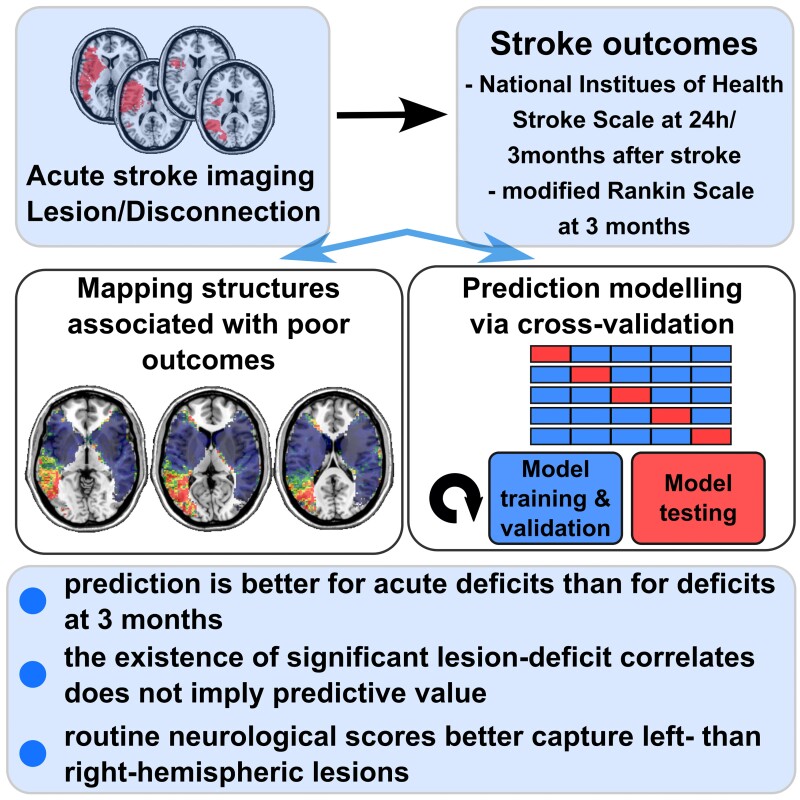
Personalized prediction of stroke outcome using lesion imaging markers is still too imprecise to make a breakthrough in clinical practice. We performed a combined prediction and brain mapping study on topographic and connectomic lesion imaging data to evaluate (i) the relationship between lesion-deficit associations and their predictive value and (ii) the influence of time since stroke. In patients with first-ever ischaemic stroke, we first applied high-dimensional machine learning models on lesion topographies or structural disconnection data to model stroke severity (National Institutes of Health Stroke Scale 24 h/3 months) and functional outcome (modified Rankin Scale 3 months) in cross-validation. Second, we mapped the topographic and connectomic lesion impact on both clinical measures. We retrospectively included 685 patients [age 67.4 ± 15.1, National Institutes of Health Stroke Scale 24 h median(IQR) = 3(1; 6), modified Rankin Scale 3 months = 1(0; 2), National Institutes of Health Stroke Scale 3 months = 0(0; 2)]. Predictions for acute stroke severity (National Institutes of Health Stroke Scale 24 h) were better with topographic lesion imaging (R² = 0.41) than with disconnection data (R² = 0.29, P = 0.0015), whereas predictions at 3 months (National Institutes of Health Stroke Scale/modified Rankin Scale) were generally close to chance level. In the analysis of lesion-deficit associations, the correlates of more severe acute stroke (National Institutes of Health Stroke Scale 24 h > 4) and poor functional outcome (modified Rankin Scale 3 months ≥ 2) were left-lateralized. The lesion location impact of both variables corresponded in right-hemisphere stroke with peaks in primary motor regions, but it markedly differed in left-hemisphere stroke. Topographic and disconnection lesion features predict acute stroke severity better than the 3-months outcome. This suggests a likely higher impact of lesion-independent factors in the longer term and highlights challenges in the prediction of global functional outcome. Prediction and brain mapping diverge, and the existence of statistically significant associations-as here for 3-months outcomes-does not imply predictive value. Routine neurological scores better capture left- than right-hemispheric lesions, further complicating the challenge of outcome prediction.






 京公网安备 11010802042870号
京ICP备2023020795号-1
京公网安备 11010802042870号
京ICP备2023020795号-1

 分享
分享

 求助内容:
求助内容: 应助结果提醒方式:
 扫码关注我们
