Liubin Wang , Yongxin Wang , Mengdi He, Yueqi Wang, Liyun Wu, Min Gan, Qiangqiang Xiong, Yu Xiao, Kang Wei, Liyuan Wang
{"title":"1- o -没食子酰基-6- o -木犀草油基-α- d -葡萄糖高富集茶资源的鉴定及其变异的综合剖析。","authors":"Liubin Wang , Yongxin Wang , Mengdi He, Yueqi Wang, Liyun Wu, Min Gan, Qiangqiang Xiong, Yu Xiao, Kang Wei, Liyuan Wang","doi":"10.1016/j.foodres.2024.115626","DOIUrl":null,"url":null,"abstract":"<div><div>Tea is a widely consumed beverage worldwide due to its rich secondary metabolites. Gallotanin: 1-<em>O</em>-galloyl-6-<em>O</em>-luteoyl-α-D-glucose (GLAG) has strong antioxidant activity and good resistance to a wide range of bacteria and malaria. Despite its potential, there have been few reports on GLAG in plants. In this study, we identified and validated the presence of GLAG in tea plants using UPLC-qTOF MS/MS and ESI-MS. We also identified a GLAG-rich tea variety, ‘ZM2807’, for the first time and observed significant variations in GLAG content across seasons and leaf positions. In addition, our analysis explored the variations and correlations of GLAG, catechin, and caffeine contents in a hybrid population (LJ43 × BHZ) consisting of 327 F<sub>1</sub> individuals over three consecutive years. These results provided new insights into the potential applications of GLAG in food and medicine and offered a valuable reference for studying the dynamics of GLAG, catechin, and caffeine contents in adult tea plants.</div></div>","PeriodicalId":323,"journal":{"name":"Food Research International","volume":"201 ","pages":"Article 115626"},"PeriodicalIF":8.8000,"publicationDate":"2025-02-01","publicationTypes":"Journal Article","fieldsOfStudy":null,"isOpenAccess":false,"openAccessPdf":"","citationCount":"0","resultStr":"{\"title\":\"Identification of tea resources with high accumulation of 1-O-galloyl-6-O-luteoyl-α-D-glucose and comprehensive dissection of its variation\",\"authors\":\"Liubin Wang , Yongxin Wang , Mengdi He, Yueqi Wang, Liyun Wu, Min Gan, Qiangqiang Xiong, Yu Xiao, Kang Wei, Liyuan Wang\",\"doi\":\"10.1016/j.foodres.2024.115626\",\"DOIUrl\":null,\"url\":null,\"abstract\":\"<div><div>Tea is a widely consumed beverage worldwide due to its rich secondary metabolites. Gallotanin: 1-<em>O</em>-galloyl-6-<em>O</em>-luteoyl-α-D-glucose (GLAG) has strong antioxidant activity and good resistance to a wide range of bacteria and malaria. Despite its potential, there have been few reports on GLAG in plants. In this study, we identified and validated the presence of GLAG in tea plants using UPLC-qTOF MS/MS and ESI-MS. We also identified a GLAG-rich tea variety, ‘ZM2807’, for the first time and observed significant variations in GLAG content across seasons and leaf positions. In addition, our analysis explored the variations and correlations of GLAG, catechin, and caffeine contents in a hybrid population (LJ43 × BHZ) consisting of 327 F<sub>1</sub> individuals over three consecutive years. These results provided new insights into the potential applications of GLAG in food and medicine and offered a valuable reference for studying the dynamics of GLAG, catechin, and caffeine contents in adult tea plants.</div></div>\",\"PeriodicalId\":323,\"journal\":{\"name\":\"Food Research International\",\"volume\":\"201 \",\"pages\":\"Article 115626\"},\"PeriodicalIF\":8.8000,\"publicationDate\":\"2025-02-01\",\"publicationTypes\":\"Journal Article\",\"fieldsOfStudy\":null,\"isOpenAccess\":false,\"openAccessPdf\":\"\",\"citationCount\":\"0\",\"resultStr\":null,\"platform\":\"Semanticscholar\",\"paperid\":null,\"PeriodicalName\":\"Food Research International\",\"FirstCategoryId\":\"97\",\"ListUrlMain\":\"https://www.sciencedirect.com/science/article/pii/S0963996924016971\",\"RegionNum\":1,\"RegionCategory\":\"农林科学\",\"ArticlePicture\":[],\"TitleCN\":null,\"AbstractTextCN\":null,\"PMCID\":null,\"EPubDate\":\"2024/12/30 0:00:00\",\"PubModel\":\"Epub\",\"JCR\":\"Q1\",\"JCRName\":\"FOOD SCIENCE & TECHNOLOGY\",\"Score\":null,\"Total\":0}","platform":"Semanticscholar","paperid":null,"PeriodicalName":"Food Research International","FirstCategoryId":"97","ListUrlMain":"https://www.sciencedirect.com/science/article/pii/S0963996924016971","RegionNum":1,"RegionCategory":"农林科学","ArticlePicture":[],"TitleCN":null,"AbstractTextCN":null,"PMCID":null,"EPubDate":"2024/12/30 0:00:00","PubModel":"Epub","JCR":"Q1","JCRName":"FOOD SCIENCE & TECHNOLOGY","Score":null,"Total":0}
引用次数: 0
摘要
茶因其丰富的次生代谢物而成为世界范围内广泛消费的饮料。没食子苷:1- o -没食子酰-6- o -木犀草油基-α- d -葡萄糖(GLAG)具有很强的抗氧化活性,对多种细菌和疟疾具有良好的抗性。尽管具有潜力,但关于植物中glg的报道很少。在本研究中,我们利用UPLC-qTOF质谱和ESI-MS对茶树中glg的存在进行了鉴定和验证。我们还首次鉴定了一个富含glg的茶叶品种ZM2807,并观察到glg含量在季节和叶位之间的显著变化。此外,我们的分析探讨了由327个F1个体组成的杂交群体(LJ43 × BHZ)连续3年的glg、儿茶素和咖啡因含量的变化和相关性。这些研究结果为研究成年茶树中glg、儿茶素和咖啡因含量的动态变化提供了有价值的参考。
Identification of tea resources with high accumulation of 1-O-galloyl-6-O-luteoyl-α-D-glucose and comprehensive dissection of its variation
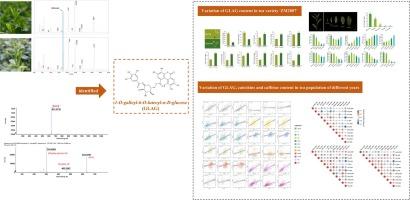
Tea is a widely consumed beverage worldwide due to its rich secondary metabolites. Gallotanin: 1-O-galloyl-6-O-luteoyl-α-D-glucose (GLAG) has strong antioxidant activity and good resistance to a wide range of bacteria and malaria. Despite its potential, there have been few reports on GLAG in plants. In this study, we identified and validated the presence of GLAG in tea plants using UPLC-qTOF MS/MS and ESI-MS. We also identified a GLAG-rich tea variety, ‘ZM2807’, for the first time and observed significant variations in GLAG content across seasons and leaf positions. In addition, our analysis explored the variations and correlations of GLAG, catechin, and caffeine contents in a hybrid population (LJ43 × BHZ) consisting of 327 F1 individuals over three consecutive years. These results provided new insights into the potential applications of GLAG in food and medicine and offered a valuable reference for studying the dynamics of GLAG, catechin, and caffeine contents in adult tea plants.
期刊介绍:
Food Research International serves as a rapid dissemination platform for significant and impactful research in food science, technology, engineering, and nutrition. The journal focuses on publishing novel, high-quality, and high-impact review papers, original research papers, and letters to the editors across various disciplines in the science and technology of food. Additionally, it follows a policy of publishing special issues on topical and emergent subjects in food research or related areas. Selected, peer-reviewed papers from scientific meetings, workshops, and conferences on the science, technology, and engineering of foods are also featured in special issues.




 京公网安备 11010802042870号
京ICP备2023020795号-1
京公网安备 11010802042870号
京ICP备2023020795号-1

 分享
分享
 求助内容:
求助内容: 应助结果提醒方式:
 扫码关注我们
