Yehua Liu , Hongying Li , Mingming Li , Linggao Liu , Kuan Lu , Shenghui Bi , Mixin Zhou , Li Chen , Lisha Lan , Minping Wei , Ying Zhou , Qiujin Zhu
{"title":"电刺激下猪里脊火腿发酵过程中蛋白质水解及微生物群落变化研究。","authors":"Yehua Liu , Hongying Li , Mingming Li , Linggao Liu , Kuan Lu , Shenghui Bi , Mixin Zhou , Li Chen , Lisha Lan , Minping Wei , Ying Zhou , Qiujin Zhu","doi":"10.1016/j.foodres.2024.115640","DOIUrl":null,"url":null,"abstract":"<div><div>This study explored the effect of electrical stimulation (ES) and <em>Pediococcus pentosaceus</em> LL-07 (<em>P. pentosaceus</em> LL-07) and <em>Staphylococcus simulans</em> QB7 (<em>S. simulans</em> QB7) on the quality and microbial community of loin ham during the ripening. After the ES and starter culture treatments, the Aw and pH were decreased. Surface hydrophobicity, myogenic fiber fragmentation index (MFI), TCA-soluble peptide, amino nitrogen and free amino acids (FAAs) were also significantly higher than the control group (CK) (<em>P</em> < 0.05). This increase was more significant in the E-S group (electrical stimulation followed by inoculation with <em>P. pentosaceus</em> LL-07 and <em>S. simulans</em> QB7) than the rest of the experimental group (E、S、S-E group). Furthermore, the CK and E-S groups were subjected to a bacterial community comparison experiment. The microbial diversity of these two groups was increased. <em>Pediococcus</em> spp. and <em>Staphylococcus</em> spp. became the dominant bacteria in E-S groups during the ripening. Correlation analyses show a strong correlation between protein hydrolysis, microorganisms and FAAs. In conclusion, the combination of ES and starter culture could promote protein hydrolysis, the accumulation of FAAS, and improves the bacterial community of loin ham.</div></div>","PeriodicalId":323,"journal":{"name":"Food Research International","volume":"201 ","pages":"Article 115640"},"PeriodicalIF":8.0000,"publicationDate":"2025-02-01","publicationTypes":"Journal Article","fieldsOfStudy":null,"isOpenAccess":false,"openAccessPdf":"","citationCount":"0","resultStr":"{\"title\":\"Study on protein hydrolysis and microbial community changes during the fermentation of pork loin ham mediated by electrical stimulation\",\"authors\":\"Yehua Liu , Hongying Li , Mingming Li , Linggao Liu , Kuan Lu , Shenghui Bi , Mixin Zhou , Li Chen , Lisha Lan , Minping Wei , Ying Zhou , Qiujin Zhu\",\"doi\":\"10.1016/j.foodres.2024.115640\",\"DOIUrl\":null,\"url\":null,\"abstract\":\"<div><div>This study explored the effect of electrical stimulation (ES) and <em>Pediococcus pentosaceus</em> LL-07 (<em>P. pentosaceus</em> LL-07) and <em>Staphylococcus simulans</em> QB7 (<em>S. simulans</em> QB7) on the quality and microbial community of loin ham during the ripening. After the ES and starter culture treatments, the Aw and pH were decreased. Surface hydrophobicity, myogenic fiber fragmentation index (MFI), TCA-soluble peptide, amino nitrogen and free amino acids (FAAs) were also significantly higher than the control group (CK) (<em>P</em> < 0.05). This increase was more significant in the E-S group (electrical stimulation followed by inoculation with <em>P. pentosaceus</em> LL-07 and <em>S. simulans</em> QB7) than the rest of the experimental group (E、S、S-E group). Furthermore, the CK and E-S groups were subjected to a bacterial community comparison experiment. The microbial diversity of these two groups was increased. <em>Pediococcus</em> spp. and <em>Staphylococcus</em> spp. became the dominant bacteria in E-S groups during the ripening. Correlation analyses show a strong correlation between protein hydrolysis, microorganisms and FAAs. In conclusion, the combination of ES and starter culture could promote protein hydrolysis, the accumulation of FAAS, and improves the bacterial community of loin ham.</div></div>\",\"PeriodicalId\":323,\"journal\":{\"name\":\"Food Research International\",\"volume\":\"201 \",\"pages\":\"Article 115640\"},\"PeriodicalIF\":8.0000,\"publicationDate\":\"2025-02-01\",\"publicationTypes\":\"Journal Article\",\"fieldsOfStudy\":null,\"isOpenAccess\":false,\"openAccessPdf\":\"\",\"citationCount\":\"0\",\"resultStr\":null,\"platform\":\"Semanticscholar\",\"paperid\":null,\"PeriodicalName\":\"Food Research International\",\"FirstCategoryId\":\"97\",\"ListUrlMain\":\"https://www.sciencedirect.com/science/article/pii/S0963996924017113\",\"RegionNum\":1,\"RegionCategory\":\"农林科学\",\"ArticlePicture\":[],\"TitleCN\":null,\"AbstractTextCN\":null,\"PMCID\":null,\"EPubDate\":\"2024/12/30 0:00:00\",\"PubModel\":\"Epub\",\"JCR\":\"Q1\",\"JCRName\":\"FOOD SCIENCE & TECHNOLOGY\",\"Score\":null,\"Total\":0}","platform":"Semanticscholar","paperid":null,"PeriodicalName":"Food Research International","FirstCategoryId":"97","ListUrlMain":"https://www.sciencedirect.com/science/article/pii/S0963996924017113","RegionNum":1,"RegionCategory":"农林科学","ArticlePicture":[],"TitleCN":null,"AbstractTextCN":null,"PMCID":null,"EPubDate":"2024/12/30 0:00:00","PubModel":"Epub","JCR":"Q1","JCRName":"FOOD SCIENCE & TECHNOLOGY","Score":null,"Total":0}
Study on protein hydrolysis and microbial community changes during the fermentation of pork loin ham mediated by electrical stimulation
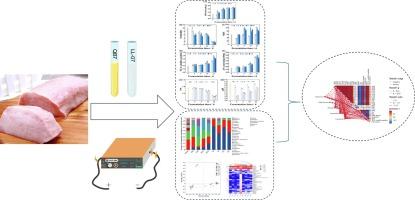
This study explored the effect of electrical stimulation (ES) and Pediococcus pentosaceus LL-07 (P. pentosaceus LL-07) and Staphylococcus simulans QB7 (S. simulans QB7) on the quality and microbial community of loin ham during the ripening. After the ES and starter culture treatments, the Aw and pH were decreased. Surface hydrophobicity, myogenic fiber fragmentation index (MFI), TCA-soluble peptide, amino nitrogen and free amino acids (FAAs) were also significantly higher than the control group (CK) (P < 0.05). This increase was more significant in the E-S group (electrical stimulation followed by inoculation with P. pentosaceus LL-07 and S. simulans QB7) than the rest of the experimental group (E、S、S-E group). Furthermore, the CK and E-S groups were subjected to a bacterial community comparison experiment. The microbial diversity of these two groups was increased. Pediococcus spp. and Staphylococcus spp. became the dominant bacteria in E-S groups during the ripening. Correlation analyses show a strong correlation between protein hydrolysis, microorganisms and FAAs. In conclusion, the combination of ES and starter culture could promote protein hydrolysis, the accumulation of FAAS, and improves the bacterial community of loin ham.
期刊介绍:
Food Research International serves as a rapid dissemination platform for significant and impactful research in food science, technology, engineering, and nutrition. The journal focuses on publishing novel, high-quality, and high-impact review papers, original research papers, and letters to the editors across various disciplines in the science and technology of food. Additionally, it follows a policy of publishing special issues on topical and emergent subjects in food research or related areas. Selected, peer-reviewed papers from scientific meetings, workshops, and conferences on the science, technology, and engineering of foods are also featured in special issues.




 京公网安备 11010802042870号
京ICP备2023020795号-1
京公网安备 11010802042870号
京ICP备2023020795号-1

 分享
分享
 求助内容:
求助内容: 应助结果提醒方式:
 扫码关注我们
