Xavier Flores-Alsina , Anna Katrine Vangsgaard , Nerea Uri-Carreño , Per H. Nielsen , Krist V. Gernaey
{"title":"定量、预测和减少全规模部分硝化/厌氧氨氧化反应器处理废水的氧化亚氮排放。","authors":"Xavier Flores-Alsina , Anna Katrine Vangsgaard , Nerea Uri-Carreño , Per H. Nielsen , Krist V. Gernaey","doi":"10.1016/j.watres.2025.123200","DOIUrl":null,"url":null,"abstract":"<div><div>In this paper, a set of mathematical tools are developed and assembled to quantify, predict and virtually assess N<sub>2</sub>O emission mitigation strategies in partial nitritation (PN) / anammox (ANX) granular based reactors. The proposed approach is constructed upon a set of data pre-treatment methods, process simulation models, control tools (and algorithms) and key performance indicators to analyze, reproduce, and forecast the behavior of multiple operational variables within aerobic granular sludge systems. All these elements are tested on two full-scale data sets (#D1, #D2) collected over a period of four months (Sept-Dec 2023). Results show that data pretreatment is essential for noise reduction, filling data gaps, and ensuring smooth process simulations. The model accurately predicts (normalized RMSE< 1) multiple N oxidation states (NH<sub>x</sub>, NO<sub>2</sub><sup>-</sup>, NO<sub>3</sub><sup>-</sup>, N<sub>2</sub>O) and dissolved oxygen (DO), demonstrating its capability to describe bacterial behavior within the studied system. Special emphasis is placed on weak acid-base chemistry where pH is reliably reproduced, and it can be used for control purposes. Both biological and physico-chemical aspects are predicted at different time scales (months, days, minutes). While nitritation mainly occurred in the bulk, biofilm distribution showed inactive inner granule parts and increasing biomass (mostly ANX) towards the surface, with distinct organic concentrations. Gradients for multiple soluble compounds could also be reflected. Nitrifier denitrification (ND) is identified as the main N<sub>2</sub>O production pathway. The model revealed that the system was suffering from low ANX activity leading to NO<sub>2</sub><sup>-</sup> accumulation. This in combination with low DO levels resulted in an unusually high emission factor (EF). The validation data set also yielded satisfactory results (normalized RMSE< 1). The scenario analysis revealed that modification of the operational parameters could improve the ANX activity and lead to N<sub>2</sub>O emission rates that are in line with what is normally expected from similar systems. The study includes a discussion on transitioning from process models to digital shadows/ twins for real-time process monitoring. Additionally, it emphasizes the necessity of evaluating reject water technologies from a plant-wide perspective.</div></div>","PeriodicalId":443,"journal":{"name":"Water Research","volume":"278 ","pages":"Article 123200"},"PeriodicalIF":12.8000,"publicationDate":"2025-06-15","publicationTypes":"Journal Article","fieldsOfStudy":null,"isOpenAccess":false,"openAccessPdf":"","citationCount":"0","resultStr":"{\"title\":\"Quantifying, predicting, and mitigating nitrous oxide emissions in a full-scale partial nitritation/anammox reactor treating reject water\",\"authors\":\"Xavier Flores-Alsina , Anna Katrine Vangsgaard , Nerea Uri-Carreño , Per H. Nielsen , Krist V. Gernaey\",\"doi\":\"10.1016/j.watres.2025.123200\",\"DOIUrl\":null,\"url\":null,\"abstract\":\"<div><div>In this paper, a set of mathematical tools are developed and assembled to quantify, predict and virtually assess N<sub>2</sub>O emission mitigation strategies in partial nitritation (PN) / anammox (ANX) granular based reactors. The proposed approach is constructed upon a set of data pre-treatment methods, process simulation models, control tools (and algorithms) and key performance indicators to analyze, reproduce, and forecast the behavior of multiple operational variables within aerobic granular sludge systems. All these elements are tested on two full-scale data sets (#D1, #D2) collected over a period of four months (Sept-Dec 2023). Results show that data pretreatment is essential for noise reduction, filling data gaps, and ensuring smooth process simulations. The model accurately predicts (normalized RMSE< 1) multiple N oxidation states (NH<sub>x</sub>, NO<sub>2</sub><sup>-</sup>, NO<sub>3</sub><sup>-</sup>, N<sub>2</sub>O) and dissolved oxygen (DO), demonstrating its capability to describe bacterial behavior within the studied system. Special emphasis is placed on weak acid-base chemistry where pH is reliably reproduced, and it can be used for control purposes. Both biological and physico-chemical aspects are predicted at different time scales (months, days, minutes). While nitritation mainly occurred in the bulk, biofilm distribution showed inactive inner granule parts and increasing biomass (mostly ANX) towards the surface, with distinct organic concentrations. Gradients for multiple soluble compounds could also be reflected. Nitrifier denitrification (ND) is identified as the main N<sub>2</sub>O production pathway. The model revealed that the system was suffering from low ANX activity leading to NO<sub>2</sub><sup>-</sup> accumulation. This in combination with low DO levels resulted in an unusually high emission factor (EF). The validation data set also yielded satisfactory results (normalized RMSE< 1). The scenario analysis revealed that modification of the operational parameters could improve the ANX activity and lead to N<sub>2</sub>O emission rates that are in line with what is normally expected from similar systems. The study includes a discussion on transitioning from process models to digital shadows/ twins for real-time process monitoring. Additionally, it emphasizes the necessity of evaluating reject water technologies from a plant-wide perspective.</div></div>\",\"PeriodicalId\":443,\"journal\":{\"name\":\"Water Research\",\"volume\":\"278 \",\"pages\":\"Article 123200\"},\"PeriodicalIF\":12.8000,\"publicationDate\":\"2025-06-15\",\"publicationTypes\":\"Journal Article\",\"fieldsOfStudy\":null,\"isOpenAccess\":false,\"openAccessPdf\":\"\",\"citationCount\":\"0\",\"resultStr\":null,\"platform\":\"Semanticscholar\",\"paperid\":null,\"PeriodicalName\":\"Water Research\",\"FirstCategoryId\":\"93\",\"ListUrlMain\":\"https://www.sciencedirect.com/science/article/pii/S0043135425001149\",\"RegionNum\":1,\"RegionCategory\":\"环境科学与生态学\",\"ArticlePicture\":[],\"TitleCN\":null,\"AbstractTextCN\":null,\"PMCID\":null,\"EPubDate\":\"2025/1/25 0:00:00\",\"PubModel\":\"Epub\",\"JCR\":\"Q1\",\"JCRName\":\"ENGINEERING, ENVIRONMENTAL\",\"Score\":null,\"Total\":0}","platform":"Semanticscholar","paperid":null,"PeriodicalName":"Water Research","FirstCategoryId":"93","ListUrlMain":"https://www.sciencedirect.com/science/article/pii/S0043135425001149","RegionNum":1,"RegionCategory":"环境科学与生态学","ArticlePicture":[],"TitleCN":null,"AbstractTextCN":null,"PMCID":null,"EPubDate":"2025/1/25 0:00:00","PubModel":"Epub","JCR":"Q1","JCRName":"ENGINEERING, ENVIRONMENTAL","Score":null,"Total":0}
Quantifying, predicting, and mitigating nitrous oxide emissions in a full-scale partial nitritation/anammox reactor treating reject water
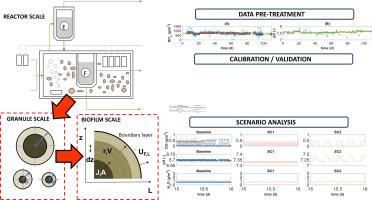
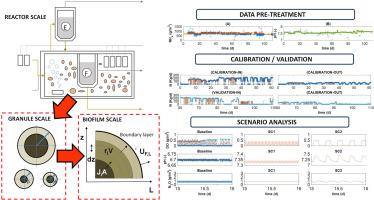
In this paper, a set of mathematical tools are developed and assembled to quantify, predict and virtually assess N2O emission mitigation strategies in partial nitritation (PN) / anammox (ANX) granular based reactors. The proposed approach is constructed upon a set of data pre-treatment methods, process simulation models, control tools (and algorithms) and key performance indicators to analyze, reproduce, and forecast the behavior of multiple operational variables within aerobic granular sludge systems. All these elements are tested on two full-scale data sets (#D1, #D2) collected over a period of four months (Sept-Dec 2023). Results show that data pretreatment is essential for noise reduction, filling data gaps, and ensuring smooth process simulations. The model accurately predicts (normalized RMSE< 1) multiple N oxidation states (NHx, NO2-, NO3-, N2O) and dissolved oxygen (DO), demonstrating its capability to describe bacterial behavior within the studied system. Special emphasis is placed on weak acid-base chemistry where pH is reliably reproduced, and it can be used for control purposes. Both biological and physico-chemical aspects are predicted at different time scales (months, days, minutes). While nitritation mainly occurred in the bulk, biofilm distribution showed inactive inner granule parts and increasing biomass (mostly ANX) towards the surface, with distinct organic concentrations. Gradients for multiple soluble compounds could also be reflected. Nitrifier denitrification (ND) is identified as the main N2O production pathway. The model revealed that the system was suffering from low ANX activity leading to NO2- accumulation. This in combination with low DO levels resulted in an unusually high emission factor (EF). The validation data set also yielded satisfactory results (normalized RMSE< 1). The scenario analysis revealed that modification of the operational parameters could improve the ANX activity and lead to N2O emission rates that are in line with what is normally expected from similar systems. The study includes a discussion on transitioning from process models to digital shadows/ twins for real-time process monitoring. Additionally, it emphasizes the necessity of evaluating reject water technologies from a plant-wide perspective.
期刊介绍:
Water Research, along with its open access companion journal Water Research X, serves as a platform for publishing original research papers covering various aspects of the science and technology related to the anthropogenic water cycle, water quality, and its management worldwide. The audience targeted by the journal comprises biologists, chemical engineers, chemists, civil engineers, environmental engineers, limnologists, and microbiologists. The scope of the journal include:
•Treatment processes for water and wastewaters (municipal, agricultural, industrial, and on-site treatment), including resource recovery and residuals management;
•Urban hydrology including sewer systems, stormwater management, and green infrastructure;
•Drinking water treatment and distribution;
•Potable and non-potable water reuse;
•Sanitation, public health, and risk assessment;
•Anaerobic digestion, solid and hazardous waste management, including source characterization and the effects and control of leachates and gaseous emissions;
•Contaminants (chemical, microbial, anthropogenic particles such as nanoparticles or microplastics) and related water quality sensing, monitoring, fate, and assessment;
•Anthropogenic impacts on inland, tidal, coastal and urban waters, focusing on surface and ground waters, and point and non-point sources of pollution;
•Environmental restoration, linked to surface water, groundwater and groundwater remediation;
•Analysis of the interfaces between sediments and water, and between water and atmosphere, focusing specifically on anthropogenic impacts;
•Mathematical modelling, systems analysis, machine learning, and beneficial use of big data related to the anthropogenic water cycle;
•Socio-economic, policy, and regulations studies.




 京公网安备 11010802042870号
京ICP备2023020795号-1
京公网安备 11010802042870号
京ICP备2023020795号-1

 分享
分享
 求助内容:
求助内容: 应助结果提醒方式:
 扫码关注我们
