Hao Ye, Jingying Xu, Yaru Wang, Mengyao Zhao, Wanjing Li, Xianglong Li, Bin Yang
{"title":"基于改进喷丝孔腔结构的离心纺丝制备并排微纳复合纤维的研究","authors":"Hao Ye, Jingying Xu, Yaru Wang, Mengyao Zhao, Wanjing Li, Xianglong Li, Bin Yang","doi":"10.1016/j.polymer.2025.128077","DOIUrl":null,"url":null,"abstract":"<div><div>Centrifugal spinning of nanofibers has garnered significant attention due to its numerous advantages and industrial potential. However, meeting diverse needs with a single material is challenging, and the production of mixed material fibers often compromises fiber quality due to miscibility issues with different materials. Therefore, this study introduces a novel approach for efficiently preparing side-by-side micro-nano composite fibers by modifying the cavity structure of the centrifugal spinneret. Based on the experimental analysis of fiber spinnability, we derive the motion equation of polymer solution in the spinneret and analyze how the position of cavity plate influences the force exerted on the polymer solution. The optimal spinneret structure was determined through simulation of the solution motion mechanism in various types of spinnerets. Subsequently, polyvinylpyrrolidone (PVP)/ethylene oxide (PEO) composite micro-nanofibers were prepared using a centrifugal spinning device for experimental validation. The results indicate that the left and right cavity structure results in a significant disparity in flow between the two cavities at the nozzle, rendering it unsuitable for producing juxtaposed micro-nano composite fibers. The upper and lower cavity configuration does not impact the flow rate of the two cavities, making it suitable for stable and efficient preparation of side-by-side micro-nano composite fibers.</div></div>","PeriodicalId":405,"journal":{"name":"Polymer","volume":"320 ","pages":"Article 128077"},"PeriodicalIF":5.1000,"publicationDate":"2025-02-21","publicationTypes":"Journal Article","fieldsOfStudy":null,"isOpenAccess":false,"openAccessPdf":"","citationCount":"0","resultStr":"{\"title\":\"Study on the preparation of side-by-side micro-nano composite fibers by centrifugal spinning based on improved spinneret cavity structure\",\"authors\":\"Hao Ye, Jingying Xu, Yaru Wang, Mengyao Zhao, Wanjing Li, Xianglong Li, Bin Yang\",\"doi\":\"10.1016/j.polymer.2025.128077\",\"DOIUrl\":null,\"url\":null,\"abstract\":\"<div><div>Centrifugal spinning of nanofibers has garnered significant attention due to its numerous advantages and industrial potential. However, meeting diverse needs with a single material is challenging, and the production of mixed material fibers often compromises fiber quality due to miscibility issues with different materials. Therefore, this study introduces a novel approach for efficiently preparing side-by-side micro-nano composite fibers by modifying the cavity structure of the centrifugal spinneret. Based on the experimental analysis of fiber spinnability, we derive the motion equation of polymer solution in the spinneret and analyze how the position of cavity plate influences the force exerted on the polymer solution. The optimal spinneret structure was determined through simulation of the solution motion mechanism in various types of spinnerets. Subsequently, polyvinylpyrrolidone (PVP)/ethylene oxide (PEO) composite micro-nanofibers were prepared using a centrifugal spinning device for experimental validation. The results indicate that the left and right cavity structure results in a significant disparity in flow between the two cavities at the nozzle, rendering it unsuitable for producing juxtaposed micro-nano composite fibers. The upper and lower cavity configuration does not impact the flow rate of the two cavities, making it suitable for stable and efficient preparation of side-by-side micro-nano composite fibers.</div></div>\",\"PeriodicalId\":405,\"journal\":{\"name\":\"Polymer\",\"volume\":\"320 \",\"pages\":\"Article 128077\"},\"PeriodicalIF\":5.1000,\"publicationDate\":\"2025-02-21\",\"publicationTypes\":\"Journal Article\",\"fieldsOfStudy\":null,\"isOpenAccess\":false,\"openAccessPdf\":\"\",\"citationCount\":\"0\",\"resultStr\":null,\"platform\":\"Semanticscholar\",\"paperid\":null,\"PeriodicalName\":\"Polymer\",\"FirstCategoryId\":\"92\",\"ListUrlMain\":\"https://www.sciencedirect.com/science/article/pii/S0032386125000631\",\"RegionNum\":2,\"RegionCategory\":\"化学\",\"ArticlePicture\":[],\"TitleCN\":null,\"AbstractTextCN\":null,\"PMCID\":null,\"EPubDate\":\"2025/1/25 0:00:00\",\"PubModel\":\"Epub\",\"JCR\":\"Q2\",\"JCRName\":\"POLYMER SCIENCE\",\"Score\":null,\"Total\":0}","platform":"Semanticscholar","paperid":null,"PeriodicalName":"Polymer","FirstCategoryId":"92","ListUrlMain":"https://www.sciencedirect.com/science/article/pii/S0032386125000631","RegionNum":2,"RegionCategory":"化学","ArticlePicture":[],"TitleCN":null,"AbstractTextCN":null,"PMCID":null,"EPubDate":"2025/1/25 0:00:00","PubModel":"Epub","JCR":"Q2","JCRName":"POLYMER SCIENCE","Score":null,"Total":0}
Study on the preparation of side-by-side micro-nano composite fibers by centrifugal spinning based on improved spinneret cavity structure
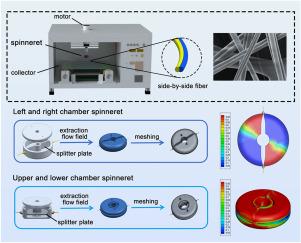
Centrifugal spinning of nanofibers has garnered significant attention due to its numerous advantages and industrial potential. However, meeting diverse needs with a single material is challenging, and the production of mixed material fibers often compromises fiber quality due to miscibility issues with different materials. Therefore, this study introduces a novel approach for efficiently preparing side-by-side micro-nano composite fibers by modifying the cavity structure of the centrifugal spinneret. Based on the experimental analysis of fiber spinnability, we derive the motion equation of polymer solution in the spinneret and analyze how the position of cavity plate influences the force exerted on the polymer solution. The optimal spinneret structure was determined through simulation of the solution motion mechanism in various types of spinnerets. Subsequently, polyvinylpyrrolidone (PVP)/ethylene oxide (PEO) composite micro-nanofibers were prepared using a centrifugal spinning device for experimental validation. The results indicate that the left and right cavity structure results in a significant disparity in flow between the two cavities at the nozzle, rendering it unsuitable for producing juxtaposed micro-nano composite fibers. The upper and lower cavity configuration does not impact the flow rate of the two cavities, making it suitable for stable and efficient preparation of side-by-side micro-nano composite fibers.
期刊介绍:
Polymer is an interdisciplinary journal dedicated to publishing innovative and significant advances in Polymer Physics, Chemistry and Technology. We welcome submissions on polymer hybrids, nanocomposites, characterisation and self-assembly. Polymer also publishes work on the technological application of polymers in energy and optoelectronics.
The main scope is covered but not limited to the following core areas:
Polymer Materials
Nanocomposites and hybrid nanomaterials
Polymer blends, films, fibres, networks and porous materials
Physical Characterization
Characterisation, modelling and simulation* of molecular and materials properties in bulk, solution, and thin films
Polymer Engineering
Advanced multiscale processing methods
Polymer Synthesis, Modification and Self-assembly
Including designer polymer architectures, mechanisms and kinetics, and supramolecular polymerization
Technological Applications
Polymers for energy generation and storage
Polymer membranes for separation technology
Polymers for opto- and microelectronics.





 京公网安备 11010802042870号
京ICP备2023020795号-1
京公网安备 11010802042870号
京ICP备2023020795号-1

 分享
分享
 求助内容:
求助内容: 应助结果提醒方式:
 扫码关注我们
