Xuri Li , Siyuan Zhang , Liang Ma , Miao Lu , Jingbao Liu , Haining Liu , Zhijian Wu , Xiangmei Cui , Xiushen Ye
{"title":"气液脉冲调制等离子体与气泡伴随等离子体衍生热增强十八胺和4-十二烷基啉的降解:性能和机制洞察","authors":"Xuri Li , Siyuan Zhang , Liang Ma , Miao Lu , Jingbao Liu , Haining Liu , Zhijian Wu , Xiangmei Cui , Xiushen Ye","doi":"10.1016/j.seppur.2025.131758","DOIUrl":null,"url":null,"abstract":"<div><div>A gas–liquid pulse-modulated plasma with bubbling coupled with plasma-derived heat system was developed for efficient degradation of octadecylamine (ODA) and 4-dodecylmorpholine (DMP). The structure–activity relationship between high-voltage electrode structures and the degradation activity of ODA and DMP was delved into using fluid dynamics simulations. The crucial role of bubbling is evident in the enhancement of ODA and DMP degradation efficiencies by 100% and 47% within 30 min, respectively. ODA and DMP degradation efficiencies reached 96% and 100% with treatment of 30 min, respectively, accompanied by a high mineralization efficiency of 80 %. An in-depth analysis was performed on the evolution of the physicochemical properties of the reaction solution during degradation. The plasma coupled with plasma-derived heat system exhibited remarkable synergistic effects, achieving synergistic intensities of 0.96 for ODA and 1.28 for DMP, with energy efficiencies increased by 31% and 16%. Analysis of the evolution of total nitrogen and nitrogen-containing species revealed that ODA and DMP degradation commenced with the decomposition of amino groups, ultimately converting them into <span><math><mrow><mi>N</mi><msubsup><mi>O</mi><mrow><mn>3</mn></mrow><mo>-</mo></msubsup></mrow></math></span> and <span><math><mrow><mi>N</mi><msubsup><mi>H</mi><mrow><mn>4</mn></mrow><mo>+</mo></msubsup></mrow></math></span>. Quenching tests and electron spin resonance characterization confirmed the generation of <span><math><mrow><mo>·</mo><mi>O</mi><mi>H</mi></mrow></math></span>, <span><math><mrow><msup><mrow><mspace></mspace></mrow><mo>·</mo></msup><msubsup><mi>O</mi><mrow><mn>2</mn></mrow><mo>-</mo></msubsup></mrow></math></span> and <span><math><mrow><msup><mrow><mspace></mspace></mrow><mn>1</mn></msup><msub><mi>O</mi><mn>2</mn></msub></mrow></math></span>, with <span><math><mrow><mo>·</mo><mi>O</mi><mi>H</mi></mrow></math></span> playing a pivotal role in the degradation process. Furthermore, the possible degradation pathways of ODA and DMP were elucidated by the theoretical calculations and gas chromatography-mass spectrometry results, respectively. The toxicity evaluation of degradation intermediates demonstrated a consistent decrease in toxicity during the degradation process. This study advances our understanding of the synergistic potential of plasma-plasma-derived heat systems for pollutant degradation and paves the way for the development of more effective pollutant degradation technologies.</div></div>","PeriodicalId":427,"journal":{"name":"Separation and Purification Technology","volume":"362 ","pages":"Article 131758"},"PeriodicalIF":9.1000,"publicationDate":"2025-07-30","publicationTypes":"Journal Article","fieldsOfStudy":null,"isOpenAccess":false,"openAccessPdf":"","citationCount":"0","resultStr":"{\"title\":\"Gas-liquid pulse-modulated plasma with bubbling concomitant with plasma-derived heat enhanced degradation of the octadecylamine and 4-dodecylmorpholine: Performance and mechanism insight\",\"authors\":\"Xuri Li , Siyuan Zhang , Liang Ma , Miao Lu , Jingbao Liu , Haining Liu , Zhijian Wu , Xiangmei Cui , Xiushen Ye\",\"doi\":\"10.1016/j.seppur.2025.131758\",\"DOIUrl\":null,\"url\":null,\"abstract\":\"<div><div>A gas–liquid pulse-modulated plasma with bubbling coupled with plasma-derived heat system was developed for efficient degradation of octadecylamine (ODA) and 4-dodecylmorpholine (DMP). The structure–activity relationship between high-voltage electrode structures and the degradation activity of ODA and DMP was delved into using fluid dynamics simulations. The crucial role of bubbling is evident in the enhancement of ODA and DMP degradation efficiencies by 100% and 47% within 30 min, respectively. ODA and DMP degradation efficiencies reached 96% and 100% with treatment of 30 min, respectively, accompanied by a high mineralization efficiency of 80 %. An in-depth analysis was performed on the evolution of the physicochemical properties of the reaction solution during degradation. The plasma coupled with plasma-derived heat system exhibited remarkable synergistic effects, achieving synergistic intensities of 0.96 for ODA and 1.28 for DMP, with energy efficiencies increased by 31% and 16%. Analysis of the evolution of total nitrogen and nitrogen-containing species revealed that ODA and DMP degradation commenced with the decomposition of amino groups, ultimately converting them into <span><math><mrow><mi>N</mi><msubsup><mi>O</mi><mrow><mn>3</mn></mrow><mo>-</mo></msubsup></mrow></math></span> and <span><math><mrow><mi>N</mi><msubsup><mi>H</mi><mrow><mn>4</mn></mrow><mo>+</mo></msubsup></mrow></math></span>. Quenching tests and electron spin resonance characterization confirmed the generation of <span><math><mrow><mo>·</mo><mi>O</mi><mi>H</mi></mrow></math></span>, <span><math><mrow><msup><mrow><mspace></mspace></mrow><mo>·</mo></msup><msubsup><mi>O</mi><mrow><mn>2</mn></mrow><mo>-</mo></msubsup></mrow></math></span> and <span><math><mrow><msup><mrow><mspace></mspace></mrow><mn>1</mn></msup><msub><mi>O</mi><mn>2</mn></msub></mrow></math></span>, with <span><math><mrow><mo>·</mo><mi>O</mi><mi>H</mi></mrow></math></span> playing a pivotal role in the degradation process. Furthermore, the possible degradation pathways of ODA and DMP were elucidated by the theoretical calculations and gas chromatography-mass spectrometry results, respectively. The toxicity evaluation of degradation intermediates demonstrated a consistent decrease in toxicity during the degradation process. This study advances our understanding of the synergistic potential of plasma-plasma-derived heat systems for pollutant degradation and paves the way for the development of more effective pollutant degradation technologies.</div></div>\",\"PeriodicalId\":427,\"journal\":{\"name\":\"Separation and Purification Technology\",\"volume\":\"362 \",\"pages\":\"Article 131758\"},\"PeriodicalIF\":9.1000,\"publicationDate\":\"2025-07-30\",\"publicationTypes\":\"Journal Article\",\"fieldsOfStudy\":null,\"isOpenAccess\":false,\"openAccessPdf\":\"\",\"citationCount\":\"0\",\"resultStr\":null,\"platform\":\"Semanticscholar\",\"paperid\":null,\"PeriodicalName\":\"Separation and Purification Technology\",\"FirstCategoryId\":\"5\",\"ListUrlMain\":\"https://www.sciencedirect.com/science/article/pii/S1383586625003557\",\"RegionNum\":1,\"RegionCategory\":\"工程技术\",\"ArticlePicture\":[],\"TitleCN\":null,\"AbstractTextCN\":null,\"PMCID\":null,\"EPubDate\":\"2025/1/25 0:00:00\",\"PubModel\":\"Epub\",\"JCR\":\"Q1\",\"JCRName\":\"ENGINEERING, CHEMICAL\",\"Score\":null,\"Total\":0}","platform":"Semanticscholar","paperid":null,"PeriodicalName":"Separation and Purification Technology","FirstCategoryId":"5","ListUrlMain":"https://www.sciencedirect.com/science/article/pii/S1383586625003557","RegionNum":1,"RegionCategory":"工程技术","ArticlePicture":[],"TitleCN":null,"AbstractTextCN":null,"PMCID":null,"EPubDate":"2025/1/25 0:00:00","PubModel":"Epub","JCR":"Q1","JCRName":"ENGINEERING, CHEMICAL","Score":null,"Total":0}
Gas-liquid pulse-modulated plasma with bubbling concomitant with plasma-derived heat enhanced degradation of the octadecylamine and 4-dodecylmorpholine: Performance and mechanism insight
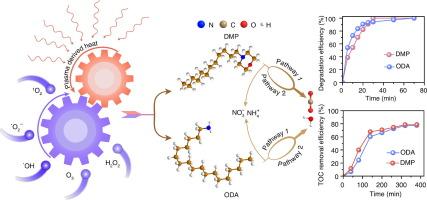
A gas–liquid pulse-modulated plasma with bubbling coupled with plasma-derived heat system was developed for efficient degradation of octadecylamine (ODA) and 4-dodecylmorpholine (DMP). The structure–activity relationship between high-voltage electrode structures and the degradation activity of ODA and DMP was delved into using fluid dynamics simulations. The crucial role of bubbling is evident in the enhancement of ODA and DMP degradation efficiencies by 100% and 47% within 30 min, respectively. ODA and DMP degradation efficiencies reached 96% and 100% with treatment of 30 min, respectively, accompanied by a high mineralization efficiency of 80 %. An in-depth analysis was performed on the evolution of the physicochemical properties of the reaction solution during degradation. The plasma coupled with plasma-derived heat system exhibited remarkable synergistic effects, achieving synergistic intensities of 0.96 for ODA and 1.28 for DMP, with energy efficiencies increased by 31% and 16%. Analysis of the evolution of total nitrogen and nitrogen-containing species revealed that ODA and DMP degradation commenced with the decomposition of amino groups, ultimately converting them into and . Quenching tests and electron spin resonance characterization confirmed the generation of , and , with playing a pivotal role in the degradation process. Furthermore, the possible degradation pathways of ODA and DMP were elucidated by the theoretical calculations and gas chromatography-mass spectrometry results, respectively. The toxicity evaluation of degradation intermediates demonstrated a consistent decrease in toxicity during the degradation process. This study advances our understanding of the synergistic potential of plasma-plasma-derived heat systems for pollutant degradation and paves the way for the development of more effective pollutant degradation technologies.
期刊介绍:
Separation and Purification Technology is a premier journal committed to sharing innovative methods for separation and purification in chemical and environmental engineering, encompassing both homogeneous solutions and heterogeneous mixtures. Our scope includes the separation and/or purification of liquids, vapors, and gases, as well as carbon capture and separation techniques. However, it's important to note that methods solely intended for analytical purposes are not within the scope of the journal. Additionally, disciplines such as soil science, polymer science, and metallurgy fall outside the purview of Separation and Purification Technology. Join us in advancing the field of separation and purification methods for sustainable solutions in chemical and environmental engineering.





 京公网安备 11010802042870号
京ICP备2023020795号-1
京公网安备 11010802042870号
京ICP备2023020795号-1

 分享
分享
 求助内容:
求助内容: 应助结果提醒方式:
 扫码关注我们
