Kun Wang, Chutao Wang, Sheng Liu, Congcong Du, Qingyi Zheng, Jiaqing Cui, Xinxin Yang, Yuxin Tang, Ruming Yuan, Mingsen Zheng, Jingmin Fan and Quanfeng Dong
{"title":"预构造一个榫卯连接基层,以实现Li金属阳极上的增强SEI","authors":"Kun Wang, Chutao Wang, Sheng Liu, Congcong Du, Qingyi Zheng, Jiaqing Cui, Xinxin Yang, Yuxin Tang, Ruming Yuan, Mingsen Zheng, Jingmin Fan and Quanfeng Dong","doi":"10.1039/D4EE04617J","DOIUrl":null,"url":null,"abstract":"<p >For the efficient functioning of a lithium anode, it requires an ideal protective layer that has its own strength and strongly bonds with the substrate. There are many studies on the strength of such protective layers, but very few reports on their bond strength with substrates. Herein, a design strategy is proposedto pre-construct a based-layer, where a mortice-tenon joint will connect with the subsequent electrochemically active SEI that is set on a Li anode surface. Initially, a tightly bonded base layer was chemically formed <em>via</em> the reaction between 2-(fluorosulfonyl)difluoroacetate (DFSA) and lithium metal. Then, trimethylsilyl 2-(fluorosulphonyl)difluoroacetate (TSFSA), which has a similar molecular structure and same functional group as DFSA, was introduced to act as an SEI enhancer that can preferentially decompose over carbonate solvents under electrochemical conditions with the same components of the based-layer, which was thus strengthened to form an enhanced SEI (ESEI). The Li anode with ESEI achieved long cycling stability (≥ 2100 h) and a high average CE (99.2%) in carbonate electrolytes. Full cells with high cathode loading (20.5 mg cm<small><sup>−2</sup></small>) also achieved high cycling stability at low N/P ratios, demonstrating its great prospects for practical applications in high energy density Li-metal batteries.</p>","PeriodicalId":72,"journal":{"name":"Energy & Environmental Science","volume":" 5","pages":" 2610-2621"},"PeriodicalIF":30.5000,"publicationDate":"2025-01-25","publicationTypes":"Journal Article","fieldsOfStudy":null,"isOpenAccess":false,"openAccessPdf":"https://pubs.rsc.org/en/content/articlepdf/2025/ee/d4ee04617j?page=search","citationCount":"0","resultStr":"{\"title\":\"Pre-constructing a mortice-tenon joint based-layer to achieve an enhanced SEI on Li metal anode†\",\"authors\":\"Kun Wang, Chutao Wang, Sheng Liu, Congcong Du, Qingyi Zheng, Jiaqing Cui, Xinxin Yang, Yuxin Tang, Ruming Yuan, Mingsen Zheng, Jingmin Fan and Quanfeng Dong\",\"doi\":\"10.1039/D4EE04617J\",\"DOIUrl\":null,\"url\":null,\"abstract\":\"<p >For the efficient functioning of a lithium anode, it requires an ideal protective layer that has its own strength and strongly bonds with the substrate. There are many studies on the strength of such protective layers, but very few reports on their bond strength with substrates. Herein, a design strategy is proposedto pre-construct a based-layer, where a mortice-tenon joint will connect with the subsequent electrochemically active SEI that is set on a Li anode surface. Initially, a tightly bonded base layer was chemically formed <em>via</em> the reaction between 2-(fluorosulfonyl)difluoroacetate (DFSA) and lithium metal. Then, trimethylsilyl 2-(fluorosulphonyl)difluoroacetate (TSFSA), which has a similar molecular structure and same functional group as DFSA, was introduced to act as an SEI enhancer that can preferentially decompose over carbonate solvents under electrochemical conditions with the same components of the based-layer, which was thus strengthened to form an enhanced SEI (ESEI). The Li anode with ESEI achieved long cycling stability (≥ 2100 h) and a high average CE (99.2%) in carbonate electrolytes. Full cells with high cathode loading (20.5 mg cm<small><sup>−2</sup></small>) also achieved high cycling stability at low N/P ratios, demonstrating its great prospects for practical applications in high energy density Li-metal batteries.</p>\",\"PeriodicalId\":72,\"journal\":{\"name\":\"Energy & Environmental Science\",\"volume\":\" 5\",\"pages\":\" 2610-2621\"},\"PeriodicalIF\":30.5000,\"publicationDate\":\"2025-01-25\",\"publicationTypes\":\"Journal Article\",\"fieldsOfStudy\":null,\"isOpenAccess\":false,\"openAccessPdf\":\"https://pubs.rsc.org/en/content/articlepdf/2025/ee/d4ee04617j?page=search\",\"citationCount\":\"0\",\"resultStr\":null,\"platform\":\"Semanticscholar\",\"paperid\":null,\"PeriodicalName\":\"Energy & Environmental Science\",\"FirstCategoryId\":\"88\",\"ListUrlMain\":\"https://pubs.rsc.org/en/content/articlelanding/2025/ee/d4ee04617j\",\"RegionNum\":1,\"RegionCategory\":\"材料科学\",\"ArticlePicture\":[],\"TitleCN\":null,\"AbstractTextCN\":null,\"PMCID\":null,\"EPubDate\":\"\",\"PubModel\":\"\",\"JCR\":\"Q1\",\"JCRName\":\"CHEMISTRY, MULTIDISCIPLINARY\",\"Score\":null,\"Total\":0}","platform":"Semanticscholar","paperid":null,"PeriodicalName":"Energy & Environmental Science","FirstCategoryId":"88","ListUrlMain":"https://pubs.rsc.org/en/content/articlelanding/2025/ee/d4ee04617j","RegionNum":1,"RegionCategory":"材料科学","ArticlePicture":[],"TitleCN":null,"AbstractTextCN":null,"PMCID":null,"EPubDate":"","PubModel":"","JCR":"Q1","JCRName":"CHEMISTRY, MULTIDISCIPLINARY","Score":null,"Total":0}
Pre-constructing a mortice-tenon joint based-layer to achieve an enhanced SEI on Li metal anode†
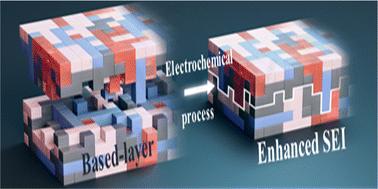
For the efficient functioning of a lithium anode, it requires an ideal protective layer that has its own strength and strongly bonds with the substrate. There are many studies on the strength of such protective layers, but very few reports on their bond strength with substrates. Herein, a design strategy is proposedto pre-construct a based-layer, where a mortice-tenon joint will connect with the subsequent electrochemically active SEI that is set on a Li anode surface. Initially, a tightly bonded base layer was chemically formed via the reaction between 2-(fluorosulfonyl)difluoroacetate (DFSA) and lithium metal. Then, trimethylsilyl 2-(fluorosulphonyl)difluoroacetate (TSFSA), which has a similar molecular structure and same functional group as DFSA, was introduced to act as an SEI enhancer that can preferentially decompose over carbonate solvents under electrochemical conditions with the same components of the based-layer, which was thus strengthened to form an enhanced SEI (ESEI). The Li anode with ESEI achieved long cycling stability (≥ 2100 h) and a high average CE (99.2%) in carbonate electrolytes. Full cells with high cathode loading (20.5 mg cm−2) also achieved high cycling stability at low N/P ratios, demonstrating its great prospects for practical applications in high energy density Li-metal batteries.
期刊介绍:
Energy & Environmental Science, a peer-reviewed scientific journal, publishes original research and review articles covering interdisciplinary topics in the (bio)chemical and (bio)physical sciences, as well as chemical engineering disciplines. Published monthly by the Royal Society of Chemistry (RSC), a not-for-profit publisher, Energy & Environmental Science is recognized as a leading journal. It boasts an impressive impact factor of 8.500 as of 2009, ranking 8th among 140 journals in the category "Chemistry, Multidisciplinary," second among 71 journals in "Energy & Fuels," second among 128 journals in "Engineering, Chemical," and first among 181 scientific journals in "Environmental Sciences."
Energy & Environmental Science publishes various types of articles, including Research Papers (original scientific work), Review Articles, Perspectives, and Minireviews (feature review-type articles of broad interest), Communications (original scientific work of an urgent nature), Opinions (personal, often speculative viewpoints or hypotheses on current topics), and Analysis Articles (in-depth examination of energy-related issues).




 京公网安备 11010802042870号
京ICP备2023020795号-1
京公网安备 11010802042870号
京ICP备2023020795号-1

 分享
分享
 求助内容:
求助内容: 应助结果提醒方式:
 扫码关注我们
