Jibran Ahmed MD, Filip Janku MD, PhD, Daniel D. Karp MD, Sarina A. Piha-Paul MD, Apostolia M. Tsimberidou MD, PhD, Timothy Anthony Yap MD, PhD, Bettzy Stephen MBBS, Yali Yang PhD, Serdar Gurses PhD, Qian Liu PhD, Juhee Song PhD, Funda Meric-Bernstam MD, Aung Naing MD
{"title":"talabostat是一种二肽基肽酶的小分子抑制剂,在晚期实体癌患者中与派姆单抗联合使用。","authors":"Jibran Ahmed MD, Filip Janku MD, PhD, Daniel D. Karp MD, Sarina A. Piha-Paul MD, Apostolia M. Tsimberidou MD, PhD, Timothy Anthony Yap MD, PhD, Bettzy Stephen MBBS, Yali Yang PhD, Serdar Gurses PhD, Qian Liu PhD, Juhee Song PhD, Funda Meric-Bernstam MD, Aung Naing MD","doi":"10.1002/cncr.35728","DOIUrl":null,"url":null,"abstract":"<div>\n \n \n <section>\n \n <h3> Background</h3>\n \n <p>Talabostat, an oral small molecule inhibitor of dipeptidyl peptidases (DPP4 and DPP8/9), has shown synergistic activity with immune checkpoint inhibitors in preclinical studies. This open label, phase 2 basket trial assessed the antitumor activity of combining talabostat and pembrolizumab (anti–programmed death-1 antibody) in advanced solid tumor patients.</p>\n </section>\n \n <section>\n \n <h3> Methods</h3>\n \n <p>The primary objective was assessment of dose-limiting toxicity (DLT) rates in the first six patients (lead-in stage) and response rate (efficacy stage; included cohort A [checkpoint inhibitor (ICI) naive] and cohort B [ICI pretreated]) for the study treatment using the Response Evaluation Criteria in Solid Tumors (RECIST) v1.1 and immune RECIST (iRECIST). Efficacy was assessed using a Bayesian optimal phase 2 design.</p>\n </section>\n \n <section>\n \n <h3> Results</h3>\n \n <p>A total of 31 patients enrolled in this trial (14 in cohort A, 17 in cohort B). The median age was 61 years; 17 (55%) patients were male and 21 (68%) patients were White. Among 19 (61%) patients evaluable for response, the best response was stable disease in nine patients, unconfirmed progressive disease in seven patients, and clinical progressive disease in three patients based on iRECIST. Disease control rate was 47%. One patient with programmed death-ligand 1 negative, microsatellite stable endometrial cancer had unconfirmed partial response. Median progression-free survival was 2.7 months; median overall survival was 20.5 months. One patient (cohort A) experienced a grade 4 hypotension as a DLT and treatment discontinuation. The most common toxicities were hypotension (22.6%), fatigue (9.7%), diarrhea, rash, thrombocytopenia, vomiting, syncope, general disorders and administration site conditions-other, and skin and subcutaneous tissue disorders-other, each in 6.5% of patients.</p>\n </section>\n \n <section>\n \n <h3> Conclusions</h3>\n \n <p>This study of the combination of talabostat and pembrolizumab in patients with advanced solid tumors demonstrated predictable adverse events and limited activity. The combination was shown to be safe. Efficacy data shows immune stable disease in nine of 19 evaluable patients, and an unconfirmed immune partial response in a patient with endometrial cancer.</p>\n </section>\n </div>","PeriodicalId":138,"journal":{"name":"Cancer","volume":"131 3","pages":""},"PeriodicalIF":5.1000,"publicationDate":"2025-01-23","publicationTypes":"Journal Article","fieldsOfStudy":null,"isOpenAccess":false,"openAccessPdf":"","citationCount":"0","resultStr":"{\"title\":\"A phase 2 basket study of talabostat, a small-molecule inhibitor of dipeptidyl peptidases, administered in combination with pembrolizumab in patients with advanced solid cancers\",\"authors\":\"Jibran Ahmed MD, Filip Janku MD, PhD, Daniel D. Karp MD, Sarina A. Piha-Paul MD, Apostolia M. Tsimberidou MD, PhD, Timothy Anthony Yap MD, PhD, Bettzy Stephen MBBS, Yali Yang PhD, Serdar Gurses PhD, Qian Liu PhD, Juhee Song PhD, Funda Meric-Bernstam MD, Aung Naing MD\",\"doi\":\"10.1002/cncr.35728\",\"DOIUrl\":null,\"url\":null,\"abstract\":\"<div>\\n \\n \\n <section>\\n \\n <h3> Background</h3>\\n \\n <p>Talabostat, an oral small molecule inhibitor of dipeptidyl peptidases (DPP4 and DPP8/9), has shown synergistic activity with immune checkpoint inhibitors in preclinical studies. This open label, phase 2 basket trial assessed the antitumor activity of combining talabostat and pembrolizumab (anti–programmed death-1 antibody) in advanced solid tumor patients.</p>\\n </section>\\n \\n <section>\\n \\n <h3> Methods</h3>\\n \\n <p>The primary objective was assessment of dose-limiting toxicity (DLT) rates in the first six patients (lead-in stage) and response rate (efficacy stage; included cohort A [checkpoint inhibitor (ICI) naive] and cohort B [ICI pretreated]) for the study treatment using the Response Evaluation Criteria in Solid Tumors (RECIST) v1.1 and immune RECIST (iRECIST). Efficacy was assessed using a Bayesian optimal phase 2 design.</p>\\n </section>\\n \\n <section>\\n \\n <h3> Results</h3>\\n \\n <p>A total of 31 patients enrolled in this trial (14 in cohort A, 17 in cohort B). The median age was 61 years; 17 (55%) patients were male and 21 (68%) patients were White. Among 19 (61%) patients evaluable for response, the best response was stable disease in nine patients, unconfirmed progressive disease in seven patients, and clinical progressive disease in three patients based on iRECIST. Disease control rate was 47%. One patient with programmed death-ligand 1 negative, microsatellite stable endometrial cancer had unconfirmed partial response. Median progression-free survival was 2.7 months; median overall survival was 20.5 months. One patient (cohort A) experienced a grade 4 hypotension as a DLT and treatment discontinuation. The most common toxicities were hypotension (22.6%), fatigue (9.7%), diarrhea, rash, thrombocytopenia, vomiting, syncope, general disorders and administration site conditions-other, and skin and subcutaneous tissue disorders-other, each in 6.5% of patients.</p>\\n </section>\\n \\n <section>\\n \\n <h3> Conclusions</h3>\\n \\n <p>This study of the combination of talabostat and pembrolizumab in patients with advanced solid tumors demonstrated predictable adverse events and limited activity. The combination was shown to be safe. Efficacy data shows immune stable disease in nine of 19 evaluable patients, and an unconfirmed immune partial response in a patient with endometrial cancer.</p>\\n </section>\\n </div>\",\"PeriodicalId\":138,\"journal\":{\"name\":\"Cancer\",\"volume\":\"131 3\",\"pages\":\"\"},\"PeriodicalIF\":5.1000,\"publicationDate\":\"2025-01-23\",\"publicationTypes\":\"Journal Article\",\"fieldsOfStudy\":null,\"isOpenAccess\":false,\"openAccessPdf\":\"\",\"citationCount\":\"0\",\"resultStr\":null,\"platform\":\"Semanticscholar\",\"paperid\":null,\"PeriodicalName\":\"Cancer\",\"FirstCategoryId\":\"3\",\"ListUrlMain\":\"https://acsjournals.onlinelibrary.wiley.com/doi/10.1002/cncr.35728\",\"RegionNum\":2,\"RegionCategory\":\"医学\",\"ArticlePicture\":[],\"TitleCN\":null,\"AbstractTextCN\":null,\"PMCID\":null,\"EPubDate\":\"\",\"PubModel\":\"\",\"JCR\":\"Q1\",\"JCRName\":\"ONCOLOGY\",\"Score\":null,\"Total\":0}","platform":"Semanticscholar","paperid":null,"PeriodicalName":"Cancer","FirstCategoryId":"3","ListUrlMain":"https://acsjournals.onlinelibrary.wiley.com/doi/10.1002/cncr.35728","RegionNum":2,"RegionCategory":"医学","ArticlePicture":[],"TitleCN":null,"AbstractTextCN":null,"PMCID":null,"EPubDate":"","PubModel":"","JCR":"Q1","JCRName":"ONCOLOGY","Score":null,"Total":0}
A phase 2 basket study of talabostat, a small-molecule inhibitor of dipeptidyl peptidases, administered in combination with pembrolizumab in patients with advanced solid cancers
Background
Talabostat, an oral small molecule inhibitor of dipeptidyl peptidases (DPP4 and DPP8/9), has shown synergistic activity with immune checkpoint inhibitors in preclinical studies. This open label, phase 2 basket trial assessed the antitumor activity of combining talabostat and pembrolizumab (anti–programmed death-1 antibody) in advanced solid tumor patients.
Methods
The primary objective was assessment of dose-limiting toxicity (DLT) rates in the first six patients (lead-in stage) and response rate (efficacy stage; included cohort A [checkpoint inhibitor (ICI) naive] and cohort B [ICI pretreated]) for the study treatment using the Response Evaluation Criteria in Solid Tumors (RECIST) v1.1 and immune RECIST (iRECIST). Efficacy was assessed using a Bayesian optimal phase 2 design.
Results
A total of 31 patients enrolled in this trial (14 in cohort A, 17 in cohort B). The median age was 61 years; 17 (55%) patients were male and 21 (68%) patients were White. Among 19 (61%) patients evaluable for response, the best response was stable disease in nine patients, unconfirmed progressive disease in seven patients, and clinical progressive disease in three patients based on iRECIST. Disease control rate was 47%. One patient with programmed death-ligand 1 negative, microsatellite stable endometrial cancer had unconfirmed partial response. Median progression-free survival was 2.7 months; median overall survival was 20.5 months. One patient (cohort A) experienced a grade 4 hypotension as a DLT and treatment discontinuation. The most common toxicities were hypotension (22.6%), fatigue (9.7%), diarrhea, rash, thrombocytopenia, vomiting, syncope, general disorders and administration site conditions-other, and skin and subcutaneous tissue disorders-other, each in 6.5% of patients.
Conclusions
This study of the combination of talabostat and pembrolizumab in patients with advanced solid tumors demonstrated predictable adverse events and limited activity. The combination was shown to be safe. Efficacy data shows immune stable disease in nine of 19 evaluable patients, and an unconfirmed immune partial response in a patient with endometrial cancer.
期刊介绍:
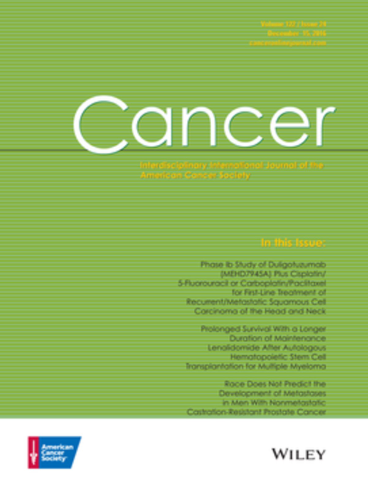
The CANCER site is a full-text, electronic implementation of CANCER, an Interdisciplinary International Journal of the American Cancer Society, and CANCER CYTOPATHOLOGY, a Journal of the American Cancer Society.
CANCER publishes interdisciplinary oncologic information according to, but not limited to, the following disease sites and disciplines: blood/bone marrow; breast disease; endocrine disorders; epidemiology; gastrointestinal tract; genitourinary disease; gynecologic oncology; head and neck disease; hepatobiliary tract; integrated medicine; lung disease; medical oncology; neuro-oncology; pathology radiation oncology; translational research




 京公网安备 11010802042870号
京ICP备2023020795号-1
京公网安备 11010802042870号
京ICP备2023020795号-1

 分享
分享
 求助内容:
求助内容: 应助结果提醒方式:
 扫码关注我们
