{"title":"转录组学分析和肿瘤微环境分类揭示了hiv相关卡波西肉瘤独特和动态的免疫生物学。","authors":"Jihua Yang, Ayse Ece Cali Daylan, Aleksei Shevkoplias, Ekaterina Postovalova, Meng Wang, Andrey Tyshevich, Matthew Lee, Hiba Narvel, Ksenia Zornikova, Nara Shin, Nikita Kotlov, Luca Paoluzzi, Changcheng Zhu, Balazs Halmos, Xingxing Zang, Haiying Cheng","doi":"10.3390/cells14020134","DOIUrl":null,"url":null,"abstract":"<p><p>Kaposi Sarcoma (KS) is a vascular tumor originating from endothelial cells and is associated with human herpesvirus 8 (KSHV) infection. It disproportionately affects populations facing health disparities. Although antiretroviral therapy (ART) has improved KS control in people with HIV (PWH), treatment options for advanced KS remain limited. This study investigates the tumor microenvironment (TME) of KS through whole-transcriptomic profiling, analyzing changes over time and differences based on HIV status. The TME was categorized into four subtypes: immune-enriched (IE), non-fibrotic, immune-enriched/fibrotic (IE/F), fibrotic (F) and immune-depleted (D). Nine KS patients (four HIV-negative and five HIV-positive) were enrolled in the study. Longitudinally collected KS samples from three patients (one HIV-negative and two HIV-positive) allowed for the investigation of dynamic TME changes within individual patients. The immune cellular composition was determined using deconvolution and compared to a cohort of non-KS patients. Our findings revealed that all KS samples, regardless of HIV status, were enriched in endothelial cells. Compared to non-KS tissues, the KS samples contained a higher percentage of NK and CD8+ T cells. HIV-negative KS samples displayed the IE and IE/F TME subtypes, while HIV-positive samples exhibited IE, IE/F, and F subtypes. Over the course of the disease, a decrease in angiogenic signatures was observed in two HIV-positive KS patients. Notably, HIV-negative KS samples showed alterations in NK cell-mediated immunity and cytotoxic response pathways, whereas HIV-positive samples exhibited changes in growth regulation and protein kinase activity pathways at the time of initial diagnosis. The gene expression of immune checkpoints, including CD274 (PD-L1) and PDCD1LC2 (PD-L2), was comparable between HIV-positive and HIV-negative KS samples at diagnosis. Furthermore, sequencing identified a shared TCR<i>β</i> chain in all patients analyzed, indicating a T-cell immune response to a common antigen. This study demonstrates unique transcriptomic features and TME subtypes in KS that differ based on HIV status. Additionally, it illustrates longitudinal dynamic changes in the gene signatures and TME subtypes in individual patients. The identification of a shared TCRβ chain suggests that immune T cells in KS patients may target a common antigen. Future studies should further explore the immune microenvironment and unique T cell clonotypes, which could pave the way for the development of novel therapeutic strategies for KS patients.</p>","PeriodicalId":9743,"journal":{"name":"Cells","volume":"14 2","pages":""},"PeriodicalIF":5.2000,"publicationDate":"2025-01-17","publicationTypes":"Journal Article","fieldsOfStudy":null,"isOpenAccess":false,"openAccessPdf":"https://www.ncbi.nlm.nih.gov/pmc/articles/PMC11764145/pdf/","citationCount":"0","resultStr":"{\"title\":\"Transcriptomic Profiling and Tumor Microenvironment Classification Reveal Unique and Dynamic Immune Biology in HIV-Associated Kaposi Sarcoma.\",\"authors\":\"Jihua Yang, Ayse Ece Cali Daylan, Aleksei Shevkoplias, Ekaterina Postovalova, Meng Wang, Andrey Tyshevich, Matthew Lee, Hiba Narvel, Ksenia Zornikova, Nara Shin, Nikita Kotlov, Luca Paoluzzi, Changcheng Zhu, Balazs Halmos, Xingxing Zang, Haiying Cheng\",\"doi\":\"10.3390/cells14020134\",\"DOIUrl\":null,\"url\":null,\"abstract\":\"<p><p>Kaposi Sarcoma (KS) is a vascular tumor originating from endothelial cells and is associated with human herpesvirus 8 (KSHV) infection. It disproportionately affects populations facing health disparities. Although antiretroviral therapy (ART) has improved KS control in people with HIV (PWH), treatment options for advanced KS remain limited. This study investigates the tumor microenvironment (TME) of KS through whole-transcriptomic profiling, analyzing changes over time and differences based on HIV status. The TME was categorized into four subtypes: immune-enriched (IE), non-fibrotic, immune-enriched/fibrotic (IE/F), fibrotic (F) and immune-depleted (D). Nine KS patients (four HIV-negative and five HIV-positive) were enrolled in the study. Longitudinally collected KS samples from three patients (one HIV-negative and two HIV-positive) allowed for the investigation of dynamic TME changes within individual patients. The immune cellular composition was determined using deconvolution and compared to a cohort of non-KS patients. Our findings revealed that all KS samples, regardless of HIV status, were enriched in endothelial cells. Compared to non-KS tissues, the KS samples contained a higher percentage of NK and CD8+ T cells. HIV-negative KS samples displayed the IE and IE/F TME subtypes, while HIV-positive samples exhibited IE, IE/F, and F subtypes. Over the course of the disease, a decrease in angiogenic signatures was observed in two HIV-positive KS patients. Notably, HIV-negative KS samples showed alterations in NK cell-mediated immunity and cytotoxic response pathways, whereas HIV-positive samples exhibited changes in growth regulation and protein kinase activity pathways at the time of initial diagnosis. The gene expression of immune checkpoints, including CD274 (PD-L1) and PDCD1LC2 (PD-L2), was comparable between HIV-positive and HIV-negative KS samples at diagnosis. Furthermore, sequencing identified a shared TCR<i>β</i> chain in all patients analyzed, indicating a T-cell immune response to a common antigen. This study demonstrates unique transcriptomic features and TME subtypes in KS that differ based on HIV status. Additionally, it illustrates longitudinal dynamic changes in the gene signatures and TME subtypes in individual patients. The identification of a shared TCRβ chain suggests that immune T cells in KS patients may target a common antigen. Future studies should further explore the immune microenvironment and unique T cell clonotypes, which could pave the way for the development of novel therapeutic strategies for KS patients.</p>\",\"PeriodicalId\":9743,\"journal\":{\"name\":\"Cells\",\"volume\":\"14 2\",\"pages\":\"\"},\"PeriodicalIF\":5.2000,\"publicationDate\":\"2025-01-17\",\"publicationTypes\":\"Journal Article\",\"fieldsOfStudy\":null,\"isOpenAccess\":false,\"openAccessPdf\":\"https://www.ncbi.nlm.nih.gov/pmc/articles/PMC11764145/pdf/\",\"citationCount\":\"0\",\"resultStr\":null,\"platform\":\"Semanticscholar\",\"paperid\":null,\"PeriodicalName\":\"Cells\",\"FirstCategoryId\":\"99\",\"ListUrlMain\":\"https://doi.org/10.3390/cells14020134\",\"RegionNum\":2,\"RegionCategory\":\"生物学\",\"ArticlePicture\":[],\"TitleCN\":null,\"AbstractTextCN\":null,\"PMCID\":null,\"EPubDate\":\"\",\"PubModel\":\"\",\"JCR\":\"Q2\",\"JCRName\":\"CELL BIOLOGY\",\"Score\":null,\"Total\":0}","platform":"Semanticscholar","paperid":null,"PeriodicalName":"Cells","FirstCategoryId":"99","ListUrlMain":"https://doi.org/10.3390/cells14020134","RegionNum":2,"RegionCategory":"生物学","ArticlePicture":[],"TitleCN":null,"AbstractTextCN":null,"PMCID":null,"EPubDate":"","PubModel":"","JCR":"Q2","JCRName":"CELL BIOLOGY","Score":null,"Total":0}
Transcriptomic Profiling and Tumor Microenvironment Classification Reveal Unique and Dynamic Immune Biology in HIV-Associated Kaposi Sarcoma.
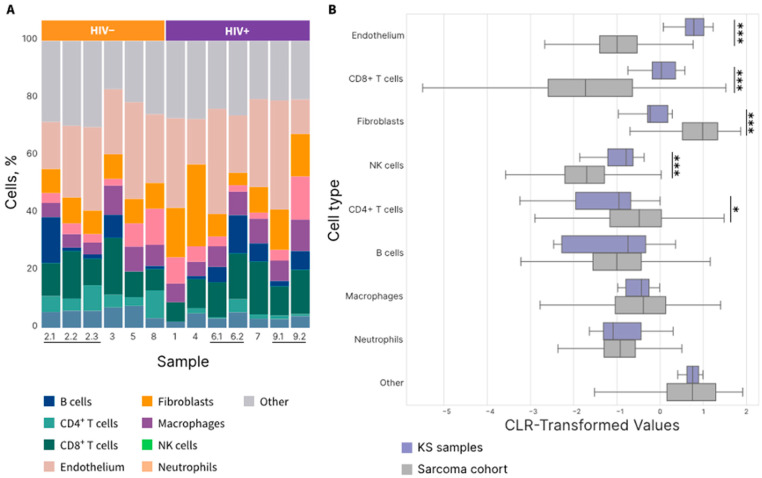
Kaposi Sarcoma (KS) is a vascular tumor originating from endothelial cells and is associated with human herpesvirus 8 (KSHV) infection. It disproportionately affects populations facing health disparities. Although antiretroviral therapy (ART) has improved KS control in people with HIV (PWH), treatment options for advanced KS remain limited. This study investigates the tumor microenvironment (TME) of KS through whole-transcriptomic profiling, analyzing changes over time and differences based on HIV status. The TME was categorized into four subtypes: immune-enriched (IE), non-fibrotic, immune-enriched/fibrotic (IE/F), fibrotic (F) and immune-depleted (D). Nine KS patients (four HIV-negative and five HIV-positive) were enrolled in the study. Longitudinally collected KS samples from three patients (one HIV-negative and two HIV-positive) allowed for the investigation of dynamic TME changes within individual patients. The immune cellular composition was determined using deconvolution and compared to a cohort of non-KS patients. Our findings revealed that all KS samples, regardless of HIV status, were enriched in endothelial cells. Compared to non-KS tissues, the KS samples contained a higher percentage of NK and CD8+ T cells. HIV-negative KS samples displayed the IE and IE/F TME subtypes, while HIV-positive samples exhibited IE, IE/F, and F subtypes. Over the course of the disease, a decrease in angiogenic signatures was observed in two HIV-positive KS patients. Notably, HIV-negative KS samples showed alterations in NK cell-mediated immunity and cytotoxic response pathways, whereas HIV-positive samples exhibited changes in growth regulation and protein kinase activity pathways at the time of initial diagnosis. The gene expression of immune checkpoints, including CD274 (PD-L1) and PDCD1LC2 (PD-L2), was comparable between HIV-positive and HIV-negative KS samples at diagnosis. Furthermore, sequencing identified a shared TCRβ chain in all patients analyzed, indicating a T-cell immune response to a common antigen. This study demonstrates unique transcriptomic features and TME subtypes in KS that differ based on HIV status. Additionally, it illustrates longitudinal dynamic changes in the gene signatures and TME subtypes in individual patients. The identification of a shared TCRβ chain suggests that immune T cells in KS patients may target a common antigen. Future studies should further explore the immune microenvironment and unique T cell clonotypes, which could pave the way for the development of novel therapeutic strategies for KS patients.
CellsBiochemistry, Genetics and Molecular Biology-Biochemistry, Genetics and Molecular Biology (all)
CiteScore
9.90
自引率
5.00%
发文量
3472
审稿时长
16 days
期刊介绍:
Cells (ISSN 2073-4409) is an international, peer-reviewed open access journal which provides an advanced forum for studies related to cell biology, molecular biology and biophysics. It publishes reviews, research articles, communications and technical notes. Our aim is to encourage scientists to publish their experimental and theoretical results in as much detail as possible. There is no restriction on the length of the papers. Full experimental and/or methodical details must be provided.







 京公网安备 11010802042870号
京ICP备2023020795号-1
京公网安备 11010802042870号
京ICP备2023020795号-1

 分享
分享
 求助内容:
求助内容: 应助结果提醒方式:
 扫码关注我们
