Elisabeth Wagner, Federico Dell'Anna, Ramil Nigmatullin, Gavin K Brennen
{"title":"非酉量子元胞自动机的密度分类。","authors":"Elisabeth Wagner, Federico Dell'Anna, Ramil Nigmatullin, Gavin K Brennen","doi":"10.3390/e27010026","DOIUrl":null,"url":null,"abstract":"<p><p>The density classification (DC) task, a computation which maps global density information to local density, is studied using one-dimensional non-unitary quantum cellular automata (QCAs). Two approaches are considered: one that preserves the number density and one that performs majority voting. For number-preserving DC, two QCAs are introduced that reach the fixed-point solution in a time scaling quadratically with the system size. One of the QCAs is based on a known classical probabilistic cellular automaton which has been studied in the context of DC. The second is a new quantum model that is designed to demonstrate additional quantum features and is restricted to only two-body interactions. Both can be generated by continuous-time Lindblad dynamics. A third QCA is a hybrid rule defined by both discrete-time and continuous-time three-body interactions that is shown to solve the majority voting problem within a time that scales linearly with the system size.</p>","PeriodicalId":11694,"journal":{"name":"Entropy","volume":"27 1","pages":""},"PeriodicalIF":2.0000,"publicationDate":"2024-12-31","publicationTypes":"Journal Article","fieldsOfStudy":null,"isOpenAccess":false,"openAccessPdf":"https://www.ncbi.nlm.nih.gov/pmc/articles/PMC11765043/pdf/","citationCount":"0","resultStr":"{\"title\":\"Density Classification with Non-Unitary Quantum Cellular Automata.\",\"authors\":\"Elisabeth Wagner, Federico Dell'Anna, Ramil Nigmatullin, Gavin K Brennen\",\"doi\":\"10.3390/e27010026\",\"DOIUrl\":null,\"url\":null,\"abstract\":\"<p><p>The density classification (DC) task, a computation which maps global density information to local density, is studied using one-dimensional non-unitary quantum cellular automata (QCAs). Two approaches are considered: one that preserves the number density and one that performs majority voting. For number-preserving DC, two QCAs are introduced that reach the fixed-point solution in a time scaling quadratically with the system size. One of the QCAs is based on a known classical probabilistic cellular automaton which has been studied in the context of DC. The second is a new quantum model that is designed to demonstrate additional quantum features and is restricted to only two-body interactions. Both can be generated by continuous-time Lindblad dynamics. A third QCA is a hybrid rule defined by both discrete-time and continuous-time three-body interactions that is shown to solve the majority voting problem within a time that scales linearly with the system size.</p>\",\"PeriodicalId\":11694,\"journal\":{\"name\":\"Entropy\",\"volume\":\"27 1\",\"pages\":\"\"},\"PeriodicalIF\":2.0000,\"publicationDate\":\"2024-12-31\",\"publicationTypes\":\"Journal Article\",\"fieldsOfStudy\":null,\"isOpenAccess\":false,\"openAccessPdf\":\"https://www.ncbi.nlm.nih.gov/pmc/articles/PMC11765043/pdf/\",\"citationCount\":\"0\",\"resultStr\":null,\"platform\":\"Semanticscholar\",\"paperid\":null,\"PeriodicalName\":\"Entropy\",\"FirstCategoryId\":\"101\",\"ListUrlMain\":\"https://doi.org/10.3390/e27010026\",\"RegionNum\":3,\"RegionCategory\":\"物理与天体物理\",\"ArticlePicture\":[],\"TitleCN\":null,\"AbstractTextCN\":null,\"PMCID\":null,\"EPubDate\":\"\",\"PubModel\":\"\",\"JCR\":\"Q2\",\"JCRName\":\"PHYSICS, MULTIDISCIPLINARY\",\"Score\":null,\"Total\":0}","platform":"Semanticscholar","paperid":null,"PeriodicalName":"Entropy","FirstCategoryId":"101","ListUrlMain":"https://doi.org/10.3390/e27010026","RegionNum":3,"RegionCategory":"物理与天体物理","ArticlePicture":[],"TitleCN":null,"AbstractTextCN":null,"PMCID":null,"EPubDate":"","PubModel":"","JCR":"Q2","JCRName":"PHYSICS, MULTIDISCIPLINARY","Score":null,"Total":0}
Density Classification with Non-Unitary Quantum Cellular Automata.
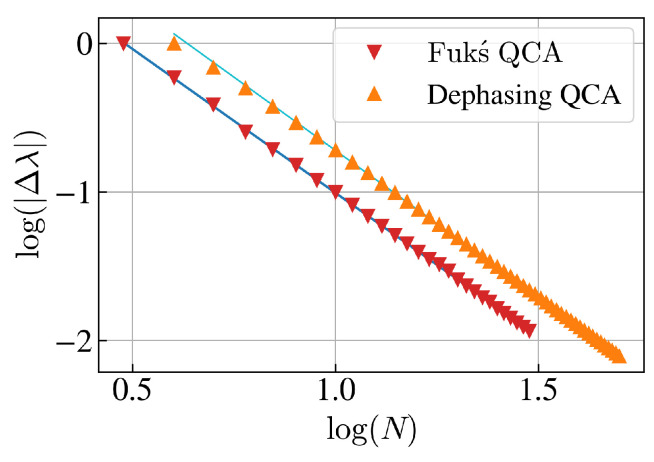
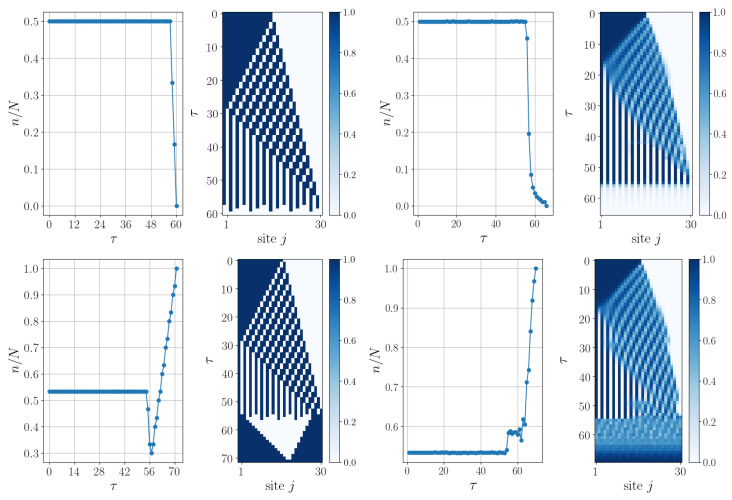
The density classification (DC) task, a computation which maps global density information to local density, is studied using one-dimensional non-unitary quantum cellular automata (QCAs). Two approaches are considered: one that preserves the number density and one that performs majority voting. For number-preserving DC, two QCAs are introduced that reach the fixed-point solution in a time scaling quadratically with the system size. One of the QCAs is based on a known classical probabilistic cellular automaton which has been studied in the context of DC. The second is a new quantum model that is designed to demonstrate additional quantum features and is restricted to only two-body interactions. Both can be generated by continuous-time Lindblad dynamics. A third QCA is a hybrid rule defined by both discrete-time and continuous-time three-body interactions that is shown to solve the majority voting problem within a time that scales linearly with the system size.
期刊介绍:
Entropy (ISSN 1099-4300), an international and interdisciplinary journal of entropy and information studies, publishes reviews, regular research papers and short notes. Our aim is to encourage scientists to publish as much as possible their theoretical and experimental details. There is no restriction on the length of the papers. If there are computation and the experiment, the details must be provided so that the results can be reproduced.





 京公网安备 11010802042870号
京ICP备2023020795号-1
京公网安备 11010802042870号
京ICP备2023020795号-1

 分享
分享
 求助内容:
求助内容: 应助结果提醒方式:
 扫码关注我们
