{"title":"用随机有限体积法计算Navier-Stokes流问题中的Shannon熵。","authors":"Marcin Kamiński, Rafał Leszek Ossowski","doi":"10.3390/e27010067","DOIUrl":null,"url":null,"abstract":"<p><p>The main aim of this study is to achieve the numerical solution for the Navier-Stokes equations for incompressible, non-turbulent, and subsonic fluid flows with some Gaussian physical uncertainties. The higher-order stochastic finite volume method (SFVM), implemented according to the iterative generalized stochastic perturbation technique and the Monte Carlo scheme, are engaged for this purpose. It is implemented with the aid of the polynomial bases for the pressure-velocity-temperature (PVT) solutions, for which the weighted least squares method (WLSM) algorithm is applicable. The deterministic problem is solved using the freeware OpenFVM, the computer algebra software MAPLE 2019 is employed for the LSM local fittings, and the resulting probabilistic quantities are computed. The first two probabilistic moments, as well as the Shannon entropy spatial distributions, are determined with this apparatus and visualized in the FEPlot software. This approach is validated using the 2D heat conduction benchmark test and then applied for the probabilistic version of the 3D coupled lid-driven cavity flow analysis. Such an implementation of the SFVM is applied to model the 2D lid-driven cavity flow problem for statistically homogeneous fluid with limited uncertainty in its viscosity and heat conductivity. Further numerical extension of this technique is seen in an application of the artificial neural networks, where polynomial approximation may be replaced automatically by some optimal, and not necessarily polynomial, bases.</p>","PeriodicalId":11694,"journal":{"name":"Entropy","volume":"27 1","pages":""},"PeriodicalIF":2.0000,"publicationDate":"2025-01-14","publicationTypes":"Journal Article","fieldsOfStudy":null,"isOpenAccess":false,"openAccessPdf":"https://www.ncbi.nlm.nih.gov/pmc/articles/PMC11765385/pdf/","citationCount":"0","resultStr":"{\"title\":\"Shannon Entropy Computations in Navier-Stokes Flow Problems Using the Stochastic Finite Volume Method.\",\"authors\":\"Marcin Kamiński, Rafał Leszek Ossowski\",\"doi\":\"10.3390/e27010067\",\"DOIUrl\":null,\"url\":null,\"abstract\":\"<p><p>The main aim of this study is to achieve the numerical solution for the Navier-Stokes equations for incompressible, non-turbulent, and subsonic fluid flows with some Gaussian physical uncertainties. The higher-order stochastic finite volume method (SFVM), implemented according to the iterative generalized stochastic perturbation technique and the Monte Carlo scheme, are engaged for this purpose. It is implemented with the aid of the polynomial bases for the pressure-velocity-temperature (PVT) solutions, for which the weighted least squares method (WLSM) algorithm is applicable. The deterministic problem is solved using the freeware OpenFVM, the computer algebra software MAPLE 2019 is employed for the LSM local fittings, and the resulting probabilistic quantities are computed. The first two probabilistic moments, as well as the Shannon entropy spatial distributions, are determined with this apparatus and visualized in the FEPlot software. This approach is validated using the 2D heat conduction benchmark test and then applied for the probabilistic version of the 3D coupled lid-driven cavity flow analysis. Such an implementation of the SFVM is applied to model the 2D lid-driven cavity flow problem for statistically homogeneous fluid with limited uncertainty in its viscosity and heat conductivity. Further numerical extension of this technique is seen in an application of the artificial neural networks, where polynomial approximation may be replaced automatically by some optimal, and not necessarily polynomial, bases.</p>\",\"PeriodicalId\":11694,\"journal\":{\"name\":\"Entropy\",\"volume\":\"27 1\",\"pages\":\"\"},\"PeriodicalIF\":2.0000,\"publicationDate\":\"2025-01-14\",\"publicationTypes\":\"Journal Article\",\"fieldsOfStudy\":null,\"isOpenAccess\":false,\"openAccessPdf\":\"https://www.ncbi.nlm.nih.gov/pmc/articles/PMC11765385/pdf/\",\"citationCount\":\"0\",\"resultStr\":null,\"platform\":\"Semanticscholar\",\"paperid\":null,\"PeriodicalName\":\"Entropy\",\"FirstCategoryId\":\"101\",\"ListUrlMain\":\"https://doi.org/10.3390/e27010067\",\"RegionNum\":3,\"RegionCategory\":\"物理与天体物理\",\"ArticlePicture\":[],\"TitleCN\":null,\"AbstractTextCN\":null,\"PMCID\":null,\"EPubDate\":\"\",\"PubModel\":\"\",\"JCR\":\"Q2\",\"JCRName\":\"PHYSICS, MULTIDISCIPLINARY\",\"Score\":null,\"Total\":0}","platform":"Semanticscholar","paperid":null,"PeriodicalName":"Entropy","FirstCategoryId":"101","ListUrlMain":"https://doi.org/10.3390/e27010067","RegionNum":3,"RegionCategory":"物理与天体物理","ArticlePicture":[],"TitleCN":null,"AbstractTextCN":null,"PMCID":null,"EPubDate":"","PubModel":"","JCR":"Q2","JCRName":"PHYSICS, MULTIDISCIPLINARY","Score":null,"Total":0}
Shannon Entropy Computations in Navier-Stokes Flow Problems Using the Stochastic Finite Volume Method.
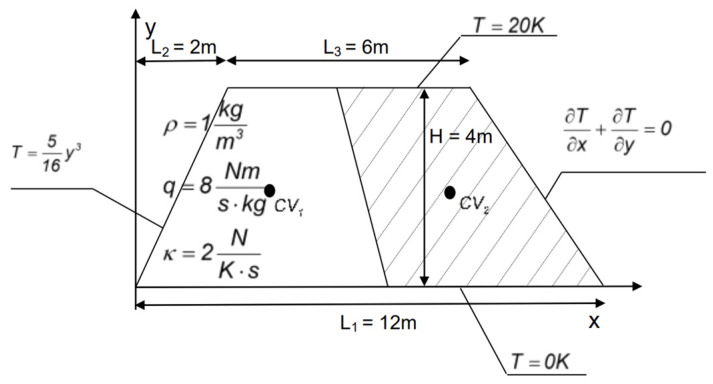
The main aim of this study is to achieve the numerical solution for the Navier-Stokes equations for incompressible, non-turbulent, and subsonic fluid flows with some Gaussian physical uncertainties. The higher-order stochastic finite volume method (SFVM), implemented according to the iterative generalized stochastic perturbation technique and the Monte Carlo scheme, are engaged for this purpose. It is implemented with the aid of the polynomial bases for the pressure-velocity-temperature (PVT) solutions, for which the weighted least squares method (WLSM) algorithm is applicable. The deterministic problem is solved using the freeware OpenFVM, the computer algebra software MAPLE 2019 is employed for the LSM local fittings, and the resulting probabilistic quantities are computed. The first two probabilistic moments, as well as the Shannon entropy spatial distributions, are determined with this apparatus and visualized in the FEPlot software. This approach is validated using the 2D heat conduction benchmark test and then applied for the probabilistic version of the 3D coupled lid-driven cavity flow analysis. Such an implementation of the SFVM is applied to model the 2D lid-driven cavity flow problem for statistically homogeneous fluid with limited uncertainty in its viscosity and heat conductivity. Further numerical extension of this technique is seen in an application of the artificial neural networks, where polynomial approximation may be replaced automatically by some optimal, and not necessarily polynomial, bases.
期刊介绍:
Entropy (ISSN 1099-4300), an international and interdisciplinary journal of entropy and information studies, publishes reviews, regular research papers and short notes. Our aim is to encourage scientists to publish as much as possible their theoretical and experimental details. There is no restriction on the length of the papers. If there are computation and the experiment, the details must be provided so that the results can be reproduced.






 京公网安备 11010802042870号
京ICP备2023020795号-1
京公网安备 11010802042870号
京ICP备2023020795号-1

 分享
分享
 求助内容:
求助内容: 应助结果提醒方式:
 扫码关注我们
