Md Shaheenur Islam Sumon, Md Sakib Abrar Hossain, Haya Al-Sulaiti, Hadi M Yassine, Muhammad E H Chowdhury
{"title":"在小分子代谢组中发现COVID-19靶标的综合机器学习方法","authors":"Md Shaheenur Islam Sumon, Md Sakib Abrar Hossain, Haya Al-Sulaiti, Hadi M Yassine, Muhammad E H Chowdhury","doi":"10.3390/metabo15010044","DOIUrl":null,"url":null,"abstract":"<p><p><b>Background/Objectives:</b> Respiratory viruses, including Influenza, RSV, and COVID-19, cause various respiratory infections. Distinguishing these viruses relies on diagnostic methods such as PCR testing. Challenges stem from overlapping symptoms and the emergence of new strains. Advanced diagnostics are crucial for accurate detection and effective management. This study leveraged nasopharyngeal metabolome data to predict respiratory virus scenarios including control vs. RSV, control vs. Influenza A, control vs. COVID-19, control vs. all respiratory viruses, and COVID-19 vs. Influenza A/RSV. <b>Method:</b> We proposed a stacking-based ensemble technique, integrating the top three best-performing ML models from the initial results to enhance prediction accuracy by leveraging the strengths of multiple base learners. Key techniques such as feature ranking, standard scaling, and SMOTE were used to address class imbalances, thus enhancing model robustness. SHAP analysis identified crucial metabolites influencing positive predictions, thereby providing valuable insights into diagnostic markers. <b>Results:</b> Our approach not only outperformed existing methods but also revealed top dominant features for predicting COVID-19, including Lysophosphatidylcholine acyl C18:2, Kynurenine, Phenylalanine, Valine, Tyrosine, and Aspartic Acid (Asp). <b>Conclusions:</b> This study demonstrates the effectiveness of leveraging nasopharyngeal metabolome data and stacking-based ensemble techniques for predicting respiratory virus scenarios. The proposed approach enhances prediction accuracy, provides insights into key diagnostic markers, and offers a robust framework for managing respiratory infections.</p>","PeriodicalId":18496,"journal":{"name":"Metabolites","volume":"15 1","pages":""},"PeriodicalIF":4.5000,"publicationDate":"2025-01-11","publicationTypes":"Journal Article","fieldsOfStudy":null,"isOpenAccess":false,"openAccessPdf":"https://www.ncbi.nlm.nih.gov/pmc/articles/PMC11767724/pdf/","citationCount":"0","resultStr":"{\"title\":\"A Comprehensive Machine Learning Approach for COVID-19 Target Discovery in the Small-Molecule Metabolome.\",\"authors\":\"Md Shaheenur Islam Sumon, Md Sakib Abrar Hossain, Haya Al-Sulaiti, Hadi M Yassine, Muhammad E H Chowdhury\",\"doi\":\"10.3390/metabo15010044\",\"DOIUrl\":null,\"url\":null,\"abstract\":\"<p><p><b>Background/Objectives:</b> Respiratory viruses, including Influenza, RSV, and COVID-19, cause various respiratory infections. Distinguishing these viruses relies on diagnostic methods such as PCR testing. Challenges stem from overlapping symptoms and the emergence of new strains. Advanced diagnostics are crucial for accurate detection and effective management. This study leveraged nasopharyngeal metabolome data to predict respiratory virus scenarios including control vs. RSV, control vs. Influenza A, control vs. COVID-19, control vs. all respiratory viruses, and COVID-19 vs. Influenza A/RSV. <b>Method:</b> We proposed a stacking-based ensemble technique, integrating the top three best-performing ML models from the initial results to enhance prediction accuracy by leveraging the strengths of multiple base learners. Key techniques such as feature ranking, standard scaling, and SMOTE were used to address class imbalances, thus enhancing model robustness. SHAP analysis identified crucial metabolites influencing positive predictions, thereby providing valuable insights into diagnostic markers. <b>Results:</b> Our approach not only outperformed existing methods but also revealed top dominant features for predicting COVID-19, including Lysophosphatidylcholine acyl C18:2, Kynurenine, Phenylalanine, Valine, Tyrosine, and Aspartic Acid (Asp). <b>Conclusions:</b> This study demonstrates the effectiveness of leveraging nasopharyngeal metabolome data and stacking-based ensemble techniques for predicting respiratory virus scenarios. The proposed approach enhances prediction accuracy, provides insights into key diagnostic markers, and offers a robust framework for managing respiratory infections.</p>\",\"PeriodicalId\":18496,\"journal\":{\"name\":\"Metabolites\",\"volume\":\"15 1\",\"pages\":\"\"},\"PeriodicalIF\":4.5000,\"publicationDate\":\"2025-01-11\",\"publicationTypes\":\"Journal Article\",\"fieldsOfStudy\":null,\"isOpenAccess\":false,\"openAccessPdf\":\"https://www.ncbi.nlm.nih.gov/pmc/articles/PMC11767724/pdf/\",\"citationCount\":\"0\",\"resultStr\":null,\"platform\":\"Semanticscholar\",\"paperid\":null,\"PeriodicalName\":\"Metabolites\",\"FirstCategoryId\":\"99\",\"ListUrlMain\":\"https://doi.org/10.3390/metabo15010044\",\"RegionNum\":3,\"RegionCategory\":\"生物学\",\"ArticlePicture\":[],\"TitleCN\":null,\"AbstractTextCN\":null,\"PMCID\":null,\"EPubDate\":\"\",\"PubModel\":\"\",\"JCR\":\"Q2\",\"JCRName\":\"BIOCHEMISTRY & MOLECULAR BIOLOGY\",\"Score\":null,\"Total\":0}","platform":"Semanticscholar","paperid":null,"PeriodicalName":"Metabolites","FirstCategoryId":"99","ListUrlMain":"https://doi.org/10.3390/metabo15010044","RegionNum":3,"RegionCategory":"生物学","ArticlePicture":[],"TitleCN":null,"AbstractTextCN":null,"PMCID":null,"EPubDate":"","PubModel":"","JCR":"Q2","JCRName":"BIOCHEMISTRY & MOLECULAR BIOLOGY","Score":null,"Total":0}
A Comprehensive Machine Learning Approach for COVID-19 Target Discovery in the Small-Molecule Metabolome.
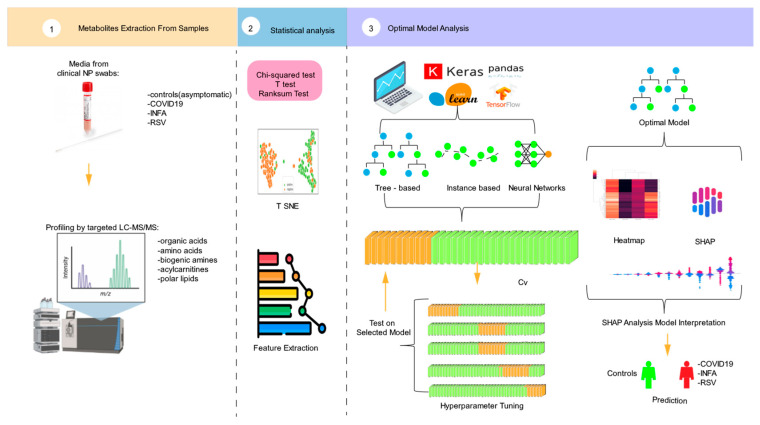
Background/Objectives: Respiratory viruses, including Influenza, RSV, and COVID-19, cause various respiratory infections. Distinguishing these viruses relies on diagnostic methods such as PCR testing. Challenges stem from overlapping symptoms and the emergence of new strains. Advanced diagnostics are crucial for accurate detection and effective management. This study leveraged nasopharyngeal metabolome data to predict respiratory virus scenarios including control vs. RSV, control vs. Influenza A, control vs. COVID-19, control vs. all respiratory viruses, and COVID-19 vs. Influenza A/RSV. Method: We proposed a stacking-based ensemble technique, integrating the top three best-performing ML models from the initial results to enhance prediction accuracy by leveraging the strengths of multiple base learners. Key techniques such as feature ranking, standard scaling, and SMOTE were used to address class imbalances, thus enhancing model robustness. SHAP analysis identified crucial metabolites influencing positive predictions, thereby providing valuable insights into diagnostic markers. Results: Our approach not only outperformed existing methods but also revealed top dominant features for predicting COVID-19, including Lysophosphatidylcholine acyl C18:2, Kynurenine, Phenylalanine, Valine, Tyrosine, and Aspartic Acid (Asp). Conclusions: This study demonstrates the effectiveness of leveraging nasopharyngeal metabolome data and stacking-based ensemble techniques for predicting respiratory virus scenarios. The proposed approach enhances prediction accuracy, provides insights into key diagnostic markers, and offers a robust framework for managing respiratory infections.
MetabolitesBiochemistry, Genetics and Molecular Biology-Molecular Biology
CiteScore
5.70
自引率
7.30%
发文量
1070
审稿时长
17.17 days
期刊介绍:
Metabolites (ISSN 2218-1989) is an international, peer-reviewed open access journal of metabolism and metabolomics. Metabolites publishes original research articles and review articles in all molecular aspects of metabolism relevant to the fields of metabolomics, metabolic biochemistry, computational and systems biology, biotechnology and medicine, with a particular focus on the biological roles of metabolites and small molecule biomarkers. Metabolites encourages scientists to publish their experimental and theoretical results in as much detail as possible. Therefore, there is no restriction on article length. Sufficient experimental details must be provided to enable the results to be accurately reproduced. Electronic material representing additional figures, materials and methods explanation, or supporting results and evidence can be submitted with the main manuscript as supplementary material.






 京公网安备 11010802042870号
京ICP备2023020795号-1
京公网安备 11010802042870号
京ICP备2023020795号-1

 分享
分享
 求助内容:
求助内容: 应助结果提醒方式:
 扫码关注我们
