Ian J Neeland, Luiz H de Gregório, Roberto Zagury, Bo Ahrén, Joel Neutel, Christian Darimont, John Corthesy, Yohan Grzywinski, Emilie Perrin, Maximilian von Eynatten, Odd Erik Johansen
{"title":"一项随机、安慰剂对照、单中心、交叉研究,评估餐前乳清蛋白微凝胶对2型糖尿病和超重或肥胖患者餐后糖代谢和氨基酸反应的影响。","authors":"Ian J Neeland, Luiz H de Gregório, Roberto Zagury, Bo Ahrén, Joel Neutel, Christian Darimont, John Corthesy, Yohan Grzywinski, Emilie Perrin, Maximilian von Eynatten, Odd Erik Johansen","doi":"10.3390/metabo15010061","DOIUrl":null,"url":null,"abstract":"<p><p><b>Purpose</b>: Whey protein (WP) consumption prior to a meal curbs appetite and reduces postprandial glucose (PPG) through stimulating endogenous GLP-1 secretion and insulin. <b>Methods</b>: We assessed the metabolic effects of a concentrated WP, using a new micelle-technology (WPM), in people with type 2 diabetes (T2D) and overweight or obesity (NCT04639726). In a randomized-crossover design, participants performed two 240 min lunch meal (622 kcal) tests 7 ± 4 days apart. After an overnight fast and a standardized breakfast, 10 g (125 mL) WPM (40 kcal) or placebo (125 mL water, 0 kcal) was consumed 15 min ahead of the mixed-nutrient meal. Effects on PPG (primary endpoint), insulin, GLP-1, and branched-chain amino acids (BCAAs) were evaluated with frequent blood sampling. Changes in incremental areas under the concentration curve (iAUC) were compared using a mixed model. <b>Results</b>: Twenty-six individuals (14 females, mean ± SD age 62.0 ± 8.3 years, HbA1c 58 ± 12 mmol/mol/7.5 ± 1.1%, BMI 29.2 ± 4.8 kg/m<sup>2</sup>) completed both tests. WPM significantly reduced PPG iAUC<sub>0-2h</sub> by 22% (<i>p</i> = 0.028), and iAUC<sub>0-3h</sub> numerically by -18% (<i>p</i> = 0.090) vs. placebo. WPM also increased insulin iAUC<sub>0-1h</sub> by 61% (<i>p</i> < 0.001), and iAUC<sub>0-3h</sub> by 30% (<i>p</i> = 0.004), respectively. Total GLP-1 iAUC<sub>0-2h</sub> was enhanced by 66% (<i>p</i> < 0.001). Postprandial plasma BCAA patterns were characterized by a rapid increase and larger iAUC<sub>0-2h</sub> (all <i>p</i> < 0.001) after WPM. No adverse events were ascribed to consuming WPM. <b>Conclusions</b>: A 125 mL pre-meal drink containing just 10 g WPM before a mixed meal reduced PPG and increased insulin, GLP-1, and BCAAs. WPM may therefore serve as a metabolic modulator in people with T2D living with overweight or obesity.</p>","PeriodicalId":18496,"journal":{"name":"Metabolites","volume":"15 1","pages":""},"PeriodicalIF":3.7000,"publicationDate":"2025-01-16","publicationTypes":"Journal Article","fieldsOfStudy":null,"isOpenAccess":false,"openAccessPdf":"https://www.ncbi.nlm.nih.gov/pmc/articles/PMC11767963/pdf/","citationCount":"0","resultStr":"{\"title\":\"A Randomized, Placebo-Controlled, Single-Center, Crossover Study to Evaluate the Effects of Pre-Meal Whey Protein Microgel on Post-Prandial Glucometabolic and Amino Acid Response in People with Type 2 Diabetes and Overweight or Obesity.\",\"authors\":\"Ian J Neeland, Luiz H de Gregório, Roberto Zagury, Bo Ahrén, Joel Neutel, Christian Darimont, John Corthesy, Yohan Grzywinski, Emilie Perrin, Maximilian von Eynatten, Odd Erik Johansen\",\"doi\":\"10.3390/metabo15010061\",\"DOIUrl\":null,\"url\":null,\"abstract\":\"<p><p><b>Purpose</b>: Whey protein (WP) consumption prior to a meal curbs appetite and reduces postprandial glucose (PPG) through stimulating endogenous GLP-1 secretion and insulin. <b>Methods</b>: We assessed the metabolic effects of a concentrated WP, using a new micelle-technology (WPM), in people with type 2 diabetes (T2D) and overweight or obesity (NCT04639726). In a randomized-crossover design, participants performed two 240 min lunch meal (622 kcal) tests 7 ± 4 days apart. After an overnight fast and a standardized breakfast, 10 g (125 mL) WPM (40 kcal) or placebo (125 mL water, 0 kcal) was consumed 15 min ahead of the mixed-nutrient meal. Effects on PPG (primary endpoint), insulin, GLP-1, and branched-chain amino acids (BCAAs) were evaluated with frequent blood sampling. Changes in incremental areas under the concentration curve (iAUC) were compared using a mixed model. <b>Results</b>: Twenty-six individuals (14 females, mean ± SD age 62.0 ± 8.3 years, HbA1c 58 ± 12 mmol/mol/7.5 ± 1.1%, BMI 29.2 ± 4.8 kg/m<sup>2</sup>) completed both tests. WPM significantly reduced PPG iAUC<sub>0-2h</sub> by 22% (<i>p</i> = 0.028), and iAUC<sub>0-3h</sub> numerically by -18% (<i>p</i> = 0.090) vs. placebo. WPM also increased insulin iAUC<sub>0-1h</sub> by 61% (<i>p</i> < 0.001), and iAUC<sub>0-3h</sub> by 30% (<i>p</i> = 0.004), respectively. Total GLP-1 iAUC<sub>0-2h</sub> was enhanced by 66% (<i>p</i> < 0.001). Postprandial plasma BCAA patterns were characterized by a rapid increase and larger iAUC<sub>0-2h</sub> (all <i>p</i> < 0.001) after WPM. No adverse events were ascribed to consuming WPM. <b>Conclusions</b>: A 125 mL pre-meal drink containing just 10 g WPM before a mixed meal reduced PPG and increased insulin, GLP-1, and BCAAs. WPM may therefore serve as a metabolic modulator in people with T2D living with overweight or obesity.</p>\",\"PeriodicalId\":18496,\"journal\":{\"name\":\"Metabolites\",\"volume\":\"15 1\",\"pages\":\"\"},\"PeriodicalIF\":3.7000,\"publicationDate\":\"2025-01-16\",\"publicationTypes\":\"Journal Article\",\"fieldsOfStudy\":null,\"isOpenAccess\":false,\"openAccessPdf\":\"https://www.ncbi.nlm.nih.gov/pmc/articles/PMC11767963/pdf/\",\"citationCount\":\"0\",\"resultStr\":null,\"platform\":\"Semanticscholar\",\"paperid\":null,\"PeriodicalName\":\"Metabolites\",\"FirstCategoryId\":\"99\",\"ListUrlMain\":\"https://doi.org/10.3390/metabo15010061\",\"RegionNum\":3,\"RegionCategory\":\"生物学\",\"ArticlePicture\":[],\"TitleCN\":null,\"AbstractTextCN\":null,\"PMCID\":null,\"EPubDate\":\"\",\"PubModel\":\"\",\"JCR\":\"Q2\",\"JCRName\":\"BIOCHEMISTRY & MOLECULAR BIOLOGY\",\"Score\":null,\"Total\":0}","platform":"Semanticscholar","paperid":null,"PeriodicalName":"Metabolites","FirstCategoryId":"99","ListUrlMain":"https://doi.org/10.3390/metabo15010061","RegionNum":3,"RegionCategory":"生物学","ArticlePicture":[],"TitleCN":null,"AbstractTextCN":null,"PMCID":null,"EPubDate":"","PubModel":"","JCR":"Q2","JCRName":"BIOCHEMISTRY & MOLECULAR BIOLOGY","Score":null,"Total":0}
A Randomized, Placebo-Controlled, Single-Center, Crossover Study to Evaluate the Effects of Pre-Meal Whey Protein Microgel on Post-Prandial Glucometabolic and Amino Acid Response in People with Type 2 Diabetes and Overweight or Obesity.
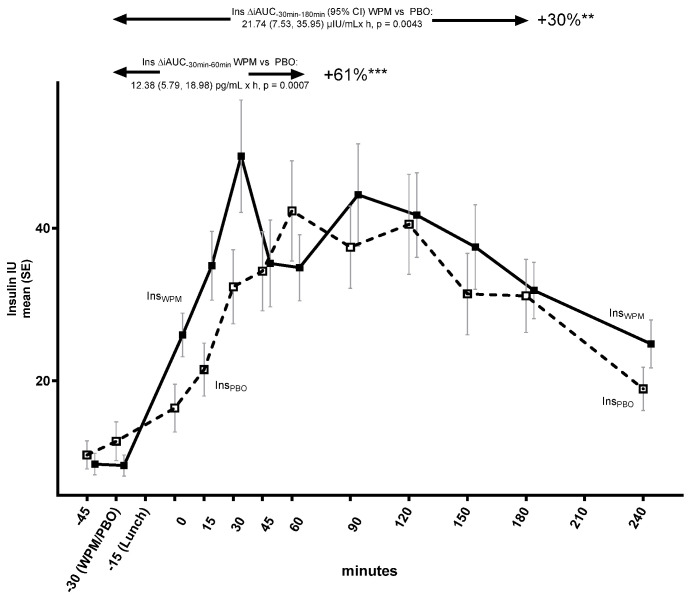
Purpose: Whey protein (WP) consumption prior to a meal curbs appetite and reduces postprandial glucose (PPG) through stimulating endogenous GLP-1 secretion and insulin. Methods: We assessed the metabolic effects of a concentrated WP, using a new micelle-technology (WPM), in people with type 2 diabetes (T2D) and overweight or obesity (NCT04639726). In a randomized-crossover design, participants performed two 240 min lunch meal (622 kcal) tests 7 ± 4 days apart. After an overnight fast and a standardized breakfast, 10 g (125 mL) WPM (40 kcal) or placebo (125 mL water, 0 kcal) was consumed 15 min ahead of the mixed-nutrient meal. Effects on PPG (primary endpoint), insulin, GLP-1, and branched-chain amino acids (BCAAs) were evaluated with frequent blood sampling. Changes in incremental areas under the concentration curve (iAUC) were compared using a mixed model. Results: Twenty-six individuals (14 females, mean ± SD age 62.0 ± 8.3 years, HbA1c 58 ± 12 mmol/mol/7.5 ± 1.1%, BMI 29.2 ± 4.8 kg/m2) completed both tests. WPM significantly reduced PPG iAUC0-2h by 22% (p = 0.028), and iAUC0-3h numerically by -18% (p = 0.090) vs. placebo. WPM also increased insulin iAUC0-1h by 61% (p < 0.001), and iAUC0-3h by 30% (p = 0.004), respectively. Total GLP-1 iAUC0-2h was enhanced by 66% (p < 0.001). Postprandial plasma BCAA patterns were characterized by a rapid increase and larger iAUC0-2h (all p < 0.001) after WPM. No adverse events were ascribed to consuming WPM. Conclusions: A 125 mL pre-meal drink containing just 10 g WPM before a mixed meal reduced PPG and increased insulin, GLP-1, and BCAAs. WPM may therefore serve as a metabolic modulator in people with T2D living with overweight or obesity.
MetabolitesBiochemistry, Genetics and Molecular Biology-Molecular Biology
CiteScore
5.70
自引率
7.30%
发文量
1070
审稿时长
17.17 days
期刊介绍:
Metabolites (ISSN 2218-1989) is an international, peer-reviewed open access journal of metabolism and metabolomics. Metabolites publishes original research articles and review articles in all molecular aspects of metabolism relevant to the fields of metabolomics, metabolic biochemistry, computational and systems biology, biotechnology and medicine, with a particular focus on the biological roles of metabolites and small molecule biomarkers. Metabolites encourages scientists to publish their experimental and theoretical results in as much detail as possible. Therefore, there is no restriction on article length. Sufficient experimental details must be provided to enable the results to be accurately reproduced. Electronic material representing additional figures, materials and methods explanation, or supporting results and evidence can be submitted with the main manuscript as supplementary material.






 京公网安备 11010802042870号
京ICP备2023020795号-1
京公网安备 11010802042870号
京ICP备2023020795号-1

 分享
分享
 求助内容:
求助内容: 应助结果提醒方式:
 扫码关注我们
