Yaseen H. Al-Qaraghuli , Rominder Suri , Mark E. Fuller , Erica R. McKenzie
{"title":"从溶解度到效率:从阴离子交换树脂再生全氟和多氟烷基物质(PFAS)。","authors":"Yaseen H. Al-Qaraghuli , Rominder Suri , Mark E. Fuller , Erica R. McKenzie","doi":"10.1016/j.scitotenv.2025.178571","DOIUrl":null,"url":null,"abstract":"<div><div>This study investigated the regenerability of anion exchange resins for per- and polyfluoroalkyl substances (PFAS), focusing on the interaction between regenerant composition and resin characteristics. The influence of salt type and concentration on PFAS solubility revealed a general decline in perfluorohexane sulfonate (PFHxS) solubility with increased salt concentrations, most strongly with KCl followed by NaCl and NH<sub>4</sub>Cl. Mixed solubility results were observed for perfluorooctanoate (PFOA) and perfluorooctane sulfonate (PFOS). Three resins – A592E and USA291597EPF (strong base resins) and USA21107 (weak base resin) – were evaluated using aqueous and organic solvent regenerants across multiple cycles. Batch regeneration experiments demonstrated that regeneration effectiveness was higher for short chain perfluoroalkyl carboxylates (PFCA) compared to long chain PFCA, followed by n:2 fluorotelomer sulfonates (FtS) and perfluoroalkane sulfonates (PFSA). Chloride-based salts regenerants were more effective, while the type of cation had minimal impact. Organic solvent regenerants outperformed aqueous solutions, with effectiveness increasing at higher percentages. For low organic solvent percentages, acetone demonstrated higher effectiveness compared to ethanol and methanol. Resin regenerability ranked as follows: USA291597EPF > A592E > USA21107. Flow through column studies confirmed the dependency of regeneration effectiveness on PFAS structural characteristics, with shorter chain PFCA demonstrating higher efficiency. The Lin and Huang model's parameters, time to desorb 50% of resin-associated PFAS (<span><math><mi>τ</mi><mo>)</mo></math></span> and the column constant (<span><math><msub><mi>k</mi><mi>c</mi></msub><mo>)</mo></math></span>, revealed two distinct desorption phases. The findings highlight the crucial role of regenerant composition in optimizing resin regeneration, offering valuable insights for developing more effective PFAS remediation strategies.</div></div>","PeriodicalId":422,"journal":{"name":"Science of the Total Environment","volume":"964 ","pages":"Article 178571"},"PeriodicalIF":8.0000,"publicationDate":"2025-02-10","publicationTypes":"Journal Article","fieldsOfStudy":null,"isOpenAccess":false,"openAccessPdf":"","citationCount":"0","resultStr":"{\"title\":\"From solubility to efficiency: Per- and polyfluoroalkyl substances (PFAS) regeneration from anion exchange resins\",\"authors\":\"Yaseen H. Al-Qaraghuli , Rominder Suri , Mark E. Fuller , Erica R. McKenzie\",\"doi\":\"10.1016/j.scitotenv.2025.178571\",\"DOIUrl\":null,\"url\":null,\"abstract\":\"<div><div>This study investigated the regenerability of anion exchange resins for per- and polyfluoroalkyl substances (PFAS), focusing on the interaction between regenerant composition and resin characteristics. The influence of salt type and concentration on PFAS solubility revealed a general decline in perfluorohexane sulfonate (PFHxS) solubility with increased salt concentrations, most strongly with KCl followed by NaCl and NH<sub>4</sub>Cl. Mixed solubility results were observed for perfluorooctanoate (PFOA) and perfluorooctane sulfonate (PFOS). Three resins – A592E and USA291597EPF (strong base resins) and USA21107 (weak base resin) – were evaluated using aqueous and organic solvent regenerants across multiple cycles. Batch regeneration experiments demonstrated that regeneration effectiveness was higher for short chain perfluoroalkyl carboxylates (PFCA) compared to long chain PFCA, followed by n:2 fluorotelomer sulfonates (FtS) and perfluoroalkane sulfonates (PFSA). Chloride-based salts regenerants were more effective, while the type of cation had minimal impact. Organic solvent regenerants outperformed aqueous solutions, with effectiveness increasing at higher percentages. For low organic solvent percentages, acetone demonstrated higher effectiveness compared to ethanol and methanol. Resin regenerability ranked as follows: USA291597EPF > A592E > USA21107. Flow through column studies confirmed the dependency of regeneration effectiveness on PFAS structural characteristics, with shorter chain PFCA demonstrating higher efficiency. The Lin and Huang model's parameters, time to desorb 50% of resin-associated PFAS (<span><math><mi>τ</mi><mo>)</mo></math></span> and the column constant (<span><math><msub><mi>k</mi><mi>c</mi></msub><mo>)</mo></math></span>, revealed two distinct desorption phases. The findings highlight the crucial role of regenerant composition in optimizing resin regeneration, offering valuable insights for developing more effective PFAS remediation strategies.</div></div>\",\"PeriodicalId\":422,\"journal\":{\"name\":\"Science of the Total Environment\",\"volume\":\"964 \",\"pages\":\"Article 178571\"},\"PeriodicalIF\":8.0000,\"publicationDate\":\"2025-02-10\",\"publicationTypes\":\"Journal Article\",\"fieldsOfStudy\":null,\"isOpenAccess\":false,\"openAccessPdf\":\"\",\"citationCount\":\"0\",\"resultStr\":null,\"platform\":\"Semanticscholar\",\"paperid\":null,\"PeriodicalName\":\"Science of the Total Environment\",\"FirstCategoryId\":\"93\",\"ListUrlMain\":\"https://www.sciencedirect.com/science/article/pii/S0048969725002050\",\"RegionNum\":1,\"RegionCategory\":\"环境科学与生态学\",\"ArticlePicture\":[],\"TitleCN\":null,\"AbstractTextCN\":null,\"PMCID\":null,\"EPubDate\":\"2025/1/24 0:00:00\",\"PubModel\":\"Epub\",\"JCR\":\"Q1\",\"JCRName\":\"ENVIRONMENTAL SCIENCES\",\"Score\":null,\"Total\":0}","platform":"Semanticscholar","paperid":null,"PeriodicalName":"Science of the Total Environment","FirstCategoryId":"93","ListUrlMain":"https://www.sciencedirect.com/science/article/pii/S0048969725002050","RegionNum":1,"RegionCategory":"环境科学与生态学","ArticlePicture":[],"TitleCN":null,"AbstractTextCN":null,"PMCID":null,"EPubDate":"2025/1/24 0:00:00","PubModel":"Epub","JCR":"Q1","JCRName":"ENVIRONMENTAL SCIENCES","Score":null,"Total":0}
From solubility to efficiency: Per- and polyfluoroalkyl substances (PFAS) regeneration from anion exchange resins
This study investigated the regenerability of anion exchange resins for per- and polyfluoroalkyl substances (PFAS), focusing on the interaction between regenerant composition and resin characteristics. The influence of salt type and concentration on PFAS solubility revealed a general decline in perfluorohexane sulfonate (PFHxS) solubility with increased salt concentrations, most strongly with KCl followed by NaCl and NH4Cl. Mixed solubility results were observed for perfluorooctanoate (PFOA) and perfluorooctane sulfonate (PFOS). Three resins – A592E and USA291597EPF (strong base resins) and USA21107 (weak base resin) – were evaluated using aqueous and organic solvent regenerants across multiple cycles. Batch regeneration experiments demonstrated that regeneration effectiveness was higher for short chain perfluoroalkyl carboxylates (PFCA) compared to long chain PFCA, followed by n:2 fluorotelomer sulfonates (FtS) and perfluoroalkane sulfonates (PFSA). Chloride-based salts regenerants were more effective, while the type of cation had minimal impact. Organic solvent regenerants outperformed aqueous solutions, with effectiveness increasing at higher percentages. For low organic solvent percentages, acetone demonstrated higher effectiveness compared to ethanol and methanol. Resin regenerability ranked as follows: USA291597EPF > A592E > USA21107. Flow through column studies confirmed the dependency of regeneration effectiveness on PFAS structural characteristics, with shorter chain PFCA demonstrating higher efficiency. The Lin and Huang model's parameters, time to desorb 50% of resin-associated PFAS ( and the column constant (, revealed two distinct desorption phases. The findings highlight the crucial role of regenerant composition in optimizing resin regeneration, offering valuable insights for developing more effective PFAS remediation strategies.
期刊介绍:
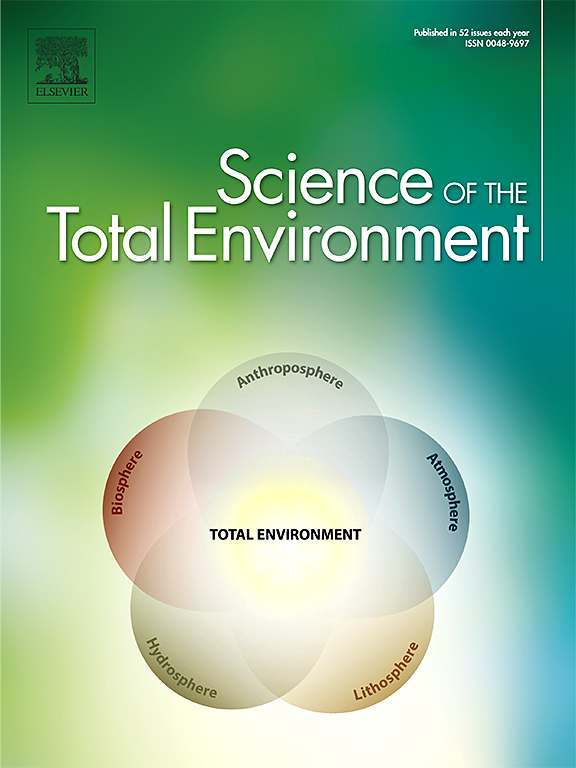
The Science of the Total Environment is an international journal dedicated to scientific research on the environment and its interaction with humanity. It covers a wide range of disciplines and seeks to publish innovative, hypothesis-driven, and impactful research that explores the entire environment, including the atmosphere, lithosphere, hydrosphere, biosphere, and anthroposphere.
The journal's updated Aims & Scope emphasizes the importance of interdisciplinary environmental research with broad impact. Priority is given to studies that advance fundamental understanding and explore the interconnectedness of multiple environmental spheres. Field studies are preferred, while laboratory experiments must demonstrate significant methodological advancements or mechanistic insights with direct relevance to the environment.





 京公网安备 11010802042870号
京ICP备2023020795号-1
京公网安备 11010802042870号
京ICP备2023020795号-1

 分享
分享
 求助内容:
求助内容: 应助结果提醒方式:
 扫码关注我们
