Angelo Santoro, Antonio Ricci, Manuela Rodriquez, Michela Buonocore, Anna Maria D'Ursi
{"title":"抗氧化剂姜黄素对Aβ(1-42)淀粉样肽的结构影响。","authors":"Angelo Santoro, Antonio Ricci, Manuela Rodriquez, Michela Buonocore, Anna Maria D'Ursi","doi":"10.3390/antiox14010053","DOIUrl":null,"url":null,"abstract":"<p><p>Investigating amyloid-β (Aβ) peptides in solution is essential during the initial stages of developing lead compounds that can influence Aβ fibrillation while the peptide is still in a soluble state. The tendency of the Aβ(1-42) peptide to misfold in solution, correlated to the aetiology of Alzheimer's disease (AD), is one of the main hindrances to characterising its aggregation kinetics in a cell-mimetic environment. Moreover, the Aβ(1-42) aggregation triggers the unfolded protein response (UPR) in the endoplasmic reticulum (ER), leading to cellular dysfunction and multiple cell death modalities, exacerbated by reactive oxygen species (ROS), which damage cellular components and trigger inflammation. Antioxidants like curcumin, a derivative of Curcuma longa, help mitigate ER stress by scavenging ROS and enhancing antioxidant enzymes. Furthermore, evidence in the literature highlights the effect of curcumin on the secondary structure of Aβ(1-42). This explorative study investigates the Aβ(1-42) peptide conformational behaviour in the presence of curcumin and six derivatives using circular dichroism (CD) to explore their interactions with lipid bilayers, potentially preventing aggregate formation. The results suggest that the synthetic tetrahydrocurcumin (THC) derivative interacts with the amyloid peptide in all the systems presented, while cyclocurcumin (CYC) and bisdemethoxycurcumin (BMDC) only interact when the peptide is in a less stable conformation. Molecular dynamics simulations helped visualise the curcuminoids' effect in an aqueous system and hypothesise the importance of the peptide surface exposition to the solvent, differently modulated by the curcumin derivatives.</p>","PeriodicalId":7984,"journal":{"name":"Antioxidants","volume":"14 1","pages":""},"PeriodicalIF":6.6000,"publicationDate":"2025-01-05","publicationTypes":"Journal Article","fieldsOfStudy":null,"isOpenAccess":false,"openAccessPdf":"https://www.ncbi.nlm.nih.gov/pmc/articles/PMC11759820/pdf/","citationCount":"0","resultStr":"{\"title\":\"A Structural Effect of the Antioxidant Curcuminoids on the Aβ(1-42) Amyloid Peptide.\",\"authors\":\"Angelo Santoro, Antonio Ricci, Manuela Rodriquez, Michela Buonocore, Anna Maria D'Ursi\",\"doi\":\"10.3390/antiox14010053\",\"DOIUrl\":null,\"url\":null,\"abstract\":\"<p><p>Investigating amyloid-β (Aβ) peptides in solution is essential during the initial stages of developing lead compounds that can influence Aβ fibrillation while the peptide is still in a soluble state. The tendency of the Aβ(1-42) peptide to misfold in solution, correlated to the aetiology of Alzheimer's disease (AD), is one of the main hindrances to characterising its aggregation kinetics in a cell-mimetic environment. Moreover, the Aβ(1-42) aggregation triggers the unfolded protein response (UPR) in the endoplasmic reticulum (ER), leading to cellular dysfunction and multiple cell death modalities, exacerbated by reactive oxygen species (ROS), which damage cellular components and trigger inflammation. Antioxidants like curcumin, a derivative of Curcuma longa, help mitigate ER stress by scavenging ROS and enhancing antioxidant enzymes. Furthermore, evidence in the literature highlights the effect of curcumin on the secondary structure of Aβ(1-42). This explorative study investigates the Aβ(1-42) peptide conformational behaviour in the presence of curcumin and six derivatives using circular dichroism (CD) to explore their interactions with lipid bilayers, potentially preventing aggregate formation. The results suggest that the synthetic tetrahydrocurcumin (THC) derivative interacts with the amyloid peptide in all the systems presented, while cyclocurcumin (CYC) and bisdemethoxycurcumin (BMDC) only interact when the peptide is in a less stable conformation. Molecular dynamics simulations helped visualise the curcuminoids' effect in an aqueous system and hypothesise the importance of the peptide surface exposition to the solvent, differently modulated by the curcumin derivatives.</p>\",\"PeriodicalId\":7984,\"journal\":{\"name\":\"Antioxidants\",\"volume\":\"14 1\",\"pages\":\"\"},\"PeriodicalIF\":6.6000,\"publicationDate\":\"2025-01-05\",\"publicationTypes\":\"Journal Article\",\"fieldsOfStudy\":null,\"isOpenAccess\":false,\"openAccessPdf\":\"https://www.ncbi.nlm.nih.gov/pmc/articles/PMC11759820/pdf/\",\"citationCount\":\"0\",\"resultStr\":null,\"platform\":\"Semanticscholar\",\"paperid\":null,\"PeriodicalName\":\"Antioxidants\",\"FirstCategoryId\":\"3\",\"ListUrlMain\":\"https://doi.org/10.3390/antiox14010053\",\"RegionNum\":2,\"RegionCategory\":\"医学\",\"ArticlePicture\":[],\"TitleCN\":null,\"AbstractTextCN\":null,\"PMCID\":null,\"EPubDate\":\"\",\"PubModel\":\"\",\"JCR\":\"Q1\",\"JCRName\":\"BIOCHEMISTRY & MOLECULAR BIOLOGY\",\"Score\":null,\"Total\":0}","platform":"Semanticscholar","paperid":null,"PeriodicalName":"Antioxidants","FirstCategoryId":"3","ListUrlMain":"https://doi.org/10.3390/antiox14010053","RegionNum":2,"RegionCategory":"医学","ArticlePicture":[],"TitleCN":null,"AbstractTextCN":null,"PMCID":null,"EPubDate":"","PubModel":"","JCR":"Q1","JCRName":"BIOCHEMISTRY & MOLECULAR BIOLOGY","Score":null,"Total":0}
引用次数: 0
摘要
研究淀粉样蛋白-β (a β)肽在溶液中是必要的,在开发先导化合物的初始阶段,可以在肽仍处于可溶性状态时影响a β纤颤。a β(1-42)肽在溶液中错误折叠的倾向与阿尔茨海默病(AD)的病因相关,是表征其在细胞模拟环境中聚集动力学的主要障碍之一。此外,Aβ(1-42)聚集触发内质网(ER)中的未折叠蛋白反应(UPR),导致细胞功能障碍和多种细胞死亡模式,并被活性氧(ROS)加剧,从而损伤细胞成分并引发炎症。抗氧化剂,如姜黄素,姜黄素是姜黄的衍生物,通过清除活性氧和增强抗氧化酶来帮助减轻内质网压力。此外,文献中的证据强调了姜黄素对Aβ二级结构的影响(1-42)。本探索性研究利用圆二色性(CD)研究了姜黄素及其六种衍生物存在时Aβ(1-42)肽的构象行为,以探索它们与脂质双分子层的相互作用,可能阻止聚集体的形成。结果表明,合成的四氢姜黄素(THC)衍生物在所有系统中都与淀粉样肽相互作用,而环姜黄素(CYC)和双去甲氧基姜黄素(BMDC)仅在肽处于较不稳定的构象时相互作用。分子动力学模拟有助于可视化姜黄素在水系统中的作用,并假设肽表面暴露于溶剂的重要性,姜黄素衍生物以不同的方式调节。
A Structural Effect of the Antioxidant Curcuminoids on the Aβ(1-42) Amyloid Peptide.
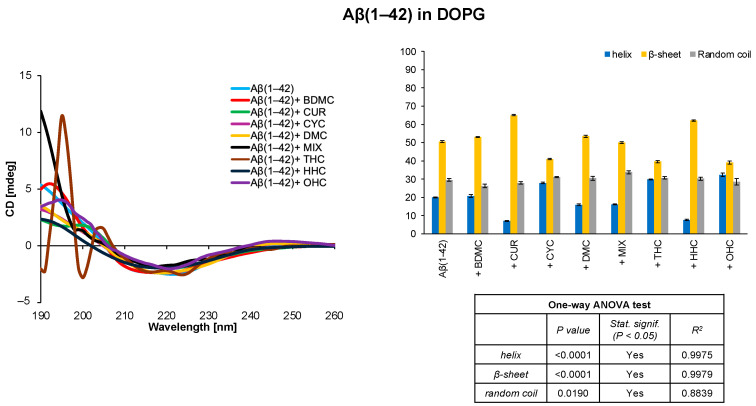
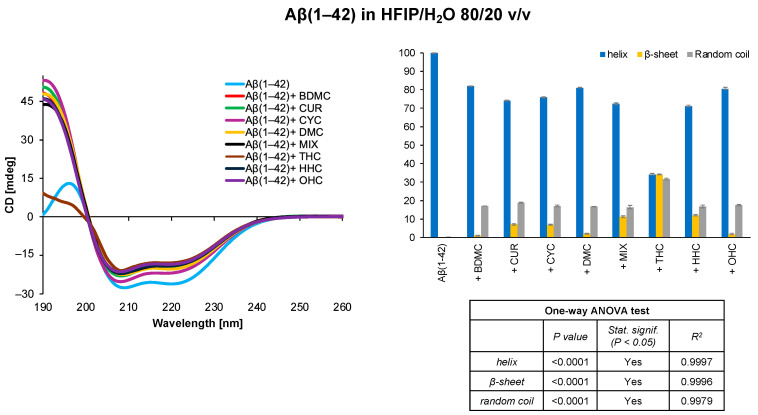
Investigating amyloid-β (Aβ) peptides in solution is essential during the initial stages of developing lead compounds that can influence Aβ fibrillation while the peptide is still in a soluble state. The tendency of the Aβ(1-42) peptide to misfold in solution, correlated to the aetiology of Alzheimer's disease (AD), is one of the main hindrances to characterising its aggregation kinetics in a cell-mimetic environment. Moreover, the Aβ(1-42) aggregation triggers the unfolded protein response (UPR) in the endoplasmic reticulum (ER), leading to cellular dysfunction and multiple cell death modalities, exacerbated by reactive oxygen species (ROS), which damage cellular components and trigger inflammation. Antioxidants like curcumin, a derivative of Curcuma longa, help mitigate ER stress by scavenging ROS and enhancing antioxidant enzymes. Furthermore, evidence in the literature highlights the effect of curcumin on the secondary structure of Aβ(1-42). This explorative study investigates the Aβ(1-42) peptide conformational behaviour in the presence of curcumin and six derivatives using circular dichroism (CD) to explore their interactions with lipid bilayers, potentially preventing aggregate formation. The results suggest that the synthetic tetrahydrocurcumin (THC) derivative interacts with the amyloid peptide in all the systems presented, while cyclocurcumin (CYC) and bisdemethoxycurcumin (BMDC) only interact when the peptide is in a less stable conformation. Molecular dynamics simulations helped visualise the curcuminoids' effect in an aqueous system and hypothesise the importance of the peptide surface exposition to the solvent, differently modulated by the curcumin derivatives.
AntioxidantsBiochemistry, Genetics and Molecular Biology-Physiology
CiteScore
10.60
自引率
11.40%
发文量
2123
审稿时长
16.3 days
期刊介绍:
Antioxidants (ISSN 2076-3921), provides an advanced forum for studies related to the science and technology of antioxidants. It publishes research papers, reviews and communications. Our aim is to encourage scientists to publish their experimental and theoretical results in as much detail as possible. There is no restriction on the length of the papers. The full experimental details must be provided so that the results can be reproduced. Electronic files and software regarding the full details of the calculation or experimental procedure, if unable to be published in a normal way, can be deposited as supplementary electronic material.





 京公网安备 11010802042870号
京ICP备2023020795号-1
京公网安备 11010802042870号
京ICP备2023020795号-1

 分享
分享
 求助内容:
求助内容: 应助结果提醒方式:
 扫码关注我们
