Yuanhong Liu, Min Xu, Liqing Wang, Linyun Meng, Mengran Li, Shumin Mu
{"title":"由HOMA-IR和HDL-C介导的非老年人内脏和皮下脂肪区域与表型年龄的关系","authors":"Yuanhong Liu, Min Xu, Liqing Wang, Linyun Meng, Mengran Li, Shumin Mu","doi":"10.1186/s12944-025-02446-4","DOIUrl":null,"url":null,"abstract":"<p><strong>Background: </strong>Ageing results in diminished adaptability, as well as declines in physiological and psychological functions and resilience. The epigenetic clock 'Phenotypic Age' (PhenoAge) represents 'preclinical ageing'. Phenotypic Age Acceleration (PhenoAgeAccel) is defined as the residual from a linear regression model predicting PhenoAge on the basis of chronological age. Abdominal subcutaneous adipose tissue, visceral adipose tissue, the Homeostasis Model Assessment of Insulin Resistance (HOMA-IR), and high-density lipoprotein cholesterol (HDL-C) have all been shown to correlate with ageing; however, the connections between these factors and PhenoAge are still insufficiently investigated.</p><p><strong>Methods: </strong>Data for this study were sourced from the National Health and Nutrition Examination Survey (2015-2018), comprising 2580 participants. Complex survey designs were considered. To examine the association between body fat area and PhenoAgeAccel, logistic regression was applied. Additionally, subgroup analysis was used to identify variations in population characteristics. The dose‒response relationship between body fat area and PhenoAgeAccel was determined via restricted cubic spline analysis. Mediation and interaction analyses were further employed to investigate the roles of the HOMA-IR and HDL-C in this association.</p><p><strong>Results: </strong>In nonelderly adults, the relationships between body fat area and PhenoAgeAccel differed chronological age. For abdominal subcutaneous fat area (SFA), this relationship was nonlinear in individuals aged 18-44 years and 45-59 years, with thresholds of 2.969 m² and 3.394 m², respectively. In contrast, a nonlinear relationship of visceral fat area (VFA) with PhenoAgeAccel was observed in individuals aged 18-44 years, while this relationship was linear in individuals aged 45-59 years, with thresholds of 0.769 m² and 1.220 m², respectively. Mediation effect analysis revealed that the HOMA-IR had a more pronounced mediation effect in individuals aged 18-44 years, accounting for 13.4% of the relationship between VFA and PhenoAgeAccel and 6.9% of the relationship between SFA and PhenoAgeAccel. Conversely, HDL-C had a greater mediating effect in individuals aged 45-59 years, accounting for 21.7% of the relationship between VFA and PhenoAgeAccel and 11.6% of the relationship between abdominal SFA and PhenoAgeAccel. HOMA-IR ≥ 2.73 or VFA > 0.925 m², as well as HOMA-IR ≥ 2.73 or abdominal SFA > 3.137 m², accelerated PhenoAge, whereas 1.60 < HDL-C ≤ 3.90 mmol/L combined with abdominal SFA ≤ 3.137 m² or VFA ≤ 0.925 m² decelerated PhenoAge.</p><p><strong>Conclusion: </strong>In this study, the nonlinear relationships among abdominal SFA, VFA, and PhenoAgeAccel were elucidated, while characteristic thresholds across different age groups were identified. The results of this study emphasize the complex influence of fat distribution on the ageing process and refine the roles of HOMA-IR and HDL-C in various age cohorts. These findings provide a biological basis for future screening for accelerated ageing and appropriate intervention in high-risk populations and offer valuable insights for guiding personalized clinical interventions and health management strategies.</p>","PeriodicalId":18073,"journal":{"name":"Lipids in Health and Disease","volume":"24 1","pages":"22"},"PeriodicalIF":6.9000,"publicationDate":"2025-01-24","publicationTypes":"Journal Article","fieldsOfStudy":null,"isOpenAccess":false,"openAccessPdf":"https://www.ncbi.nlm.nih.gov/pmc/articles/PMC11761183/pdf/","citationCount":"0","resultStr":"{\"title\":\"The association of visceral and subcutaneous fat areas with phenotypic age in non-elderly adults, mediated by HOMA-IR and HDL-C.\",\"authors\":\"Yuanhong Liu, Min Xu, Liqing Wang, Linyun Meng, Mengran Li, Shumin Mu\",\"doi\":\"10.1186/s12944-025-02446-4\",\"DOIUrl\":null,\"url\":null,\"abstract\":\"<p><strong>Background: </strong>Ageing results in diminished adaptability, as well as declines in physiological and psychological functions and resilience. The epigenetic clock 'Phenotypic Age' (PhenoAge) represents 'preclinical ageing'. Phenotypic Age Acceleration (PhenoAgeAccel) is defined as the residual from a linear regression model predicting PhenoAge on the basis of chronological age. Abdominal subcutaneous adipose tissue, visceral adipose tissue, the Homeostasis Model Assessment of Insulin Resistance (HOMA-IR), and high-density lipoprotein cholesterol (HDL-C) have all been shown to correlate with ageing; however, the connections between these factors and PhenoAge are still insufficiently investigated.</p><p><strong>Methods: </strong>Data for this study were sourced from the National Health and Nutrition Examination Survey (2015-2018), comprising 2580 participants. Complex survey designs were considered. To examine the association between body fat area and PhenoAgeAccel, logistic regression was applied. Additionally, subgroup analysis was used to identify variations in population characteristics. The dose‒response relationship between body fat area and PhenoAgeAccel was determined via restricted cubic spline analysis. Mediation and interaction analyses were further employed to investigate the roles of the HOMA-IR and HDL-C in this association.</p><p><strong>Results: </strong>In nonelderly adults, the relationships between body fat area and PhenoAgeAccel differed chronological age. For abdominal subcutaneous fat area (SFA), this relationship was nonlinear in individuals aged 18-44 years and 45-59 years, with thresholds of 2.969 m² and 3.394 m², respectively. In contrast, a nonlinear relationship of visceral fat area (VFA) with PhenoAgeAccel was observed in individuals aged 18-44 years, while this relationship was linear in individuals aged 45-59 years, with thresholds of 0.769 m² and 1.220 m², respectively. Mediation effect analysis revealed that the HOMA-IR had a more pronounced mediation effect in individuals aged 18-44 years, accounting for 13.4% of the relationship between VFA and PhenoAgeAccel and 6.9% of the relationship between SFA and PhenoAgeAccel. Conversely, HDL-C had a greater mediating effect in individuals aged 45-59 years, accounting for 21.7% of the relationship between VFA and PhenoAgeAccel and 11.6% of the relationship between abdominal SFA and PhenoAgeAccel. HOMA-IR ≥ 2.73 or VFA > 0.925 m², as well as HOMA-IR ≥ 2.73 or abdominal SFA > 3.137 m², accelerated PhenoAge, whereas 1.60 < HDL-C ≤ 3.90 mmol/L combined with abdominal SFA ≤ 3.137 m² or VFA ≤ 0.925 m² decelerated PhenoAge.</p><p><strong>Conclusion: </strong>In this study, the nonlinear relationships among abdominal SFA, VFA, and PhenoAgeAccel were elucidated, while characteristic thresholds across different age groups were identified. The results of this study emphasize the complex influence of fat distribution on the ageing process and refine the roles of HOMA-IR and HDL-C in various age cohorts. These findings provide a biological basis for future screening for accelerated ageing and appropriate intervention in high-risk populations and offer valuable insights for guiding personalized clinical interventions and health management strategies.</p>\",\"PeriodicalId\":18073,\"journal\":{\"name\":\"Lipids in Health and Disease\",\"volume\":\"24 1\",\"pages\":\"22\"},\"PeriodicalIF\":6.9000,\"publicationDate\":\"2025-01-24\",\"publicationTypes\":\"Journal Article\",\"fieldsOfStudy\":null,\"isOpenAccess\":false,\"openAccessPdf\":\"https://www.ncbi.nlm.nih.gov/pmc/articles/PMC11761183/pdf/\",\"citationCount\":\"0\",\"resultStr\":null,\"platform\":\"Semanticscholar\",\"paperid\":null,\"PeriodicalName\":\"Lipids in Health and Disease\",\"FirstCategoryId\":\"3\",\"ListUrlMain\":\"https://doi.org/10.1186/s12944-025-02446-4\",\"RegionNum\":2,\"RegionCategory\":\"医学\",\"ArticlePicture\":[],\"TitleCN\":null,\"AbstractTextCN\":null,\"PMCID\":null,\"EPubDate\":\"\",\"PubModel\":\"\",\"JCR\":\"Q2\",\"JCRName\":\"BIOCHEMISTRY & MOLECULAR BIOLOGY\",\"Score\":null,\"Total\":0}","platform":"Semanticscholar","paperid":null,"PeriodicalName":"Lipids in Health and Disease","FirstCategoryId":"3","ListUrlMain":"https://doi.org/10.1186/s12944-025-02446-4","RegionNum":2,"RegionCategory":"医学","ArticlePicture":[],"TitleCN":null,"AbstractTextCN":null,"PMCID":null,"EPubDate":"","PubModel":"","JCR":"Q2","JCRName":"BIOCHEMISTRY & MOLECULAR BIOLOGY","Score":null,"Total":0}
The association of visceral and subcutaneous fat areas with phenotypic age in non-elderly adults, mediated by HOMA-IR and HDL-C.
Background: Ageing results in diminished adaptability, as well as declines in physiological and psychological functions and resilience. The epigenetic clock 'Phenotypic Age' (PhenoAge) represents 'preclinical ageing'. Phenotypic Age Acceleration (PhenoAgeAccel) is defined as the residual from a linear regression model predicting PhenoAge on the basis of chronological age. Abdominal subcutaneous adipose tissue, visceral adipose tissue, the Homeostasis Model Assessment of Insulin Resistance (HOMA-IR), and high-density lipoprotein cholesterol (HDL-C) have all been shown to correlate with ageing; however, the connections between these factors and PhenoAge are still insufficiently investigated.
Methods: Data for this study were sourced from the National Health and Nutrition Examination Survey (2015-2018), comprising 2580 participants. Complex survey designs were considered. To examine the association between body fat area and PhenoAgeAccel, logistic regression was applied. Additionally, subgroup analysis was used to identify variations in population characteristics. The dose‒response relationship between body fat area and PhenoAgeAccel was determined via restricted cubic spline analysis. Mediation and interaction analyses were further employed to investigate the roles of the HOMA-IR and HDL-C in this association.
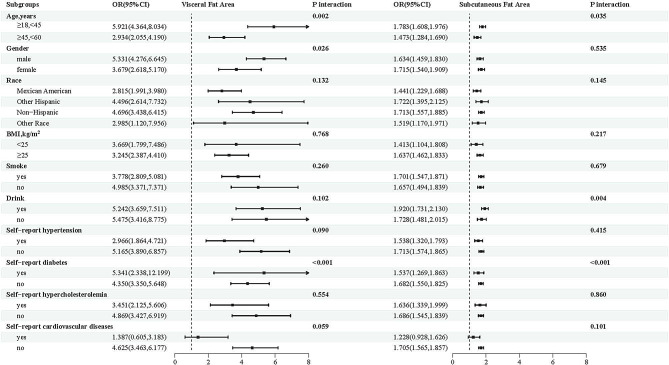
Results: In nonelderly adults, the relationships between body fat area and PhenoAgeAccel differed chronological age. For abdominal subcutaneous fat area (SFA), this relationship was nonlinear in individuals aged 18-44 years and 45-59 years, with thresholds of 2.969 m² and 3.394 m², respectively. In contrast, a nonlinear relationship of visceral fat area (VFA) with PhenoAgeAccel was observed in individuals aged 18-44 years, while this relationship was linear in individuals aged 45-59 years, with thresholds of 0.769 m² and 1.220 m², respectively. Mediation effect analysis revealed that the HOMA-IR had a more pronounced mediation effect in individuals aged 18-44 years, accounting for 13.4% of the relationship between VFA and PhenoAgeAccel and 6.9% of the relationship between SFA and PhenoAgeAccel. Conversely, HDL-C had a greater mediating effect in individuals aged 45-59 years, accounting for 21.7% of the relationship between VFA and PhenoAgeAccel and 11.6% of the relationship between abdominal SFA and PhenoAgeAccel. HOMA-IR ≥ 2.73 or VFA > 0.925 m², as well as HOMA-IR ≥ 2.73 or abdominal SFA > 3.137 m², accelerated PhenoAge, whereas 1.60 < HDL-C ≤ 3.90 mmol/L combined with abdominal SFA ≤ 3.137 m² or VFA ≤ 0.925 m² decelerated PhenoAge.
Conclusion: In this study, the nonlinear relationships among abdominal SFA, VFA, and PhenoAgeAccel were elucidated, while characteristic thresholds across different age groups were identified. The results of this study emphasize the complex influence of fat distribution on the ageing process and refine the roles of HOMA-IR and HDL-C in various age cohorts. These findings provide a biological basis for future screening for accelerated ageing and appropriate intervention in high-risk populations and offer valuable insights for guiding personalized clinical interventions and health management strategies.
期刊介绍:
Lipids in Health and Disease is an open access, peer-reviewed, journal that publishes articles on all aspects of lipids: their biochemistry, pharmacology, toxicology, role in health and disease, and the synthesis of new lipid compounds.
Lipids in Health and Disease is aimed at all scientists, health professionals and physicians interested in the area of lipids. Lipids are defined here in their broadest sense, to include: cholesterol, essential fatty acids, saturated fatty acids, phospholipids, inositol lipids, second messenger lipids, enzymes and synthetic machinery that is involved in the metabolism of various lipids in the cells and tissues, and also various aspects of lipid transport, etc. In addition, the journal also publishes research that investigates and defines the role of lipids in various physiological processes, pathology and disease. In particular, the journal aims to bridge the gap between the bench and the clinic by publishing articles that are particularly relevant to human diseases and the role of lipids in the management of various diseases.





 京公网安备 11010802042870号
京ICP备2023020795号-1
京公网安备 11010802042870号
京ICP备2023020795号-1

 分享
分享
 求助内容:
求助内容: 应助结果提醒方式:
 扫码关注我们
