Njood F AlAzzam, Salwa O Bajunaid, Bashayer H Baras, Heba A Mitwalli, Michael D Weir, Hockin H K Xu
{"title":"用二甲氨基十六烷基甲基丙烯酸酯和/或2-甲基丙烯酰氧乙基磷酸胆碱作为抗菌和蛋白驱避材料修饰的热聚合和3d打印义齿基托材料的微生物粘附和细胞毒性","authors":"Njood F AlAzzam, Salwa O Bajunaid, Bashayer H Baras, Heba A Mitwalli, Michael D Weir, Hockin H K Xu","doi":"10.3390/polym17020228","DOIUrl":null,"url":null,"abstract":"<p><strong>Background: </strong>Polymethyl methacrylate (PMMA) is ideal for denture bases but is prone to biofilm accumulation, leading to denture stomatitis (DS), often involving <i>Candida albicans</i>. Dimethylaminohexadecyl methacrylate (DMAHDM) and 2-methacryloyloxyethyl phosphorylcholine (MPC) are introduced into dental materials for their antimicrobial and protein-repellent properties. This study investigates the effects of incorporating dimethylaminohexadecyl methacrylate (DMAHDM) and 2-methacryloyloxyethyl phosphorylcholine (MPC) into heat-polymerized (HP) and 3D-printed (3DP) denture base resins on microbial adhesion and cytotoxicity.</p><p><strong>Methods: </strong>HP and 3DP denture base specimens were prepared using varying concentrations of DMAHDM and MPC. Microbial adhesion was quantified using CFU counts of <i>C. albicans</i>, and cytotoxicity was assessed via an MTT assay using fibroblast cells after 24 h, 3 days, and 7 days.</p><p><strong>Results: </strong>Both DMAHDM and MPC significantly reduced the CFU counts in both HP and 3DP materials; the combination of 1.5% DMAHDM and 3% MPC exhibited the most substantial antimicrobial effects. Cytotoxicity results varied between materials and time points; however, all treated groups maintained cell viability above the 70% threshold, indicating no significant cytotoxic effects.</p><p><strong>Conclusion: </strong>Incorporating DMAHDM and MPC into denture base resins can effectively reduce microbial adhesion while maintaining acceptable cytotoxicity levels.</p>","PeriodicalId":20416,"journal":{"name":"Polymers","volume":"17 2","pages":""},"PeriodicalIF":4.9000,"publicationDate":"2025-01-18","publicationTypes":"Journal Article","fieldsOfStudy":null,"isOpenAccess":false,"openAccessPdf":"https://www.ncbi.nlm.nih.gov/pmc/articles/PMC11768527/pdf/","citationCount":"0","resultStr":"{\"title\":\"Microbial Adhesion and Cytotoxicity of Heat-Polymerized and 3D-Printed Denture Base Materials when Modified with Dimethylaminohexadecyl Methacrylate and/or 2-Methacryloyloxyethyl Phosphorylcholine as Antimicrobial and Protein-Repellent Materials.\",\"authors\":\"Njood F AlAzzam, Salwa O Bajunaid, Bashayer H Baras, Heba A Mitwalli, Michael D Weir, Hockin H K Xu\",\"doi\":\"10.3390/polym17020228\",\"DOIUrl\":null,\"url\":null,\"abstract\":\"<p><strong>Background: </strong>Polymethyl methacrylate (PMMA) is ideal for denture bases but is prone to biofilm accumulation, leading to denture stomatitis (DS), often involving <i>Candida albicans</i>. Dimethylaminohexadecyl methacrylate (DMAHDM) and 2-methacryloyloxyethyl phosphorylcholine (MPC) are introduced into dental materials for their antimicrobial and protein-repellent properties. This study investigates the effects of incorporating dimethylaminohexadecyl methacrylate (DMAHDM) and 2-methacryloyloxyethyl phosphorylcholine (MPC) into heat-polymerized (HP) and 3D-printed (3DP) denture base resins on microbial adhesion and cytotoxicity.</p><p><strong>Methods: </strong>HP and 3DP denture base specimens were prepared using varying concentrations of DMAHDM and MPC. Microbial adhesion was quantified using CFU counts of <i>C. albicans</i>, and cytotoxicity was assessed via an MTT assay using fibroblast cells after 24 h, 3 days, and 7 days.</p><p><strong>Results: </strong>Both DMAHDM and MPC significantly reduced the CFU counts in both HP and 3DP materials; the combination of 1.5% DMAHDM and 3% MPC exhibited the most substantial antimicrobial effects. Cytotoxicity results varied between materials and time points; however, all treated groups maintained cell viability above the 70% threshold, indicating no significant cytotoxic effects.</p><p><strong>Conclusion: </strong>Incorporating DMAHDM and MPC into denture base resins can effectively reduce microbial adhesion while maintaining acceptable cytotoxicity levels.</p>\",\"PeriodicalId\":20416,\"journal\":{\"name\":\"Polymers\",\"volume\":\"17 2\",\"pages\":\"\"},\"PeriodicalIF\":4.9000,\"publicationDate\":\"2025-01-18\",\"publicationTypes\":\"Journal Article\",\"fieldsOfStudy\":null,\"isOpenAccess\":false,\"openAccessPdf\":\"https://www.ncbi.nlm.nih.gov/pmc/articles/PMC11768527/pdf/\",\"citationCount\":\"0\",\"resultStr\":null,\"platform\":\"Semanticscholar\",\"paperid\":null,\"PeriodicalName\":\"Polymers\",\"FirstCategoryId\":\"5\",\"ListUrlMain\":\"https://doi.org/10.3390/polym17020228\",\"RegionNum\":3,\"RegionCategory\":\"工程技术\",\"ArticlePicture\":[],\"TitleCN\":null,\"AbstractTextCN\":null,\"PMCID\":null,\"EPubDate\":\"\",\"PubModel\":\"\",\"JCR\":\"Q1\",\"JCRName\":\"POLYMER SCIENCE\",\"Score\":null,\"Total\":0}","platform":"Semanticscholar","paperid":null,"PeriodicalName":"Polymers","FirstCategoryId":"5","ListUrlMain":"https://doi.org/10.3390/polym17020228","RegionNum":3,"RegionCategory":"工程技术","ArticlePicture":[],"TitleCN":null,"AbstractTextCN":null,"PMCID":null,"EPubDate":"","PubModel":"","JCR":"Q1","JCRName":"POLYMER SCIENCE","Score":null,"Total":0}
Microbial Adhesion and Cytotoxicity of Heat-Polymerized and 3D-Printed Denture Base Materials when Modified with Dimethylaminohexadecyl Methacrylate and/or 2-Methacryloyloxyethyl Phosphorylcholine as Antimicrobial and Protein-Repellent Materials.
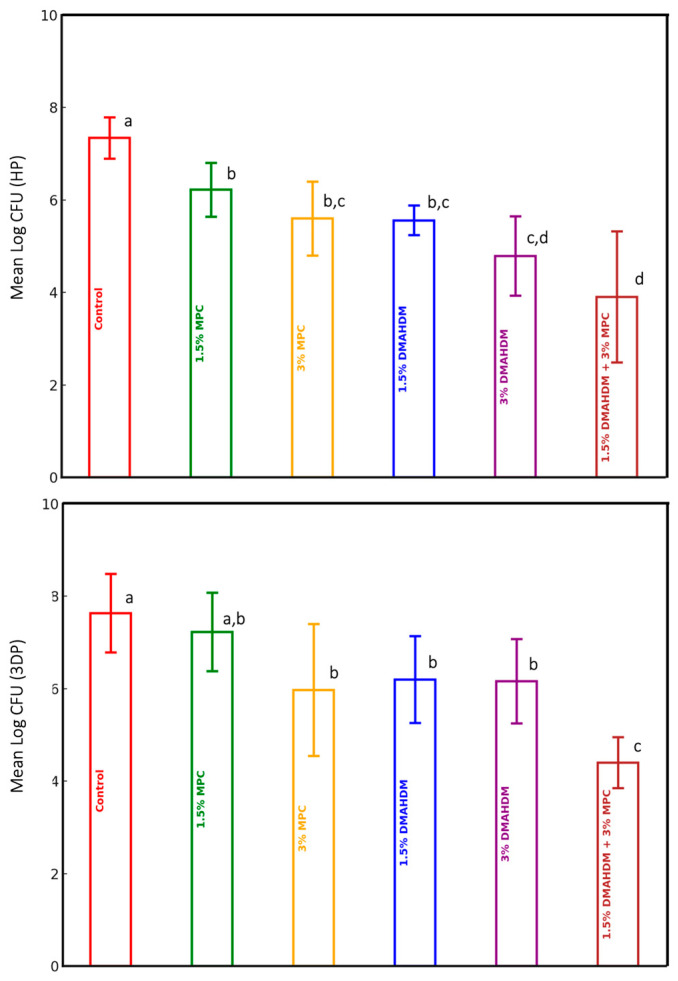
Background: Polymethyl methacrylate (PMMA) is ideal for denture bases but is prone to biofilm accumulation, leading to denture stomatitis (DS), often involving Candida albicans. Dimethylaminohexadecyl methacrylate (DMAHDM) and 2-methacryloyloxyethyl phosphorylcholine (MPC) are introduced into dental materials for their antimicrobial and protein-repellent properties. This study investigates the effects of incorporating dimethylaminohexadecyl methacrylate (DMAHDM) and 2-methacryloyloxyethyl phosphorylcholine (MPC) into heat-polymerized (HP) and 3D-printed (3DP) denture base resins on microbial adhesion and cytotoxicity.
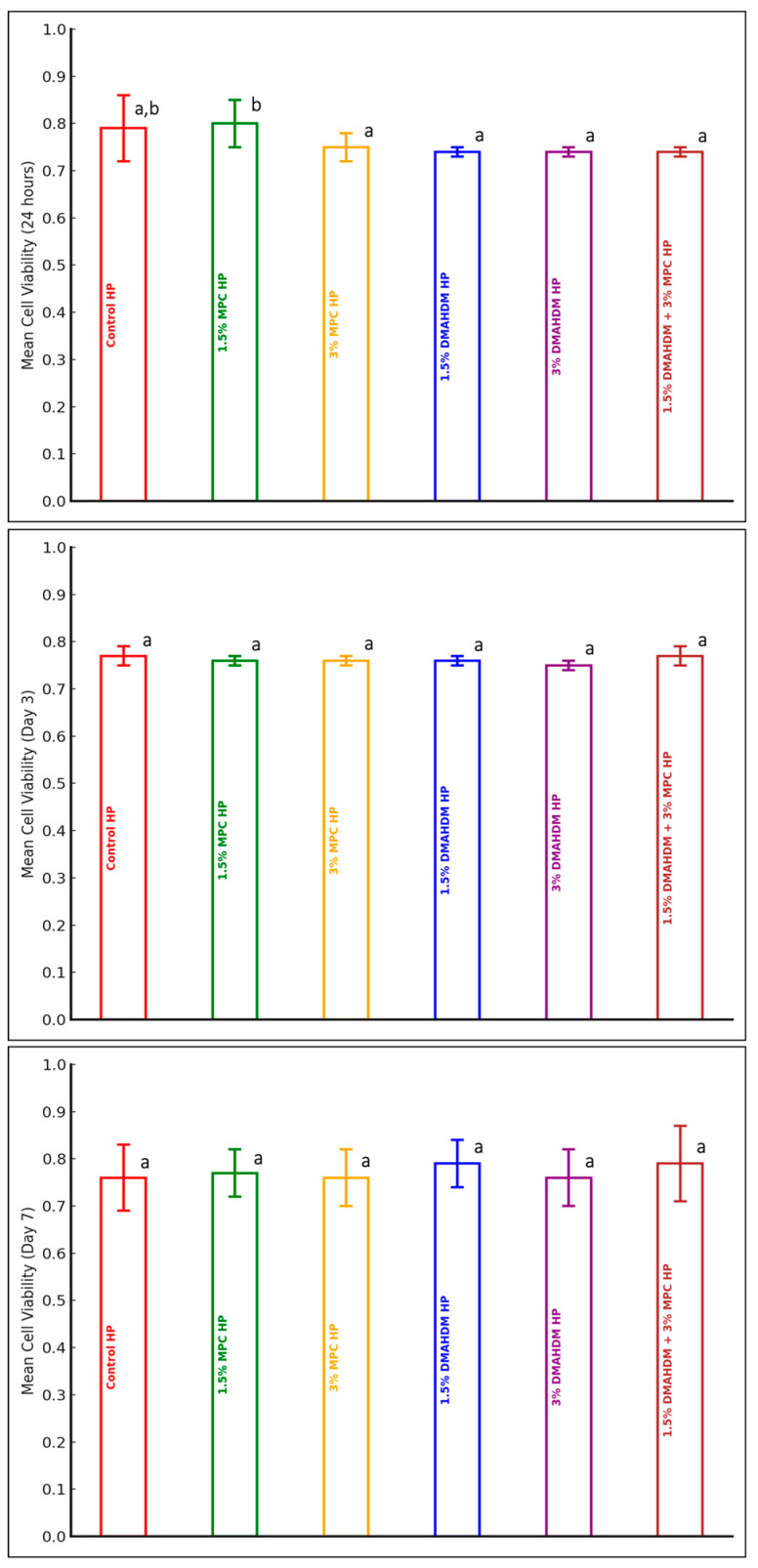
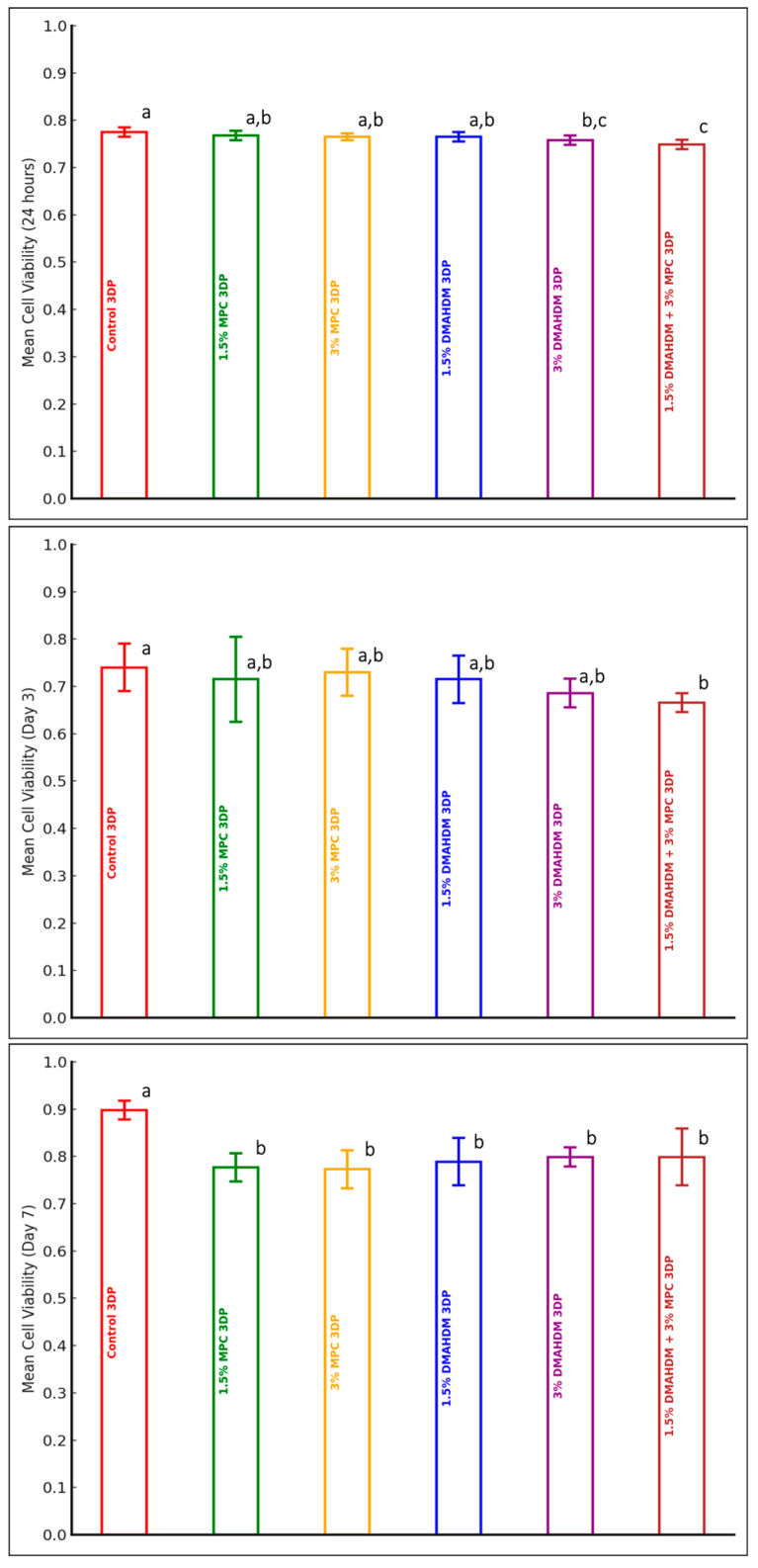
Methods: HP and 3DP denture base specimens were prepared using varying concentrations of DMAHDM and MPC. Microbial adhesion was quantified using CFU counts of C. albicans, and cytotoxicity was assessed via an MTT assay using fibroblast cells after 24 h, 3 days, and 7 days.
Results: Both DMAHDM and MPC significantly reduced the CFU counts in both HP and 3DP materials; the combination of 1.5% DMAHDM and 3% MPC exhibited the most substantial antimicrobial effects. Cytotoxicity results varied between materials and time points; however, all treated groups maintained cell viability above the 70% threshold, indicating no significant cytotoxic effects.
Conclusion: Incorporating DMAHDM and MPC into denture base resins can effectively reduce microbial adhesion while maintaining acceptable cytotoxicity levels.
期刊介绍:
Polymers (ISSN 2073-4360) is an international, open access journal of polymer science. It publishes research papers, short communications and review papers. Our aim is to encourage scientists to publish their experimental and theoretical results in as much detail as possible. Therefore, there is no restriction on the length of the papers. The full experimental details must be provided so that the results can be reproduced. Polymers provides an interdisciplinary forum for publishing papers which advance the fields of (i) polymerization methods, (ii) theory, simulation, and modeling, (iii) understanding of new physical phenomena, (iv) advances in characterization techniques, and (v) harnessing of self-assembly and biological strategies for producing complex multifunctional structures.




 京公网安备 11010802042870号
京ICP备2023020795号-1
京公网安备 11010802042870号
京ICP备2023020795号-1

 分享
分享
 求助内容:
求助内容: 应助结果提醒方式:
 扫码关注我们
