{"title":"儿科急诊科抗菌药物管理:一项观察性的前后研究","authors":"Erika Silvestro, Ilaria Mussinatto, Antonia Versace, Marco Denina, Giulia Pruccoli, Raffaella Marino, Giulia Mazzetti, Lorenzo Scaglione, Federico Vigna, Alessandra Macciotta, Silvia Garazzino, Claudia Bondone","doi":"10.3390/children12010046","DOIUrl":null,"url":null,"abstract":"<p><p><b>Background/Objectives</b>: To face antimicrobial resistance, antimicrobial stewardship programs (ASPs) have been implemented in the pediatric age, but the area of urgency remains understudied. We aimed to assess the impact of an educational program on optimizing antibiotic appropriateness in a pediatric ED. <b>Methods</b>: We conducted a pre-post observational study with an audit, intervention, and feedback given to prescribers. We recorded all systemic antibiotic prescriptions for children attending our pediatric ED from January to March and from July to September 2020. The study's team assigned a score to each prescription, regarding the appropriate molecule, dose, and duration of therapy, according to the diagnosis. From April to June 2020, we held weekly meetings focusing on different pediatric infectious diseases, with interaction between one to three ED physicians and the infectious disease (ID) specialist of the study's team. We then distributed synthetic digital guidelines adapted to our reality to all prescribers. <b>Results</b>: Optimal antibiotic prescriptions increased after the intervention, with statistical significance (<i>p</i> < 0.001) in four main aspects (overall adequacy: 13% PRE vs. 43% POST; need of antibiotics: 53% vs. 68%; adequacy of the spectrum: 55% vs. 63%; adequacy of the chosen molecule: 54% vs. 62%). We observed an improvement in all the main infectious diseases and concerns all the ED physicians. The prescription of first-choice drugs increased in specific and common illnesses such as otitis and pharyngotonsillitis. <b>Conclusions</b>: An antimicrobial stewardship program is a relevant method for improving the appropriateness of antimicrobial use also in the complex setting of a pediatric ED.</p>","PeriodicalId":48588,"journal":{"name":"Children-Basel","volume":"12 1","pages":""},"PeriodicalIF":2.6000,"publicationDate":"2024-12-30","publicationTypes":"Journal Article","fieldsOfStudy":null,"isOpenAccess":false,"openAccessPdf":"https://www.ncbi.nlm.nih.gov/pmc/articles/PMC11764019/pdf/","citationCount":"0","resultStr":"{\"title\":\"Antimicrobial Stewardship in the Pediatric Emergency Department: An Observational Pre-Post Study.\",\"authors\":\"Erika Silvestro, Ilaria Mussinatto, Antonia Versace, Marco Denina, Giulia Pruccoli, Raffaella Marino, Giulia Mazzetti, Lorenzo Scaglione, Federico Vigna, Alessandra Macciotta, Silvia Garazzino, Claudia Bondone\",\"doi\":\"10.3390/children12010046\",\"DOIUrl\":null,\"url\":null,\"abstract\":\"<p><p><b>Background/Objectives</b>: To face antimicrobial resistance, antimicrobial stewardship programs (ASPs) have been implemented in the pediatric age, but the area of urgency remains understudied. We aimed to assess the impact of an educational program on optimizing antibiotic appropriateness in a pediatric ED. <b>Methods</b>: We conducted a pre-post observational study with an audit, intervention, and feedback given to prescribers. We recorded all systemic antibiotic prescriptions for children attending our pediatric ED from January to March and from July to September 2020. The study's team assigned a score to each prescription, regarding the appropriate molecule, dose, and duration of therapy, according to the diagnosis. From April to June 2020, we held weekly meetings focusing on different pediatric infectious diseases, with interaction between one to three ED physicians and the infectious disease (ID) specialist of the study's team. We then distributed synthetic digital guidelines adapted to our reality to all prescribers. <b>Results</b>: Optimal antibiotic prescriptions increased after the intervention, with statistical significance (<i>p</i> < 0.001) in four main aspects (overall adequacy: 13% PRE vs. 43% POST; need of antibiotics: 53% vs. 68%; adequacy of the spectrum: 55% vs. 63%; adequacy of the chosen molecule: 54% vs. 62%). We observed an improvement in all the main infectious diseases and concerns all the ED physicians. The prescription of first-choice drugs increased in specific and common illnesses such as otitis and pharyngotonsillitis. <b>Conclusions</b>: An antimicrobial stewardship program is a relevant method for improving the appropriateness of antimicrobial use also in the complex setting of a pediatric ED.</p>\",\"PeriodicalId\":48588,\"journal\":{\"name\":\"Children-Basel\",\"volume\":\"12 1\",\"pages\":\"\"},\"PeriodicalIF\":2.6000,\"publicationDate\":\"2024-12-30\",\"publicationTypes\":\"Journal Article\",\"fieldsOfStudy\":null,\"isOpenAccess\":false,\"openAccessPdf\":\"https://www.ncbi.nlm.nih.gov/pmc/articles/PMC11764019/pdf/\",\"citationCount\":\"0\",\"resultStr\":null,\"platform\":\"Semanticscholar\",\"paperid\":null,\"PeriodicalName\":\"Children-Basel\",\"FirstCategoryId\":\"3\",\"ListUrlMain\":\"https://doi.org/10.3390/children12010046\",\"RegionNum\":4,\"RegionCategory\":\"医学\",\"ArticlePicture\":[],\"TitleCN\":null,\"AbstractTextCN\":null,\"PMCID\":null,\"EPubDate\":\"\",\"PubModel\":\"\",\"JCR\":\"Q2\",\"JCRName\":\"PEDIATRICS\",\"Score\":null,\"Total\":0}","platform":"Semanticscholar","paperid":null,"PeriodicalName":"Children-Basel","FirstCategoryId":"3","ListUrlMain":"https://doi.org/10.3390/children12010046","RegionNum":4,"RegionCategory":"医学","ArticlePicture":[],"TitleCN":null,"AbstractTextCN":null,"PMCID":null,"EPubDate":"","PubModel":"","JCR":"Q2","JCRName":"PEDIATRICS","Score":null,"Total":0}
引用次数: 0
摘要
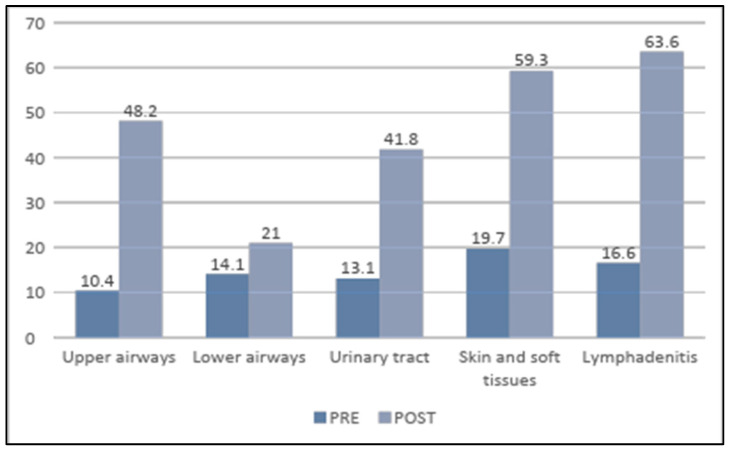
背景/目的:为了应对抗菌药物耐药性,抗菌药物管理计划(asp)已在儿科实施,但该领域的紧迫性仍未得到充分研究。我们的目的是评估教育项目对优化儿科急诊科抗生素适宜性的影响。方法:我们进行了一项前后观察性研究,对处方者进行了审计、干预和反馈。我们记录了2020年1月至3月和7月至9月在儿科急诊科就诊的儿童的所有系统性抗生素处方。该研究团队根据诊断,根据合适的分子、剂量和治疗持续时间,给每种处方打分。从2020年4月到6月,我们每周召开一次会议,重点关注不同的儿科传染病,由一到三名急诊科医生与研究团队的传染病(ID)专家进行互动。然后,我们将符合我们实际情况的合成数字指南分发给所有开处方的人。结果:干预后最佳抗生素处方增加,在四个主要方面(总体充分性:干预前13% vs干预后43%;抗生素需求:53%对68%;频谱充分性:55% vs. 63%;所选分子的充分性:54%对62%)。我们观察到所有主要传染病的改善,并关注所有急诊科医生。在特殊和常见疾病如中耳炎和咽扁桃体炎中,首选药物的处方增加。结论:抗菌药物管理计划是提高抗菌药物使用的适当性的相关方法,也适用于儿科急诊科的复杂环境。
Antimicrobial Stewardship in the Pediatric Emergency Department: An Observational Pre-Post Study.
Background/Objectives: To face antimicrobial resistance, antimicrobial stewardship programs (ASPs) have been implemented in the pediatric age, but the area of urgency remains understudied. We aimed to assess the impact of an educational program on optimizing antibiotic appropriateness in a pediatric ED. Methods: We conducted a pre-post observational study with an audit, intervention, and feedback given to prescribers. We recorded all systemic antibiotic prescriptions for children attending our pediatric ED from January to March and from July to September 2020. The study's team assigned a score to each prescription, regarding the appropriate molecule, dose, and duration of therapy, according to the diagnosis. From April to June 2020, we held weekly meetings focusing on different pediatric infectious diseases, with interaction between one to three ED physicians and the infectious disease (ID) specialist of the study's team. We then distributed synthetic digital guidelines adapted to our reality to all prescribers. Results: Optimal antibiotic prescriptions increased after the intervention, with statistical significance (p < 0.001) in four main aspects (overall adequacy: 13% PRE vs. 43% POST; need of antibiotics: 53% vs. 68%; adequacy of the spectrum: 55% vs. 63%; adequacy of the chosen molecule: 54% vs. 62%). We observed an improvement in all the main infectious diseases and concerns all the ED physicians. The prescription of first-choice drugs increased in specific and common illnesses such as otitis and pharyngotonsillitis. Conclusions: An antimicrobial stewardship program is a relevant method for improving the appropriateness of antimicrobial use also in the complex setting of a pediatric ED.
期刊介绍:
Children is an international, open access journal dedicated to a streamlined, yet scientifically rigorous, dissemination of peer-reviewed science related to childhood health and disease in developed and developing countries.
The publication focuses on sharing clinical, epidemiological and translational science relevant to children’s health. Moreover, the primary goals of the publication are to highlight under‑represented pediatric disciplines, to emphasize interdisciplinary research and to disseminate advances in knowledge in global child health. In addition to original research, the journal publishes expert editorials and commentaries, clinical case reports, and insightful communications reflecting the latest developments in pediatric medicine. By publishing meritorious articles as soon as the editorial review process is completed, rather than at predefined intervals, Children also permits rapid open access sharing of new information, allowing us to reach the broadest audience in the most expedient fashion.





 京公网安备 11010802042870号
京ICP备2023020795号-1
京公网安备 11010802042870号
京ICP备2023020795号-1

 分享
分享
 求助内容:
求助内容: 应助结果提醒方式:
 扫码关注我们
