Alexandra Bagaïni, Yunrui Liu, Madlaina Kapoor, Gayoung Son, Paul-Christian Bürkner, Loreen Tisdall, Rui Mata
{"title":"风险偏好措施的时间稳定性和收敛有效性的系统回顾和荟萃分析","authors":"Alexandra Bagaïni, Yunrui Liu, Madlaina Kapoor, Gayoung Son, Paul-Christian Bürkner, Loreen Tisdall, Rui Mata","doi":"10.1038/s41562-024-02085-2","DOIUrl":null,"url":null,"abstract":"Understanding whether risk preference represents a stable, coherent trait is central to efforts aimed at explaining, predicting and preventing risk-related behaviours. We help characterize the nature of the construct by adopting a systematic review and individual participant data meta-analytic approach to summarize the temporal stability of 358 risk preference measures (33 panels, 57 samples, 579,114 respondents). Our findings reveal noteworthy heterogeneity across and within measure categories (propensity, frequency and behaviour), domains (for example, investment, occupational and alcohol consumption) and sample characteristics (for example, age). Specifically, while self-reported propensity and frequency measures of risk preference show a higher degree of stability than behavioural measures, these patterns are moderated by domain and age. Crucially, an analysis of convergent validity reveals a low agreement across measures, questioning the idea that they capture the same underlying phenomena. Our results raise concerns about the coherence and measurement of the risk preference construct. Bagaïni et al. use an individual participant data meta-analytic approach to summarize the temporal stability of 358 risk preference measures, finding evidence of low agreement across measures.","PeriodicalId":19074,"journal":{"name":"Nature Human Behaviour","volume":"9 4","pages":"700-712"},"PeriodicalIF":15.9000,"publicationDate":"2025-01-27","publicationTypes":"Journal Article","fieldsOfStudy":null,"isOpenAccess":false,"openAccessPdf":"https://www.nature.comhttps://www.nature.com/articles/s41562-024-02085-2.pdf","citationCount":"0","resultStr":"{\"title\":\"A systematic review and meta-analyses of the temporal stability and convergent validity of risk preference measures\",\"authors\":\"Alexandra Bagaïni, Yunrui Liu, Madlaina Kapoor, Gayoung Son, Paul-Christian Bürkner, Loreen Tisdall, Rui Mata\",\"doi\":\"10.1038/s41562-024-02085-2\",\"DOIUrl\":null,\"url\":null,\"abstract\":\"Understanding whether risk preference represents a stable, coherent trait is central to efforts aimed at explaining, predicting and preventing risk-related behaviours. We help characterize the nature of the construct by adopting a systematic review and individual participant data meta-analytic approach to summarize the temporal stability of 358 risk preference measures (33 panels, 57 samples, 579,114 respondents). Our findings reveal noteworthy heterogeneity across and within measure categories (propensity, frequency and behaviour), domains (for example, investment, occupational and alcohol consumption) and sample characteristics (for example, age). Specifically, while self-reported propensity and frequency measures of risk preference show a higher degree of stability than behavioural measures, these patterns are moderated by domain and age. Crucially, an analysis of convergent validity reveals a low agreement across measures, questioning the idea that they capture the same underlying phenomena. Our results raise concerns about the coherence and measurement of the risk preference construct. Bagaïni et al. use an individual participant data meta-analytic approach to summarize the temporal stability of 358 risk preference measures, finding evidence of low agreement across measures.\",\"PeriodicalId\":19074,\"journal\":{\"name\":\"Nature Human Behaviour\",\"volume\":\"9 4\",\"pages\":\"700-712\"},\"PeriodicalIF\":15.9000,\"publicationDate\":\"2025-01-27\",\"publicationTypes\":\"Journal Article\",\"fieldsOfStudy\":null,\"isOpenAccess\":false,\"openAccessPdf\":\"https://www.nature.comhttps://www.nature.com/articles/s41562-024-02085-2.pdf\",\"citationCount\":\"0\",\"resultStr\":null,\"platform\":\"Semanticscholar\",\"paperid\":null,\"PeriodicalName\":\"Nature Human Behaviour\",\"FirstCategoryId\":\"102\",\"ListUrlMain\":\"https://www.nature.com/articles/s41562-024-02085-2\",\"RegionNum\":1,\"RegionCategory\":\"心理学\",\"ArticlePicture\":[],\"TitleCN\":null,\"AbstractTextCN\":null,\"PMCID\":null,\"EPubDate\":\"\",\"PubModel\":\"\",\"JCR\":\"Q1\",\"JCRName\":\"MULTIDISCIPLINARY SCIENCES\",\"Score\":null,\"Total\":0}","platform":"Semanticscholar","paperid":null,"PeriodicalName":"Nature Human Behaviour","FirstCategoryId":"102","ListUrlMain":"https://www.nature.com/articles/s41562-024-02085-2","RegionNum":1,"RegionCategory":"心理学","ArticlePicture":[],"TitleCN":null,"AbstractTextCN":null,"PMCID":null,"EPubDate":"","PubModel":"","JCR":"Q1","JCRName":"MULTIDISCIPLINARY SCIENCES","Score":null,"Total":0}
A systematic review and meta-analyses of the temporal stability and convergent validity of risk preference measures
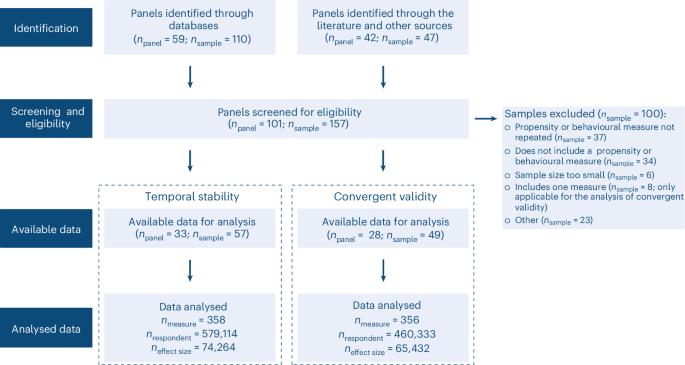
Understanding whether risk preference represents a stable, coherent trait is central to efforts aimed at explaining, predicting and preventing risk-related behaviours. We help characterize the nature of the construct by adopting a systematic review and individual participant data meta-analytic approach to summarize the temporal stability of 358 risk preference measures (33 panels, 57 samples, 579,114 respondents). Our findings reveal noteworthy heterogeneity across and within measure categories (propensity, frequency and behaviour), domains (for example, investment, occupational and alcohol consumption) and sample characteristics (for example, age). Specifically, while self-reported propensity and frequency measures of risk preference show a higher degree of stability than behavioural measures, these patterns are moderated by domain and age. Crucially, an analysis of convergent validity reveals a low agreement across measures, questioning the idea that they capture the same underlying phenomena. Our results raise concerns about the coherence and measurement of the risk preference construct. Bagaïni et al. use an individual participant data meta-analytic approach to summarize the temporal stability of 358 risk preference measures, finding evidence of low agreement across measures.
期刊介绍:
Nature Human Behaviour is a journal that focuses on publishing research of outstanding significance into any aspect of human behavior.The research can cover various areas such as psychological, biological, and social bases of human behavior.It also includes the study of origins, development, and disorders related to human behavior.The primary aim of the journal is to increase the visibility of research in the field and enhance its societal reach and impact.





 京公网安备 11010802042870号
京ICP备2023020795号-1
京公网安备 11010802042870号
京ICP备2023020795号-1

 分享
分享
 求助内容:
求助内容: 应助结果提醒方式:
 扫码关注我们
