Hang Yang, Wei-Jie Wang, Jun-Zhe Zhu, Li Ma, Damiano Pasini, Wei Zhai
{"title":"预应力细胞超材料中温度驱动的拓扑变换","authors":"Hang Yang, Wei-Jie Wang, Jun-Zhe Zhu, Li Ma, Damiano Pasini, Wei Zhai","doi":"10.1002/adfm.202413962","DOIUrl":null,"url":null,"abstract":"<p>Stimuli-responsive materials are able to alter their physicochemical properties, e.g., shape, color, or stiffness, upon exposure to an external trigger, e.g., heat, light, or humidity, exhibiting environmental adaptability. Their capacity to undergo shape reconfiguration, pattern transformation, and property modulation enables multifunctionality. In this work, two strategies are harnessed, i.e., prestressed assembly and temperature-dependent stiffness reversal, to introduce a class of temperature-responsive metamaterials capable of undergoing topological transformations, endowing them with smart functionality. Through a combination of mechanics theory, numerical simulations, and thermomechanical experiments, the physical mechanisms underlying the temperature-triggered topological transformations leading to pattern switches are first elucidated, and then the insights are leveraged to demonstrate tunable bandgaps and robotic capturers. These findings reveal the attainment of giant negative and positive values of coefficient of thermal expansion, accompanied by isotropic expansion and shrinkage under thermal actuation within a fairly rapid timeframe, below 6 s. The strategy here presented is versatile as it relies on a pair of off-the-shelf 3D printable materials, can be up- and down-scaled, and can also be realized through other physical stimuli, e.g., light and moisture, paving the way for use in multifunctional applications, including stimulus-triggered morphing devices, autonomous sensors and actuators, and reconfigurable soft robots.</p>","PeriodicalId":112,"journal":{"name":"Advanced Functional Materials","volume":"35 9","pages":""},"PeriodicalIF":19.0000,"publicationDate":"2025-01-26","publicationTypes":"Journal Article","fieldsOfStudy":null,"isOpenAccess":false,"openAccessPdf":"https://onlinelibrary.wiley.com/doi/epdf/10.1002/adfm.202413962","citationCount":"0","resultStr":"{\"title\":\"Temperature-Driven Topological Transformations in Prestressed Cellular Metamaterials\",\"authors\":\"Hang Yang, Wei-Jie Wang, Jun-Zhe Zhu, Li Ma, Damiano Pasini, Wei Zhai\",\"doi\":\"10.1002/adfm.202413962\",\"DOIUrl\":null,\"url\":null,\"abstract\":\"<p>Stimuli-responsive materials are able to alter their physicochemical properties, e.g., shape, color, or stiffness, upon exposure to an external trigger, e.g., heat, light, or humidity, exhibiting environmental adaptability. Their capacity to undergo shape reconfiguration, pattern transformation, and property modulation enables multifunctionality. In this work, two strategies are harnessed, i.e., prestressed assembly and temperature-dependent stiffness reversal, to introduce a class of temperature-responsive metamaterials capable of undergoing topological transformations, endowing them with smart functionality. Through a combination of mechanics theory, numerical simulations, and thermomechanical experiments, the physical mechanisms underlying the temperature-triggered topological transformations leading to pattern switches are first elucidated, and then the insights are leveraged to demonstrate tunable bandgaps and robotic capturers. These findings reveal the attainment of giant negative and positive values of coefficient of thermal expansion, accompanied by isotropic expansion and shrinkage under thermal actuation within a fairly rapid timeframe, below 6 s. The strategy here presented is versatile as it relies on a pair of off-the-shelf 3D printable materials, can be up- and down-scaled, and can also be realized through other physical stimuli, e.g., light and moisture, paving the way for use in multifunctional applications, including stimulus-triggered morphing devices, autonomous sensors and actuators, and reconfigurable soft robots.</p>\",\"PeriodicalId\":112,\"journal\":{\"name\":\"Advanced Functional Materials\",\"volume\":\"35 9\",\"pages\":\"\"},\"PeriodicalIF\":19.0000,\"publicationDate\":\"2025-01-26\",\"publicationTypes\":\"Journal Article\",\"fieldsOfStudy\":null,\"isOpenAccess\":false,\"openAccessPdf\":\"https://onlinelibrary.wiley.com/doi/epdf/10.1002/adfm.202413962\",\"citationCount\":\"0\",\"resultStr\":null,\"platform\":\"Semanticscholar\",\"paperid\":null,\"PeriodicalName\":\"Advanced Functional Materials\",\"FirstCategoryId\":\"88\",\"ListUrlMain\":\"https://advanced.onlinelibrary.wiley.com/doi/10.1002/adfm.202413962\",\"RegionNum\":1,\"RegionCategory\":\"材料科学\",\"ArticlePicture\":[],\"TitleCN\":null,\"AbstractTextCN\":null,\"PMCID\":null,\"EPubDate\":\"\",\"PubModel\":\"\",\"JCR\":\"Q1\",\"JCRName\":\"CHEMISTRY, MULTIDISCIPLINARY\",\"Score\":null,\"Total\":0}","platform":"Semanticscholar","paperid":null,"PeriodicalName":"Advanced Functional Materials","FirstCategoryId":"88","ListUrlMain":"https://advanced.onlinelibrary.wiley.com/doi/10.1002/adfm.202413962","RegionNum":1,"RegionCategory":"材料科学","ArticlePicture":[],"TitleCN":null,"AbstractTextCN":null,"PMCID":null,"EPubDate":"","PubModel":"","JCR":"Q1","JCRName":"CHEMISTRY, MULTIDISCIPLINARY","Score":null,"Total":0}
Temperature-Driven Topological Transformations in Prestressed Cellular Metamaterials
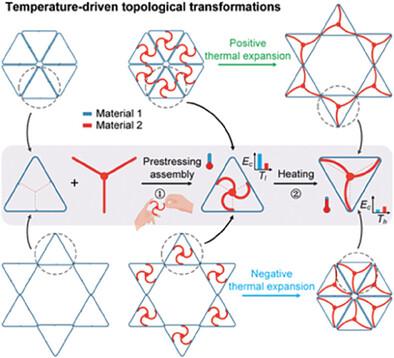
Stimuli-responsive materials are able to alter their physicochemical properties, e.g., shape, color, or stiffness, upon exposure to an external trigger, e.g., heat, light, or humidity, exhibiting environmental adaptability. Their capacity to undergo shape reconfiguration, pattern transformation, and property modulation enables multifunctionality. In this work, two strategies are harnessed, i.e., prestressed assembly and temperature-dependent stiffness reversal, to introduce a class of temperature-responsive metamaterials capable of undergoing topological transformations, endowing them with smart functionality. Through a combination of mechanics theory, numerical simulations, and thermomechanical experiments, the physical mechanisms underlying the temperature-triggered topological transformations leading to pattern switches are first elucidated, and then the insights are leveraged to demonstrate tunable bandgaps and robotic capturers. These findings reveal the attainment of giant negative and positive values of coefficient of thermal expansion, accompanied by isotropic expansion and shrinkage under thermal actuation within a fairly rapid timeframe, below 6 s. The strategy here presented is versatile as it relies on a pair of off-the-shelf 3D printable materials, can be up- and down-scaled, and can also be realized through other physical stimuli, e.g., light and moisture, paving the way for use in multifunctional applications, including stimulus-triggered morphing devices, autonomous sensors and actuators, and reconfigurable soft robots.
期刊介绍:
Firmly established as a top-tier materials science journal, Advanced Functional Materials reports breakthrough research in all aspects of materials science, including nanotechnology, chemistry, physics, and biology every week.
Advanced Functional Materials is known for its rapid and fair peer review, quality content, and high impact, making it the first choice of the international materials science community.









 京公网安备 11010802042870号
京ICP备2023020795号-1
京公网安备 11010802042870号
京ICP备2023020795号-1

 分享
分享
 求助内容:
求助内容: 应助结果提醒方式:
 扫码关注我们
