Hongyue Tian, Hang Zhou, Lu Zhang, Wenjing Xu, Ruifeng Gong, Yuheng Ni, Sang Young Jeong, Xixiang Zhu, Han Young Woo, Xiaoling Ma, Lifang Lu, Fujun Zhang
{"title":"通过改善激子解离和电荷输运,单层有机光伏电池的效率超过19.2%","authors":"Hongyue Tian, Hang Zhou, Lu Zhang, Wenjing Xu, Ruifeng Gong, Yuheng Ni, Sang Young Jeong, Xixiang Zhu, Han Young Woo, Xiaoling Ma, Lifang Lu, Fujun Zhang","doi":"10.1002/adfm.202422867","DOIUrl":null,"url":null,"abstract":"<p>Layer-by-layer (LbL) organic photovoltaics (OPVs) are fabricated with polymer PM1 as donor and small molecule L8-BO as acceptor by employing sequential spin-coating technology. The small molecule BTP-eC9 and polymer PTAA are deliberately selected for individually incorporating into PM1 layer and L8-BO layer, resulting in the power conversion efficiency (PCE) increased from 18.22% to 19.23%. The improvement of performance is attributed to the synergistically increased short circuit current density (<i>J<sub>SC</sub></i>) of 27.78 mA cm<sup>−2</sup> and fill factor (FF) of 78.23%. The introduction of BTP-eC9 into PM1 layer can promote the photogenerated exciton dissociation, especially for the excitons near the anode. Meanwhile, molecular crystallinity of PM1 is also enhanced by incorporating appropriate BTP-eC9 into PM1 layer. The incorporation of PTAA into L8-BO layer can provide hole transport channels to effectively improve the transport of holes generated by the self-dissociation of L8-BO, resulting in the enhanced FFs from 77.40% to 78.23%. The synergistic effects of BTP-eC9 and PTAA incorporation in donor and acceptor layers result in a 19.23% PCE of the optimized LbL-OPVs. This work demonstrates that there is great room to hierarchically optimize donor and acceptor layers for achieving highly efficient LbL-OPVs.</p>","PeriodicalId":112,"journal":{"name":"Advanced Functional Materials","volume":"35 23","pages":""},"PeriodicalIF":19.0000,"publicationDate":"2025-01-26","publicationTypes":"Journal Article","fieldsOfStudy":null,"isOpenAccess":false,"openAccessPdf":"","citationCount":"0","resultStr":"{\"title\":\"Over 19.2% Efficiency of Layer-By-Layer Organic Photovoltaics by Ameliorating Exciton Dissociation and Charge Transport\",\"authors\":\"Hongyue Tian, Hang Zhou, Lu Zhang, Wenjing Xu, Ruifeng Gong, Yuheng Ni, Sang Young Jeong, Xixiang Zhu, Han Young Woo, Xiaoling Ma, Lifang Lu, Fujun Zhang\",\"doi\":\"10.1002/adfm.202422867\",\"DOIUrl\":null,\"url\":null,\"abstract\":\"<p>Layer-by-layer (LbL) organic photovoltaics (OPVs) are fabricated with polymer PM1 as donor and small molecule L8-BO as acceptor by employing sequential spin-coating technology. The small molecule BTP-eC9 and polymer PTAA are deliberately selected for individually incorporating into PM1 layer and L8-BO layer, resulting in the power conversion efficiency (PCE) increased from 18.22% to 19.23%. The improvement of performance is attributed to the synergistically increased short circuit current density (<i>J<sub>SC</sub></i>) of 27.78 mA cm<sup>−2</sup> and fill factor (FF) of 78.23%. The introduction of BTP-eC9 into PM1 layer can promote the photogenerated exciton dissociation, especially for the excitons near the anode. Meanwhile, molecular crystallinity of PM1 is also enhanced by incorporating appropriate BTP-eC9 into PM1 layer. The incorporation of PTAA into L8-BO layer can provide hole transport channels to effectively improve the transport of holes generated by the self-dissociation of L8-BO, resulting in the enhanced FFs from 77.40% to 78.23%. The synergistic effects of BTP-eC9 and PTAA incorporation in donor and acceptor layers result in a 19.23% PCE of the optimized LbL-OPVs. This work demonstrates that there is great room to hierarchically optimize donor and acceptor layers for achieving highly efficient LbL-OPVs.</p>\",\"PeriodicalId\":112,\"journal\":{\"name\":\"Advanced Functional Materials\",\"volume\":\"35 23\",\"pages\":\"\"},\"PeriodicalIF\":19.0000,\"publicationDate\":\"2025-01-26\",\"publicationTypes\":\"Journal Article\",\"fieldsOfStudy\":null,\"isOpenAccess\":false,\"openAccessPdf\":\"\",\"citationCount\":\"0\",\"resultStr\":null,\"platform\":\"Semanticscholar\",\"paperid\":null,\"PeriodicalName\":\"Advanced Functional Materials\",\"FirstCategoryId\":\"88\",\"ListUrlMain\":\"https://advanced.onlinelibrary.wiley.com/doi/10.1002/adfm.202422867\",\"RegionNum\":1,\"RegionCategory\":\"材料科学\",\"ArticlePicture\":[],\"TitleCN\":null,\"AbstractTextCN\":null,\"PMCID\":null,\"EPubDate\":\"\",\"PubModel\":\"\",\"JCR\":\"Q1\",\"JCRName\":\"CHEMISTRY, MULTIDISCIPLINARY\",\"Score\":null,\"Total\":0}","platform":"Semanticscholar","paperid":null,"PeriodicalName":"Advanced Functional Materials","FirstCategoryId":"88","ListUrlMain":"https://advanced.onlinelibrary.wiley.com/doi/10.1002/adfm.202422867","RegionNum":1,"RegionCategory":"材料科学","ArticlePicture":[],"TitleCN":null,"AbstractTextCN":null,"PMCID":null,"EPubDate":"","PubModel":"","JCR":"Q1","JCRName":"CHEMISTRY, MULTIDISCIPLINARY","Score":null,"Total":0}
引用次数: 0
摘要
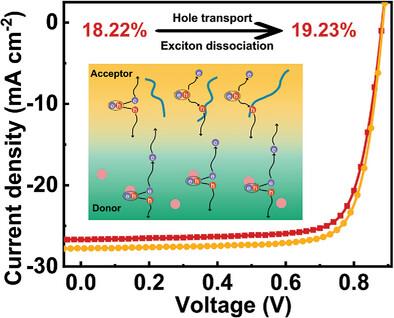
采用序旋涂技术,以聚合物PM1为给体,小分子L8-BO为受体制备了层接层有机光伏(opv)。有意选择小分子BTP-eC9和聚合物PTAA分别掺入PM1层和L8-BO层,使功率转换效率(PCE)由18.22%提高到19.23%。性能的提高是由于协同提高了27.78 mA cm−2的短路电流密度和78.23%的填充因子。在PM1层中引入BTP-eC9可以促进光生激子的解离,特别是在阳极附近的激子。同时,在PM1层中掺入合适的BTP-eC9也能提高PM1的分子结晶度。PTAA掺入L8-BO层可以提供空穴输运通道,有效提高L8-BO自解离产生的空穴输运,使FFs从77.40%提高到78.23%。BTP-eC9和PTAA掺入供体和受体层的协同效应使优化后的lbl - opv的PCE达到19.23%。这项工作表明,为了实现高效的lbl - opv,有很大的空间对供体和受体层进行分层优化。
Over 19.2% Efficiency of Layer-By-Layer Organic Photovoltaics by Ameliorating Exciton Dissociation and Charge Transport
Layer-by-layer (LbL) organic photovoltaics (OPVs) are fabricated with polymer PM1 as donor and small molecule L8-BO as acceptor by employing sequential spin-coating technology. The small molecule BTP-eC9 and polymer PTAA are deliberately selected for individually incorporating into PM1 layer and L8-BO layer, resulting in the power conversion efficiency (PCE) increased from 18.22% to 19.23%. The improvement of performance is attributed to the synergistically increased short circuit current density (JSC) of 27.78 mA cm−2 and fill factor (FF) of 78.23%. The introduction of BTP-eC9 into PM1 layer can promote the photogenerated exciton dissociation, especially for the excitons near the anode. Meanwhile, molecular crystallinity of PM1 is also enhanced by incorporating appropriate BTP-eC9 into PM1 layer. The incorporation of PTAA into L8-BO layer can provide hole transport channels to effectively improve the transport of holes generated by the self-dissociation of L8-BO, resulting in the enhanced FFs from 77.40% to 78.23%. The synergistic effects of BTP-eC9 and PTAA incorporation in donor and acceptor layers result in a 19.23% PCE of the optimized LbL-OPVs. This work demonstrates that there is great room to hierarchically optimize donor and acceptor layers for achieving highly efficient LbL-OPVs.
期刊介绍:
Firmly established as a top-tier materials science journal, Advanced Functional Materials reports breakthrough research in all aspects of materials science, including nanotechnology, chemistry, physics, and biology every week.
Advanced Functional Materials is known for its rapid and fair peer review, quality content, and high impact, making it the first choice of the international materials science community.







 京公网安备 11010802042870号
京ICP备2023020795号-1
京公网安备 11010802042870号
京ICP备2023020795号-1

 分享
分享
 求助内容:
求助内容: 应助结果提醒方式:
 扫码关注我们
