Mengkai Li , Yihao Zheng , Yanyan Huang , Jiaying Li , Zhe Sun , Ernest R. Blatchley III , Zhimin Qiang
{"title":"紫外反应器石英套上钙结垢的在线测量与模型预测","authors":"Mengkai Li , Yihao Zheng , Yanyan Huang , Jiaying Li , Zhe Sun , Ernest R. Blatchley III , Zhimin Qiang","doi":"10.1016/j.watres.2025.123203","DOIUrl":null,"url":null,"abstract":"<div><div>Quartz sleeve scaling significantly affects the efficacy of ultraviolet (UV) processes for water treatment. Investigating the scaling process and developing prediction methods are important for selecting and optimizing scaling control measures. However, these have been limited by the lack of an appropriate experimental system. Therefore, this study investigated the kinetics, mechanisms, and prediction methods of calcium scaling (a predominant scale compound encountered in drinking water treatment) on quartz sleeves. An on-line experimental system for sleeve scale UV transmittance (UVT<sub>SS</sub>) was developed based on previously developed micro-fluorescent silica detectors. The scaling process was accelerated by increases in [Ca<sup>2+</sup>] (100–400 mg L<sup>–1</sup>), alkalinity (100–400 mg L<sup>–1</sup>), and pH (6.5–8.5). Furthermore, water temperature (20.0–30.0 °C), sleeve temperature (24.9–31.7 °C), and flow velocity (2.5–10.0 cm s<sup>–1</sup>) exhibited diverse effects on calcium scaling. By delving into scaling mechanisms such as mass transfer, surface crystallization, and scale stripping processes, we proposed a prediction model. The extinction coefficient and stripping rate of calcium scale were estimated to be 0.80 μm<sup>–1</sup> and 0.155 h<sup>–1</sup>, respectively. Model predictions were validated through both laboratory and field tests. This study provides important methods for ensuring sufficient dose delivery by a UV reactor, enhancing energy efficiency, and improving reliability in UV processes for water treatment.</div></div>","PeriodicalId":443,"journal":{"name":"Water Research","volume":"275 ","pages":"Article 123203"},"PeriodicalIF":12.4000,"publicationDate":"2025-05-01","publicationTypes":"Journal Article","fieldsOfStudy":null,"isOpenAccess":false,"openAccessPdf":"","citationCount":"0","resultStr":"{\"title\":\"Calcium scaling on the quartz sleeve of ultraviolet reactor: On-line measurement and model prediction\",\"authors\":\"Mengkai Li , Yihao Zheng , Yanyan Huang , Jiaying Li , Zhe Sun , Ernest R. Blatchley III , Zhimin Qiang\",\"doi\":\"10.1016/j.watres.2025.123203\",\"DOIUrl\":null,\"url\":null,\"abstract\":\"<div><div>Quartz sleeve scaling significantly affects the efficacy of ultraviolet (UV) processes for water treatment. Investigating the scaling process and developing prediction methods are important for selecting and optimizing scaling control measures. However, these have been limited by the lack of an appropriate experimental system. Therefore, this study investigated the kinetics, mechanisms, and prediction methods of calcium scaling (a predominant scale compound encountered in drinking water treatment) on quartz sleeves. An on-line experimental system for sleeve scale UV transmittance (UVT<sub>SS</sub>) was developed based on previously developed micro-fluorescent silica detectors. The scaling process was accelerated by increases in [Ca<sup>2+</sup>] (100–400 mg L<sup>–1</sup>), alkalinity (100–400 mg L<sup>–1</sup>), and pH (6.5–8.5). Furthermore, water temperature (20.0–30.0 °C), sleeve temperature (24.9–31.7 °C), and flow velocity (2.5–10.0 cm s<sup>–1</sup>) exhibited diverse effects on calcium scaling. By delving into scaling mechanisms such as mass transfer, surface crystallization, and scale stripping processes, we proposed a prediction model. The extinction coefficient and stripping rate of calcium scale were estimated to be 0.80 μm<sup>–1</sup> and 0.155 h<sup>–1</sup>, respectively. Model predictions were validated through both laboratory and field tests. This study provides important methods for ensuring sufficient dose delivery by a UV reactor, enhancing energy efficiency, and improving reliability in UV processes for water treatment.</div></div>\",\"PeriodicalId\":443,\"journal\":{\"name\":\"Water Research\",\"volume\":\"275 \",\"pages\":\"Article 123203\"},\"PeriodicalIF\":12.4000,\"publicationDate\":\"2025-05-01\",\"publicationTypes\":\"Journal Article\",\"fieldsOfStudy\":null,\"isOpenAccess\":false,\"openAccessPdf\":\"\",\"citationCount\":\"0\",\"resultStr\":null,\"platform\":\"Semanticscholar\",\"paperid\":null,\"PeriodicalName\":\"Water Research\",\"FirstCategoryId\":\"93\",\"ListUrlMain\":\"https://www.sciencedirect.com/science/article/pii/S0043135425001174\",\"RegionNum\":1,\"RegionCategory\":\"环境科学与生态学\",\"ArticlePicture\":[],\"TitleCN\":null,\"AbstractTextCN\":null,\"PMCID\":null,\"EPubDate\":\"2025/1/26 0:00:00\",\"PubModel\":\"Epub\",\"JCR\":\"Q1\",\"JCRName\":\"ENGINEERING, ENVIRONMENTAL\",\"Score\":null,\"Total\":0}","platform":"Semanticscholar","paperid":null,"PeriodicalName":"Water Research","FirstCategoryId":"93","ListUrlMain":"https://www.sciencedirect.com/science/article/pii/S0043135425001174","RegionNum":1,"RegionCategory":"环境科学与生态学","ArticlePicture":[],"TitleCN":null,"AbstractTextCN":null,"PMCID":null,"EPubDate":"2025/1/26 0:00:00","PubModel":"Epub","JCR":"Q1","JCRName":"ENGINEERING, ENVIRONMENTAL","Score":null,"Total":0}
Calcium scaling on the quartz sleeve of ultraviolet reactor: On-line measurement and model prediction
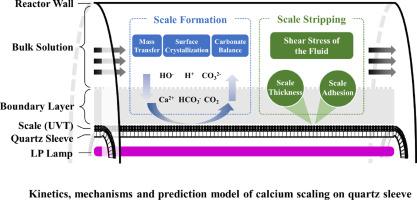
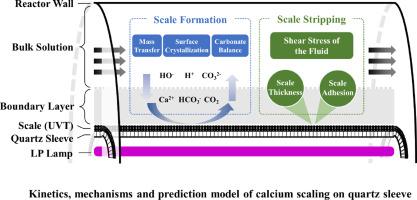
Quartz sleeve scaling significantly affects the efficacy of ultraviolet (UV) processes for water treatment. Investigating the scaling process and developing prediction methods are important for selecting and optimizing scaling control measures. However, these have been limited by the lack of an appropriate experimental system. Therefore, this study investigated the kinetics, mechanisms, and prediction methods of calcium scaling (a predominant scale compound encountered in drinking water treatment) on quartz sleeves. An on-line experimental system for sleeve scale UV transmittance (UVTSS) was developed based on previously developed micro-fluorescent silica detectors. The scaling process was accelerated by increases in [Ca2+] (100–400 mg L–1), alkalinity (100–400 mg L–1), and pH (6.5–8.5). Furthermore, water temperature (20.0–30.0 °C), sleeve temperature (24.9–31.7 °C), and flow velocity (2.5–10.0 cm s–1) exhibited diverse effects on calcium scaling. By delving into scaling mechanisms such as mass transfer, surface crystallization, and scale stripping processes, we proposed a prediction model. The extinction coefficient and stripping rate of calcium scale were estimated to be 0.80 μm–1 and 0.155 h–1, respectively. Model predictions were validated through both laboratory and field tests. This study provides important methods for ensuring sufficient dose delivery by a UV reactor, enhancing energy efficiency, and improving reliability in UV processes for water treatment.
期刊介绍:
Water Research, along with its open access companion journal Water Research X, serves as a platform for publishing original research papers covering various aspects of the science and technology related to the anthropogenic water cycle, water quality, and its management worldwide. The audience targeted by the journal comprises biologists, chemical engineers, chemists, civil engineers, environmental engineers, limnologists, and microbiologists. The scope of the journal include:
•Treatment processes for water and wastewaters (municipal, agricultural, industrial, and on-site treatment), including resource recovery and residuals management;
•Urban hydrology including sewer systems, stormwater management, and green infrastructure;
•Drinking water treatment and distribution;
•Potable and non-potable water reuse;
•Sanitation, public health, and risk assessment;
•Anaerobic digestion, solid and hazardous waste management, including source characterization and the effects and control of leachates and gaseous emissions;
•Contaminants (chemical, microbial, anthropogenic particles such as nanoparticles or microplastics) and related water quality sensing, monitoring, fate, and assessment;
•Anthropogenic impacts on inland, tidal, coastal and urban waters, focusing on surface and ground waters, and point and non-point sources of pollution;
•Environmental restoration, linked to surface water, groundwater and groundwater remediation;
•Analysis of the interfaces between sediments and water, and between water and atmosphere, focusing specifically on anthropogenic impacts;
•Mathematical modelling, systems analysis, machine learning, and beneficial use of big data related to the anthropogenic water cycle;
•Socio-economic, policy, and regulations studies.




 京公网安备 11010802042870号
京ICP备2023020795号-1
京公网安备 11010802042870号
京ICP备2023020795号-1

 分享
分享
 求助内容:
求助内容: 应助结果提醒方式:
 扫码关注我们
