Chengyu Lv, Song Wang, Chang Sun, Jing Liu, Yihao Chen, Chao Wang, Cuiping Yuan, Fengxian Qin, Tiezhu Li
{"title":"补骨脂素和异补骨脂素通过与kelch样ech相关蛋白1相互作用激活核因子红系2相关因子2。","authors":"Chengyu Lv, Song Wang, Chang Sun, Jing Liu, Yihao Chen, Chao Wang, Cuiping Yuan, Fengxian Qin, Tiezhu Li","doi":"10.1002/fsn3.4768","DOIUrl":null,"url":null,"abstract":"<p>As natural furocoumarins, psoralen and its isomer isopsoralen are widely distributed in various fruits including <i>Ficus carica</i> L., vegetables including celery, and medicinal herbs including <i>Psoralea corylifolia</i> L. Although psoralen and isopsoralen have been used as dietary supplements because of their bioactivities such as antibacterial and anti-inflammatory properties; however, the potential mechanisms underlying the antioxidant activities of these two furocoumarins still need to be explored. Hence, the aims of this work were to examine the activation of nuclear factor erythroid 2-related factor 2 (Nrf2) by psoralen and isopsoralen, as well as the binding interaction of Kelch-like ECH-associated protein 1 (Keap1) with these two furocoumarins. Interestingly, both psoralen and isopsoralen induced Nrf2 nuclear translocation in a dose-dependent manner in HEK293T cells. These two furanocoumarins also activated antioxidant response element (ARE)-driven luciferase activity. The mRNA expression of GCLM, HO-1, and NQO1 genes was significantly upregulated by treatment of HEK293T cells with psoralen and isopsoralen, respectively. Similarly, the expression of proteins can be promoted. Both psoralen and isopsoralen were located in the top of the central pocket of the Keap1 Kelch domain, suggesting that they were natural ligands of Keap1. In conclusion, both psoralen and isopsoralen activate Nrf2 through interaction with Keap1, thereby serving as natural antioxidants.</p>","PeriodicalId":12418,"journal":{"name":"Food Science & Nutrition","volume":"13 1","pages":""},"PeriodicalIF":3.8000,"publicationDate":"2025-01-24","publicationTypes":"Journal Article","fieldsOfStudy":null,"isOpenAccess":false,"openAccessPdf":"https://www.ncbi.nlm.nih.gov/pmc/articles/PMC11761412/pdf/","citationCount":"0","resultStr":"{\"title\":\"Psoralen and Isopsoralen Activate Nuclear Factor Erythroid 2-Related Factor 2 Through Interaction With Kelch-Like ECH-Associated Protein 1\",\"authors\":\"Chengyu Lv, Song Wang, Chang Sun, Jing Liu, Yihao Chen, Chao Wang, Cuiping Yuan, Fengxian Qin, Tiezhu Li\",\"doi\":\"10.1002/fsn3.4768\",\"DOIUrl\":null,\"url\":null,\"abstract\":\"<p>As natural furocoumarins, psoralen and its isomer isopsoralen are widely distributed in various fruits including <i>Ficus carica</i> L., vegetables including celery, and medicinal herbs including <i>Psoralea corylifolia</i> L. Although psoralen and isopsoralen have been used as dietary supplements because of their bioactivities such as antibacterial and anti-inflammatory properties; however, the potential mechanisms underlying the antioxidant activities of these two furocoumarins still need to be explored. Hence, the aims of this work were to examine the activation of nuclear factor erythroid 2-related factor 2 (Nrf2) by psoralen and isopsoralen, as well as the binding interaction of Kelch-like ECH-associated protein 1 (Keap1) with these two furocoumarins. Interestingly, both psoralen and isopsoralen induced Nrf2 nuclear translocation in a dose-dependent manner in HEK293T cells. These two furanocoumarins also activated antioxidant response element (ARE)-driven luciferase activity. The mRNA expression of GCLM, HO-1, and NQO1 genes was significantly upregulated by treatment of HEK293T cells with psoralen and isopsoralen, respectively. Similarly, the expression of proteins can be promoted. Both psoralen and isopsoralen were located in the top of the central pocket of the Keap1 Kelch domain, suggesting that they were natural ligands of Keap1. In conclusion, both psoralen and isopsoralen activate Nrf2 through interaction with Keap1, thereby serving as natural antioxidants.</p>\",\"PeriodicalId\":12418,\"journal\":{\"name\":\"Food Science & Nutrition\",\"volume\":\"13 1\",\"pages\":\"\"},\"PeriodicalIF\":3.8000,\"publicationDate\":\"2025-01-24\",\"publicationTypes\":\"Journal Article\",\"fieldsOfStudy\":null,\"isOpenAccess\":false,\"openAccessPdf\":\"https://www.ncbi.nlm.nih.gov/pmc/articles/PMC11761412/pdf/\",\"citationCount\":\"0\",\"resultStr\":null,\"platform\":\"Semanticscholar\",\"paperid\":null,\"PeriodicalName\":\"Food Science & Nutrition\",\"FirstCategoryId\":\"97\",\"ListUrlMain\":\"https://onlinelibrary.wiley.com/doi/10.1002/fsn3.4768\",\"RegionNum\":2,\"RegionCategory\":\"农林科学\",\"ArticlePicture\":[],\"TitleCN\":null,\"AbstractTextCN\":null,\"PMCID\":null,\"EPubDate\":\"\",\"PubModel\":\"\",\"JCR\":\"Q2\",\"JCRName\":\"FOOD SCIENCE & TECHNOLOGY\",\"Score\":null,\"Total\":0}","platform":"Semanticscholar","paperid":null,"PeriodicalName":"Food Science & Nutrition","FirstCategoryId":"97","ListUrlMain":"https://onlinelibrary.wiley.com/doi/10.1002/fsn3.4768","RegionNum":2,"RegionCategory":"农林科学","ArticlePicture":[],"TitleCN":null,"AbstractTextCN":null,"PMCID":null,"EPubDate":"","PubModel":"","JCR":"Q2","JCRName":"FOOD SCIENCE & TECHNOLOGY","Score":null,"Total":0}
Psoralen and Isopsoralen Activate Nuclear Factor Erythroid 2-Related Factor 2 Through Interaction With Kelch-Like ECH-Associated Protein 1
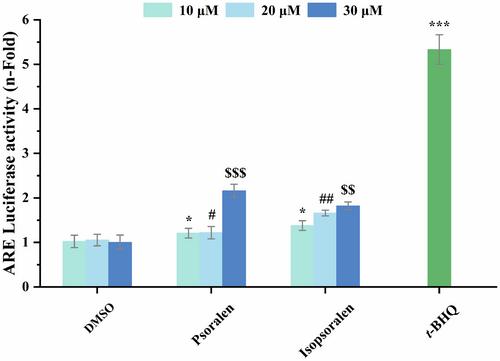
As natural furocoumarins, psoralen and its isomer isopsoralen are widely distributed in various fruits including Ficus carica L., vegetables including celery, and medicinal herbs including Psoralea corylifolia L. Although psoralen and isopsoralen have been used as dietary supplements because of their bioactivities such as antibacterial and anti-inflammatory properties; however, the potential mechanisms underlying the antioxidant activities of these two furocoumarins still need to be explored. Hence, the aims of this work were to examine the activation of nuclear factor erythroid 2-related factor 2 (Nrf2) by psoralen and isopsoralen, as well as the binding interaction of Kelch-like ECH-associated protein 1 (Keap1) with these two furocoumarins. Interestingly, both psoralen and isopsoralen induced Nrf2 nuclear translocation in a dose-dependent manner in HEK293T cells. These two furanocoumarins also activated antioxidant response element (ARE)-driven luciferase activity. The mRNA expression of GCLM, HO-1, and NQO1 genes was significantly upregulated by treatment of HEK293T cells with psoralen and isopsoralen, respectively. Similarly, the expression of proteins can be promoted. Both psoralen and isopsoralen were located in the top of the central pocket of the Keap1 Kelch domain, suggesting that they were natural ligands of Keap1. In conclusion, both psoralen and isopsoralen activate Nrf2 through interaction with Keap1, thereby serving as natural antioxidants.
期刊介绍:
Food Science & Nutrition is the peer-reviewed journal for rapid dissemination of research in all areas of food science and nutrition. The Journal will consider submissions of quality papers describing the results of fundamental and applied research related to all aspects of human food and nutrition, as well as interdisciplinary research that spans these two fields.




 京公网安备 11010802042870号
京ICP备2023020795号-1
京公网安备 11010802042870号
京ICP备2023020795号-1

 分享
分享
 求助内容:
求助内容: 应助结果提醒方式:
 扫码关注我们
