Ahmad Nazzal, Josef Yayan, Christian Biancosino, Seyed Vahid Tabatabaei, Khosro Hekmat
{"title":"辅助化疗和放疗治疗胸腺癌II期的有效性:系统回顾和荟萃分析。","authors":"Ahmad Nazzal, Josef Yayan, Christian Biancosino, Seyed Vahid Tabatabaei, Khosro Hekmat","doi":"10.1177/10732748241292781","DOIUrl":null,"url":null,"abstract":"<p><strong>Background: </strong>Thymic carcinoma is a rare tumor arising from the epithelial thymic tissue, yet among mediastinal tumors, it is the most common malignant entity. Thymic carcinoma often causes no symptoms and is incidentally discovered. Adjuvant radiotherapy is recommended, particularly in cases of incomplete resection and for stages III and IV, based on current guidelines and existing literature. In stage II (Masaoka-Koga system), the role of chemotherapy remains controversial, particularly in cases of incomplete resection. Therefore, this study aims to assess the effectiveness of adjuvant chemotherapy compared to adjuvant radiotherapy in the treatment of stage II (Masaoka-Koga system) thymic carcinoma after surgery.</p><p><strong>Methods: </strong>A comprehensive literature search was conducted in the Embase, Cochrane Central Register of Controlled Trials (CENTRAL), and MEDLINE/PubMed databases for relevant studies published through April 30<sup>th</sup>, 2023.</p><p><strong>Results: </strong>The review identified a total of 101 studies in the Embase, Cochrane Library, and MEDLINE/PubMed databases. Of these, only eight retrospective studies met the inclusion criteria and were included in the meta-analysis. These eight studies encompassed a total of 323 patients with stage II (Masaoka-Koga system) thymic carcinoma, with an average patient age of 53.8 ± 5.0 years. There was no significant difference in the number of R0 resections between patients receiving adjuvant chemotherapy and those receiving adjuvant radiotherapy (<i>P</i> = 0.82). Patients who received adjuvant radiotherapy had a higher rate of recurrence, but this difference was not statistically significant (<i>P</i> = 0.93). The meta-analysis synthesized five-year overall survival data, with a combined hazard ratio (HR) of 0.881 (95% CI: 0.463 to 1.299), indicating no statistically significant difference between the treatment groups.</p><p><strong>Conclusions: </strong>Although the results were not statistically significant, the findings suggest that adjuvant chemotherapy might be associated with a more favorable outcome for patients with stage II (Masaoka-Koga system) thymic carcinoma compared to adjuvant radiotherapy.</p>","PeriodicalId":49093,"journal":{"name":"Cancer Control","volume":"31 ","pages":"10732748241292781"},"PeriodicalIF":3.1000,"publicationDate":"2024-01-01","publicationTypes":"Journal Article","fieldsOfStudy":null,"isOpenAccess":false,"openAccessPdf":"https://www.ncbi.nlm.nih.gov/pmc/articles/PMC11503756/pdf/","citationCount":"0","resultStr":"{\"title\":\"Effectiveness of Adjuvant Chemo- and Radiotherapy in Thymic Carcinoma Stage II: A Systematic Review and Meta-Analysis.\",\"authors\":\"Ahmad Nazzal, Josef Yayan, Christian Biancosino, Seyed Vahid Tabatabaei, Khosro Hekmat\",\"doi\":\"10.1177/10732748241292781\",\"DOIUrl\":null,\"url\":null,\"abstract\":\"<p><strong>Background: </strong>Thymic carcinoma is a rare tumor arising from the epithelial thymic tissue, yet among mediastinal tumors, it is the most common malignant entity. Thymic carcinoma often causes no symptoms and is incidentally discovered. Adjuvant radiotherapy is recommended, particularly in cases of incomplete resection and for stages III and IV, based on current guidelines and existing literature. In stage II (Masaoka-Koga system), the role of chemotherapy remains controversial, particularly in cases of incomplete resection. Therefore, this study aims to assess the effectiveness of adjuvant chemotherapy compared to adjuvant radiotherapy in the treatment of stage II (Masaoka-Koga system) thymic carcinoma after surgery.</p><p><strong>Methods: </strong>A comprehensive literature search was conducted in the Embase, Cochrane Central Register of Controlled Trials (CENTRAL), and MEDLINE/PubMed databases for relevant studies published through April 30<sup>th</sup>, 2023.</p><p><strong>Results: </strong>The review identified a total of 101 studies in the Embase, Cochrane Library, and MEDLINE/PubMed databases. Of these, only eight retrospective studies met the inclusion criteria and were included in the meta-analysis. These eight studies encompassed a total of 323 patients with stage II (Masaoka-Koga system) thymic carcinoma, with an average patient age of 53.8 ± 5.0 years. There was no significant difference in the number of R0 resections between patients receiving adjuvant chemotherapy and those receiving adjuvant radiotherapy (<i>P</i> = 0.82). Patients who received adjuvant radiotherapy had a higher rate of recurrence, but this difference was not statistically significant (<i>P</i> = 0.93). The meta-analysis synthesized five-year overall survival data, with a combined hazard ratio (HR) of 0.881 (95% CI: 0.463 to 1.299), indicating no statistically significant difference between the treatment groups.</p><p><strong>Conclusions: </strong>Although the results were not statistically significant, the findings suggest that adjuvant chemotherapy might be associated with a more favorable outcome for patients with stage II (Masaoka-Koga system) thymic carcinoma compared to adjuvant radiotherapy.</p>\",\"PeriodicalId\":49093,\"journal\":{\"name\":\"Cancer Control\",\"volume\":\"31 \",\"pages\":\"10732748241292781\"},\"PeriodicalIF\":3.1000,\"publicationDate\":\"2024-01-01\",\"publicationTypes\":\"Journal Article\",\"fieldsOfStudy\":null,\"isOpenAccess\":false,\"openAccessPdf\":\"https://www.ncbi.nlm.nih.gov/pmc/articles/PMC11503756/pdf/\",\"citationCount\":\"0\",\"resultStr\":null,\"platform\":\"Semanticscholar\",\"paperid\":null,\"PeriodicalName\":\"Cancer Control\",\"FirstCategoryId\":\"3\",\"ListUrlMain\":\"https://doi.org/10.1177/10732748241292781\",\"RegionNum\":4,\"RegionCategory\":\"医学\",\"ArticlePicture\":[],\"TitleCN\":null,\"AbstractTextCN\":null,\"PMCID\":null,\"EPubDate\":\"\",\"PubModel\":\"\",\"JCR\":\"Q3\",\"JCRName\":\"ONCOLOGY\",\"Score\":null,\"Total\":0}","platform":"Semanticscholar","paperid":null,"PeriodicalName":"Cancer Control","FirstCategoryId":"3","ListUrlMain":"https://doi.org/10.1177/10732748241292781","RegionNum":4,"RegionCategory":"医学","ArticlePicture":[],"TitleCN":null,"AbstractTextCN":null,"PMCID":null,"EPubDate":"","PubModel":"","JCR":"Q3","JCRName":"ONCOLOGY","Score":null,"Total":0}
引用次数: 0
摘要
背景:胸腺癌是一种罕见的发生在胸腺上皮组织的肿瘤,但在纵隔肿瘤中,它是最常见的恶性肿瘤。胸腺癌通常没有症状,是偶然发现的。根据目前的指南和现有文献,建议辅助放疗,特别是在不完全切除的病例和III期和IV期。在II期(Masaoka-Koga系统),化疗的作用仍然存在争议,特别是在不完全切除的情况下。因此,本研究旨在评估辅助化疗与辅助放疗在II期(Masaoka-Koga系统)胸腺癌术后治疗中的有效性。方法:在Embase、Cochrane Central Register of Controlled Trials (Central)和MEDLINE/PubMed数据库中检索截至2023年4月30日发表的相关研究。结果:本综述在Embase、Cochrane图书馆和MEDLINE/PubMed数据库中共鉴定了101项研究。其中,只有8项回顾性研究符合纳入标准并被纳入meta分析。这8项研究共纳入323例II期(Masaoka-Koga系统)胸腺癌患者,患者平均年龄为53.8±5.0岁。辅助化疗组与辅助放疗组R0切除数比较,差异无统计学意义(P = 0.82)。接受辅助放疗的患者复发率较高,但差异无统计学意义(P = 0.93)。meta分析综合5年总生存数据,合并风险比(HR)为0.881 (95% CI: 0.463 ~ 1.299),两组间无统计学差异。结论:虽然结果没有统计学意义,但研究结果表明,与辅助放疗相比,辅助化疗可能与II期(Masaoka-Koga系统)胸腺癌患者更有利的预后相关。
Effectiveness of Adjuvant Chemo- and Radiotherapy in Thymic Carcinoma Stage II: A Systematic Review and Meta-Analysis.
Background: Thymic carcinoma is a rare tumor arising from the epithelial thymic tissue, yet among mediastinal tumors, it is the most common malignant entity. Thymic carcinoma often causes no symptoms and is incidentally discovered. Adjuvant radiotherapy is recommended, particularly in cases of incomplete resection and for stages III and IV, based on current guidelines and existing literature. In stage II (Masaoka-Koga system), the role of chemotherapy remains controversial, particularly in cases of incomplete resection. Therefore, this study aims to assess the effectiveness of adjuvant chemotherapy compared to adjuvant radiotherapy in the treatment of stage II (Masaoka-Koga system) thymic carcinoma after surgery.
Methods: A comprehensive literature search was conducted in the Embase, Cochrane Central Register of Controlled Trials (CENTRAL), and MEDLINE/PubMed databases for relevant studies published through April 30th, 2023.
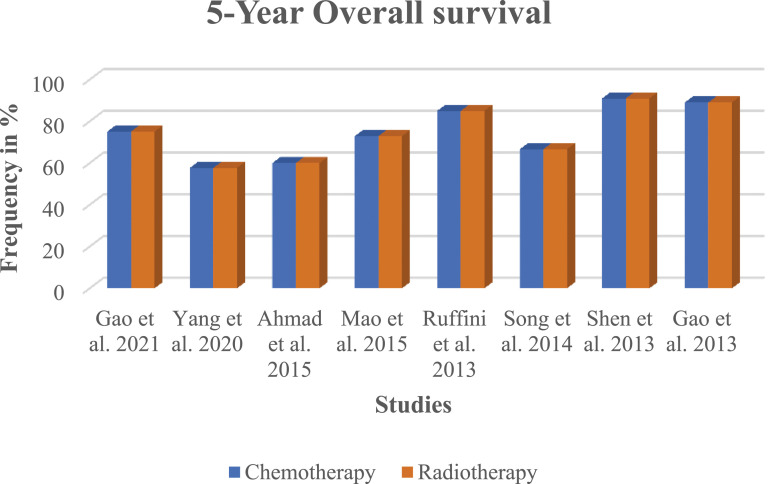
Results: The review identified a total of 101 studies in the Embase, Cochrane Library, and MEDLINE/PubMed databases. Of these, only eight retrospective studies met the inclusion criteria and were included in the meta-analysis. These eight studies encompassed a total of 323 patients with stage II (Masaoka-Koga system) thymic carcinoma, with an average patient age of 53.8 ± 5.0 years. There was no significant difference in the number of R0 resections between patients receiving adjuvant chemotherapy and those receiving adjuvant radiotherapy (P = 0.82). Patients who received adjuvant radiotherapy had a higher rate of recurrence, but this difference was not statistically significant (P = 0.93). The meta-analysis synthesized five-year overall survival data, with a combined hazard ratio (HR) of 0.881 (95% CI: 0.463 to 1.299), indicating no statistically significant difference between the treatment groups.
Conclusions: Although the results were not statistically significant, the findings suggest that adjuvant chemotherapy might be associated with a more favorable outcome for patients with stage II (Masaoka-Koga system) thymic carcinoma compared to adjuvant radiotherapy.
期刊介绍:
Cancer Control is a JCR-ranked, peer-reviewed open access journal whose mission is to advance the prevention, detection, diagnosis, treatment, and palliative care of cancer by enabling researchers, doctors, policymakers, and other healthcare professionals to freely share research along the cancer control continuum. Our vision is a world where gold-standard cancer care is the norm, not the exception.






 京公网安备 11010802042870号
京ICP备2023020795号-1
京公网安备 11010802042870号
京ICP备2023020795号-1

 分享
分享
 求助内容:
求助内容: 应助结果提醒方式:
 扫码关注我们
