Mengyao Wang , Jinjing Hu , Mengqi Li , Lisha Zhang , Mohsen Salimi , Majid Amidpour , Zhigang Chen
{"title":"太阳能驱动可持续海水淡化的光热防污织物的生物灵感设计","authors":"Mengyao Wang , Jinjing Hu , Mengqi Li , Lisha Zhang , Mohsen Salimi , Majid Amidpour , Zhigang Chen","doi":"10.1016/j.nanoen.2025.110726","DOIUrl":null,"url":null,"abstract":"<div><div>Solar-driven interfacial evaporation with photothermal membranes/fabrics is considered as an efficient and scalable strategy to produce fresh-water from seawater. While its practical application is restricted by some problems including sunlight reflection/scattering loss, high evaporation enthalpy, and organic contamination from seawater. To solve these problems, inspired by black fish-scale, we report a biomimetic design of two-dimensional photothermal fabric for efficient seawater evaporation. The photothermal fabrics have been prepared by <em>in-situ</em> polymerization of polypyrrole (PPy) nanoparticles (sizes: ∼50 nm) on cotton fabric and then PPy surface modification with cellulose nanocrystal (CNCs). Cotton/PPy/CNC fabric exhibits broad-spectral (300–2500 nm) photoabsorption with a solar-absorption efficiency of ∼98 % due to black-fish-scale-like light-trapping effect. Like the mucus of fish-scale, CNCs coating have abundant surface groups (such as -OH), which confers the formation of hydration layer. Hydration layer not only decreases water-evaporation enthalpy (1939.87 kJ kg<sup>−1</sup>) of Cotton/PPy/CNC fabric compared with that (2413.10 kJ kg<sup>−1</sup>, 37 °C) of pure water, but also results in super-hydrophilicity and super-oleophobicity. Subsequently, such fabric is hanging to construct an evaporator containing simulated seawater, and it has a high evaporation rate of 2.02 kg m<sup>−2</sup> h<sup>−1</sup> with the efficiency of 93.8 % under one sun. When oily seawater is used as model, the fabric remains a high evaporation rate of 1.90 kg m<sup>−2</sup> h<sup>−1</sup> without oil adhesion, demonstrating good anti-fouling function. Therefore, the present bioinspired design supplies some insights for constructing efficient and anti-fouling photothermal materials.</div></div>","PeriodicalId":394,"journal":{"name":"Nano Energy","volume":"136 ","pages":"Article 110726"},"PeriodicalIF":17.1000,"publicationDate":"2025-04-01","publicationTypes":"Journal Article","fieldsOfStudy":null,"isOpenAccess":false,"openAccessPdf":"","citationCount":"0","resultStr":"{\"title\":\"Bioinspired design of photothermal anti-fouling fabrics for solar-driven sustainable seawater desalination\",\"authors\":\"Mengyao Wang , Jinjing Hu , Mengqi Li , Lisha Zhang , Mohsen Salimi , Majid Amidpour , Zhigang Chen\",\"doi\":\"10.1016/j.nanoen.2025.110726\",\"DOIUrl\":null,\"url\":null,\"abstract\":\"<div><div>Solar-driven interfacial evaporation with photothermal membranes/fabrics is considered as an efficient and scalable strategy to produce fresh-water from seawater. While its practical application is restricted by some problems including sunlight reflection/scattering loss, high evaporation enthalpy, and organic contamination from seawater. To solve these problems, inspired by black fish-scale, we report a biomimetic design of two-dimensional photothermal fabric for efficient seawater evaporation. The photothermal fabrics have been prepared by <em>in-situ</em> polymerization of polypyrrole (PPy) nanoparticles (sizes: ∼50 nm) on cotton fabric and then PPy surface modification with cellulose nanocrystal (CNCs). Cotton/PPy/CNC fabric exhibits broad-spectral (300–2500 nm) photoabsorption with a solar-absorption efficiency of ∼98 % due to black-fish-scale-like light-trapping effect. Like the mucus of fish-scale, CNCs coating have abundant surface groups (such as -OH), which confers the formation of hydration layer. Hydration layer not only decreases water-evaporation enthalpy (1939.87 kJ kg<sup>−1</sup>) of Cotton/PPy/CNC fabric compared with that (2413.10 kJ kg<sup>−1</sup>, 37 °C) of pure water, but also results in super-hydrophilicity and super-oleophobicity. Subsequently, such fabric is hanging to construct an evaporator containing simulated seawater, and it has a high evaporation rate of 2.02 kg m<sup>−2</sup> h<sup>−1</sup> with the efficiency of 93.8 % under one sun. When oily seawater is used as model, the fabric remains a high evaporation rate of 1.90 kg m<sup>−2</sup> h<sup>−1</sup> without oil adhesion, demonstrating good anti-fouling function. Therefore, the present bioinspired design supplies some insights for constructing efficient and anti-fouling photothermal materials.</div></div>\",\"PeriodicalId\":394,\"journal\":{\"name\":\"Nano Energy\",\"volume\":\"136 \",\"pages\":\"Article 110726\"},\"PeriodicalIF\":17.1000,\"publicationDate\":\"2025-04-01\",\"publicationTypes\":\"Journal Article\",\"fieldsOfStudy\":null,\"isOpenAccess\":false,\"openAccessPdf\":\"\",\"citationCount\":\"0\",\"resultStr\":null,\"platform\":\"Semanticscholar\",\"paperid\":null,\"PeriodicalName\":\"Nano Energy\",\"FirstCategoryId\":\"88\",\"ListUrlMain\":\"https://www.sciencedirect.com/science/article/pii/S2211285525000850\",\"RegionNum\":1,\"RegionCategory\":\"材料科学\",\"ArticlePicture\":[],\"TitleCN\":null,\"AbstractTextCN\":null,\"PMCID\":null,\"EPubDate\":\"2025/1/27 0:00:00\",\"PubModel\":\"Epub\",\"JCR\":\"Q1\",\"JCRName\":\"CHEMISTRY, PHYSICAL\",\"Score\":null,\"Total\":0}","platform":"Semanticscholar","paperid":null,"PeriodicalName":"Nano Energy","FirstCategoryId":"88","ListUrlMain":"https://www.sciencedirect.com/science/article/pii/S2211285525000850","RegionNum":1,"RegionCategory":"材料科学","ArticlePicture":[],"TitleCN":null,"AbstractTextCN":null,"PMCID":null,"EPubDate":"2025/1/27 0:00:00","PubModel":"Epub","JCR":"Q1","JCRName":"CHEMISTRY, PHYSICAL","Score":null,"Total":0}
引用次数: 0
摘要
利用光热膜/织物的太阳能驱动界面蒸发被认为是从海水中生产淡水的一种有效和可扩展的策略。但其实际应用受到太阳光反射/散射损失、蒸发焓大、海水有机污染等问题的制约。为了解决这些问题,受黑鱼鳞的启发,我们报道了一种用于高效海水蒸发的二维光热织物的仿生设计。在棉织物上原位聚合聚吡咯(PPy)纳米粒子(尺寸:~50 nm),并用纤维素纳米晶体(cnc)对其表面进行改性,制备了光热织物。棉/PPy/CNC织物具有广谱(300-2500 nm)光吸收特性,由于类似于黑鱼鳞片的光捕获效应,其太阳能吸收效率可达98%。与鱼鳞粘液一样,cnc涂层具有丰富的表面基团(如-OH),从而形成水化层。水化层不仅使棉/PPy/CNC织物的蒸发焓(1939.87 kJ kg−1)比纯水(2413.10 kJ kg−1,37℃)降低,而且使织物具有超亲水性和超疏油性。随后,将该织物悬挂构成含模拟海水的蒸发器,其在一次太阳照射下的蒸发速率高达2.02 kg m-2 h-1,效率为93.8%。以含油海水为模型时,织物保持1.90 kg m-2 h-1的高蒸发速率,不粘油,具有良好的防污功能。因此,本文的仿生设计为构建高效、防污光热材料提供了一些启示。
Bioinspired design of photothermal anti-fouling fabrics for solar-driven sustainable seawater desalination
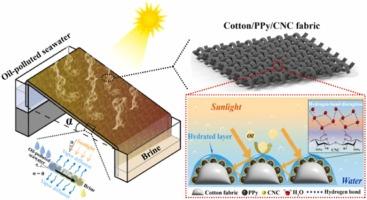
Solar-driven interfacial evaporation with photothermal membranes/fabrics is considered as an efficient and scalable strategy to produce fresh-water from seawater. While its practical application is restricted by some problems including sunlight reflection/scattering loss, high evaporation enthalpy, and organic contamination from seawater. To solve these problems, inspired by black fish-scale, we report a biomimetic design of two-dimensional photothermal fabric for efficient seawater evaporation. The photothermal fabrics have been prepared by in-situ polymerization of polypyrrole (PPy) nanoparticles (sizes: ∼50 nm) on cotton fabric and then PPy surface modification with cellulose nanocrystal (CNCs). Cotton/PPy/CNC fabric exhibits broad-spectral (300–2500 nm) photoabsorption with a solar-absorption efficiency of ∼98 % due to black-fish-scale-like light-trapping effect. Like the mucus of fish-scale, CNCs coating have abundant surface groups (such as -OH), which confers the formation of hydration layer. Hydration layer not only decreases water-evaporation enthalpy (1939.87 kJ kg−1) of Cotton/PPy/CNC fabric compared with that (2413.10 kJ kg−1, 37 °C) of pure water, but also results in super-hydrophilicity and super-oleophobicity. Subsequently, such fabric is hanging to construct an evaporator containing simulated seawater, and it has a high evaporation rate of 2.02 kg m−2 h−1 with the efficiency of 93.8 % under one sun. When oily seawater is used as model, the fabric remains a high evaporation rate of 1.90 kg m−2 h−1 without oil adhesion, demonstrating good anti-fouling function. Therefore, the present bioinspired design supplies some insights for constructing efficient and anti-fouling photothermal materials.
期刊介绍:
Nano Energy is a multidisciplinary, rapid-publication forum of original peer-reviewed contributions on the science and engineering of nanomaterials and nanodevices used in all forms of energy harvesting, conversion, storage, utilization and policy. Through its mixture of articles, reviews, communications, research news, and information on key developments, Nano Energy provides a comprehensive coverage of this exciting and dynamic field which joins nanoscience and nanotechnology with energy science. The journal is relevant to all those who are interested in nanomaterials solutions to the energy problem.
Nano Energy publishes original experimental and theoretical research on all aspects of energy-related research which utilizes nanomaterials and nanotechnology. Manuscripts of four types are considered: review articles which inform readers of the latest research and advances in energy science; rapid communications which feature exciting research breakthroughs in the field; full-length articles which report comprehensive research developments; and news and opinions which comment on topical issues or express views on the developments in related fields.




 京公网安备 11010802042870号
京ICP备2023020795号-1
京公网安备 11010802042870号
京ICP备2023020795号-1

 分享
分享
 求助内容:
求助内容: 应助结果提醒方式:
 扫码关注我们
