Lizhi Song , Wei‐Jing Chen , Jiarui Huang , Dinggen Hu , Xingxiang Ji , Li Hua , Zhaoqing Lu
{"title":"添加HPC的导电水凝胶,用于湿度传感和温度响应","authors":"Lizhi Song , Wei‐Jing Chen , Jiarui Huang , Dinggen Hu , Xingxiang Ji , Li Hua , Zhaoqing Lu","doi":"10.1016/j.cej.2025.160000","DOIUrl":null,"url":null,"abstract":"<div><div>With the rapid development of intelligent electronic technology, there have been increasing interests and demands of wearable sensors. In this emerging field, some issues of sensing materials are still need to be well-addressed, such as inadequate flexibility, poor biocompatibility, and delamination of conductive components, etc. In this study, a composite ion-conductive hydrogel with incorporated hydroxypropyl cellulose (HPC) was prepared. This composite hydrogel maintains excellent mechanical properties and biocompatibility. Moreover, the hydrogel exhibits zero crosstalk good humidity sensing as well as temperature responsiveness, and effectively avoid signal crosstalk. The hydrogel can accurately detect environmental humidity changes and real-world scenarios like oral respiration through variations in current. Additionally, it can respond to external temperature changes through transparency alterations, while retaining the strain-sensing capabilities of conductive hydrogels, enabling self-adhesive stress–strain sensing. Notably, HPC forms a network structure within the hydrogel system, leveraging its hydrophilic surface groups to enhance the humidity sensing performances. This research explores the structural distribution of HPC within the hydrogel system, offering a novel strategy for the development of HPC-added hydrogel sensors, which hold significant potentials for applications in flexible wearable devices.</div></div>","PeriodicalId":270,"journal":{"name":"Chemical Engineering Journal","volume":"506 ","pages":"Article 160000"},"PeriodicalIF":13.2000,"publicationDate":"2025-01-15","publicationTypes":"Journal Article","fieldsOfStudy":null,"isOpenAccess":false,"openAccessPdf":"","citationCount":"0","resultStr":"{\"title\":\"Conductive hydrogels with HPC additions for humidity sensing and temperature response\",\"authors\":\"Lizhi Song , Wei‐Jing Chen , Jiarui Huang , Dinggen Hu , Xingxiang Ji , Li Hua , Zhaoqing Lu\",\"doi\":\"10.1016/j.cej.2025.160000\",\"DOIUrl\":null,\"url\":null,\"abstract\":\"<div><div>With the rapid development of intelligent electronic technology, there have been increasing interests and demands of wearable sensors. In this emerging field, some issues of sensing materials are still need to be well-addressed, such as inadequate flexibility, poor biocompatibility, and delamination of conductive components, etc. In this study, a composite ion-conductive hydrogel with incorporated hydroxypropyl cellulose (HPC) was prepared. This composite hydrogel maintains excellent mechanical properties and biocompatibility. Moreover, the hydrogel exhibits zero crosstalk good humidity sensing as well as temperature responsiveness, and effectively avoid signal crosstalk. The hydrogel can accurately detect environmental humidity changes and real-world scenarios like oral respiration through variations in current. Additionally, it can respond to external temperature changes through transparency alterations, while retaining the strain-sensing capabilities of conductive hydrogels, enabling self-adhesive stress–strain sensing. Notably, HPC forms a network structure within the hydrogel system, leveraging its hydrophilic surface groups to enhance the humidity sensing performances. This research explores the structural distribution of HPC within the hydrogel system, offering a novel strategy for the development of HPC-added hydrogel sensors, which hold significant potentials for applications in flexible wearable devices.</div></div>\",\"PeriodicalId\":270,\"journal\":{\"name\":\"Chemical Engineering Journal\",\"volume\":\"506 \",\"pages\":\"Article 160000\"},\"PeriodicalIF\":13.2000,\"publicationDate\":\"2025-01-15\",\"publicationTypes\":\"Journal Article\",\"fieldsOfStudy\":null,\"isOpenAccess\":false,\"openAccessPdf\":\"\",\"citationCount\":\"0\",\"resultStr\":null,\"platform\":\"Semanticscholar\",\"paperid\":null,\"PeriodicalName\":\"Chemical Engineering Journal\",\"FirstCategoryId\":\"5\",\"ListUrlMain\":\"https://www.sciencedirect.com/science/article/pii/S1385894725007995\",\"RegionNum\":1,\"RegionCategory\":\"工程技术\",\"ArticlePicture\":[],\"TitleCN\":null,\"AbstractTextCN\":null,\"PMCID\":null,\"EPubDate\":\"2025/1/27 0:00:00\",\"PubModel\":\"Epub\",\"JCR\":\"Q1\",\"JCRName\":\"ENGINEERING, CHEMICAL\",\"Score\":null,\"Total\":0}","platform":"Semanticscholar","paperid":null,"PeriodicalName":"Chemical Engineering Journal","FirstCategoryId":"5","ListUrlMain":"https://www.sciencedirect.com/science/article/pii/S1385894725007995","RegionNum":1,"RegionCategory":"工程技术","ArticlePicture":[],"TitleCN":null,"AbstractTextCN":null,"PMCID":null,"EPubDate":"2025/1/27 0:00:00","PubModel":"Epub","JCR":"Q1","JCRName":"ENGINEERING, CHEMICAL","Score":null,"Total":0}
Conductive hydrogels with HPC additions for humidity sensing and temperature response
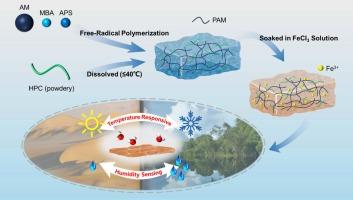
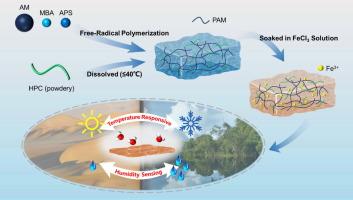
With the rapid development of intelligent electronic technology, there have been increasing interests and demands of wearable sensors. In this emerging field, some issues of sensing materials are still need to be well-addressed, such as inadequate flexibility, poor biocompatibility, and delamination of conductive components, etc. In this study, a composite ion-conductive hydrogel with incorporated hydroxypropyl cellulose (HPC) was prepared. This composite hydrogel maintains excellent mechanical properties and biocompatibility. Moreover, the hydrogel exhibits zero crosstalk good humidity sensing as well as temperature responsiveness, and effectively avoid signal crosstalk. The hydrogel can accurately detect environmental humidity changes and real-world scenarios like oral respiration through variations in current. Additionally, it can respond to external temperature changes through transparency alterations, while retaining the strain-sensing capabilities of conductive hydrogels, enabling self-adhesive stress–strain sensing. Notably, HPC forms a network structure within the hydrogel system, leveraging its hydrophilic surface groups to enhance the humidity sensing performances. This research explores the structural distribution of HPC within the hydrogel system, offering a novel strategy for the development of HPC-added hydrogel sensors, which hold significant potentials for applications in flexible wearable devices.
期刊介绍:
The Chemical Engineering Journal is an international research journal that invites contributions of original and novel fundamental research. It aims to provide an international platform for presenting original fundamental research, interpretative reviews, and discussions on new developments in chemical engineering. The journal welcomes papers that describe novel theory and its practical application, as well as those that demonstrate the transfer of techniques from other disciplines. It also welcomes reports on carefully conducted experimental work that is soundly interpreted. The main focus of the journal is on original and rigorous research results that have broad significance. The Catalysis section within the Chemical Engineering Journal focuses specifically on Experimental and Theoretical studies in the fields of heterogeneous catalysis, molecular catalysis, and biocatalysis. These studies have industrial impact on various sectors such as chemicals, energy, materials, foods, healthcare, and environmental protection.





 京公网安备 11010802042870号
京ICP备2023020795号-1
京公网安备 11010802042870号
京ICP备2023020795号-1

 分享
分享
 求助内容:
求助内容: 应助结果提醒方式:
 扫码关注我们
