{"title":"纳米-金属混合光催化剂选择性去除富营养化水中微囊藻毒素","authors":"Xiao Dai, Qi Chen, Jia Hu, Yunkai Fan, Ying Xiong, Xiaoyang Li","doi":"10.1016/j.cej.2025.159993","DOIUrl":null,"url":null,"abstract":"Microcystin-LR (MC-LR) is a major contaminant in food and the environment, posing a significant public health risk. However, targeted degradation of MC-LR in complex systems remains a challenging task. In this study, we rationally designed a hierarchically structured nanobody-metal hybrid photocatalyst with both high affinity for MC-LR and excellent photocatalytic activity. Due to the synergistic and proximity effects between nanobody and photocatalyst, the degradation efficiency of Ag/AgCl/BSA-Nb hybrid catalyst achieved a degradation rate 2.3 times higher than that of Ag/AgCl/BSA in eutrophic water. Nearly 100% degradation of MC-LR was achieved within 30 min under visible light irradiation. The degradation pathways of MC-LR were analyzed using UPLC-Q-TOF MS. The hepatotoxicity of the MC-LR transformation products was significantly reduced compared to that of MC-LR. Ag/AgCl/BSA-Nb demonstrated excellent reusability and a good industrial application prospect.","PeriodicalId":270,"journal":{"name":"Chemical Engineering Journal","volume":"6 1","pages":""},"PeriodicalIF":13.2000,"publicationDate":"2025-01-27","publicationTypes":"Journal Article","fieldsOfStudy":null,"isOpenAccess":false,"openAccessPdf":"","citationCount":"0","resultStr":"{\"title\":\"Selective removal of microcystin from eutrophic water by a nanobody-metal hybrid photocatalyst\",\"authors\":\"Xiao Dai, Qi Chen, Jia Hu, Yunkai Fan, Ying Xiong, Xiaoyang Li\",\"doi\":\"10.1016/j.cej.2025.159993\",\"DOIUrl\":null,\"url\":null,\"abstract\":\"Microcystin-LR (MC-LR) is a major contaminant in food and the environment, posing a significant public health risk. However, targeted degradation of MC-LR in complex systems remains a challenging task. In this study, we rationally designed a hierarchically structured nanobody-metal hybrid photocatalyst with both high affinity for MC-LR and excellent photocatalytic activity. Due to the synergistic and proximity effects between nanobody and photocatalyst, the degradation efficiency of Ag/AgCl/BSA-Nb hybrid catalyst achieved a degradation rate 2.3 times higher than that of Ag/AgCl/BSA in eutrophic water. Nearly 100% degradation of MC-LR was achieved within 30 min under visible light irradiation. The degradation pathways of MC-LR were analyzed using UPLC-Q-TOF MS. The hepatotoxicity of the MC-LR transformation products was significantly reduced compared to that of MC-LR. Ag/AgCl/BSA-Nb demonstrated excellent reusability and a good industrial application prospect.\",\"PeriodicalId\":270,\"journal\":{\"name\":\"Chemical Engineering Journal\",\"volume\":\"6 1\",\"pages\":\"\"},\"PeriodicalIF\":13.2000,\"publicationDate\":\"2025-01-27\",\"publicationTypes\":\"Journal Article\",\"fieldsOfStudy\":null,\"isOpenAccess\":false,\"openAccessPdf\":\"\",\"citationCount\":\"0\",\"resultStr\":null,\"platform\":\"Semanticscholar\",\"paperid\":null,\"PeriodicalName\":\"Chemical Engineering Journal\",\"FirstCategoryId\":\"5\",\"ListUrlMain\":\"https://doi.org/10.1016/j.cej.2025.159993\",\"RegionNum\":1,\"RegionCategory\":\"工程技术\",\"ArticlePicture\":[],\"TitleCN\":null,\"AbstractTextCN\":null,\"PMCID\":null,\"EPubDate\":\"\",\"PubModel\":\"\",\"JCR\":\"Q1\",\"JCRName\":\"ENGINEERING, CHEMICAL\",\"Score\":null,\"Total\":0}","platform":"Semanticscholar","paperid":null,"PeriodicalName":"Chemical Engineering Journal","FirstCategoryId":"5","ListUrlMain":"https://doi.org/10.1016/j.cej.2025.159993","RegionNum":1,"RegionCategory":"工程技术","ArticlePicture":[],"TitleCN":null,"AbstractTextCN":null,"PMCID":null,"EPubDate":"","PubModel":"","JCR":"Q1","JCRName":"ENGINEERING, CHEMICAL","Score":null,"Total":0}
引用次数: 0
摘要
微囊藻毒素- lr (MC-LR)是食品和环境中的主要污染物,对公众健康构成重大风险。然而,在复杂系统中靶向降解MC-LR仍然是一项具有挑战性的任务。在本研究中,我们合理设计了一种结构分层的纳米-金属杂化光催化剂,该催化剂对MC-LR具有高亲和力,同时具有优异的光催化活性。由于纳米体和光催化剂之间的协同和邻近效应,Ag/AgCl/BSA- nb杂化催化剂在富营养化水体中的降解效率是Ag/AgCl/BSA的2.3倍。在可见光照射下,MC-LR在30 min内降解接近100%。利用UPLC-Q-TOF ms分析MC-LR的降解途径,与MC-LR相比,MC-LR转化产物的肝毒性显著降低。Ag/AgCl/BSA-Nb具有良好的可重复使用性和良好的工业应用前景。
Selective removal of microcystin from eutrophic water by a nanobody-metal hybrid photocatalyst
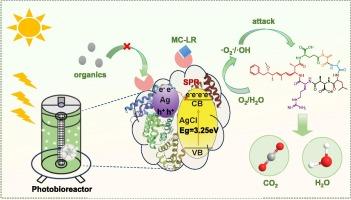
Microcystin-LR (MC-LR) is a major contaminant in food and the environment, posing a significant public health risk. However, targeted degradation of MC-LR in complex systems remains a challenging task. In this study, we rationally designed a hierarchically structured nanobody-metal hybrid photocatalyst with both high affinity for MC-LR and excellent photocatalytic activity. Due to the synergistic and proximity effects between nanobody and photocatalyst, the degradation efficiency of Ag/AgCl/BSA-Nb hybrid catalyst achieved a degradation rate 2.3 times higher than that of Ag/AgCl/BSA in eutrophic water. Nearly 100% degradation of MC-LR was achieved within 30 min under visible light irradiation. The degradation pathways of MC-LR were analyzed using UPLC-Q-TOF MS. The hepatotoxicity of the MC-LR transformation products was significantly reduced compared to that of MC-LR. Ag/AgCl/BSA-Nb demonstrated excellent reusability and a good industrial application prospect.
期刊介绍:
The Chemical Engineering Journal is an international research journal that invites contributions of original and novel fundamental research. It aims to provide an international platform for presenting original fundamental research, interpretative reviews, and discussions on new developments in chemical engineering. The journal welcomes papers that describe novel theory and its practical application, as well as those that demonstrate the transfer of techniques from other disciplines. It also welcomes reports on carefully conducted experimental work that is soundly interpreted. The main focus of the journal is on original and rigorous research results that have broad significance. The Catalysis section within the Chemical Engineering Journal focuses specifically on Experimental and Theoretical studies in the fields of heterogeneous catalysis, molecular catalysis, and biocatalysis. These studies have industrial impact on various sectors such as chemicals, energy, materials, foods, healthcare, and environmental protection.




 京公网安备 11010802042870号
京ICP备2023020795号-1
京公网安备 11010802042870号
京ICP备2023020795号-1

 分享
分享
 求助内容:
求助内容: 应助结果提醒方式:
 扫码关注我们
