Ikhtiar Gul, Murtaza Sayed, Faiza Rehman, Wang Jinlong, Pingfeng Fu, Yuliang Zhang, Mallikarjuna N. Nadagouda
{"title":"具有多面(0 0 1)和(1 0 1)TiO2 和 Ti3+/ 氧空位的 Z 型 Ti3C2@Bi2O3 基 MXene:通过过硫酸盐活化、能量利用和抗菌活性光催化降解敌敌畏","authors":"Ikhtiar Gul, Murtaza Sayed, Faiza Rehman, Wang Jinlong, Pingfeng Fu, Yuliang Zhang, Mallikarjuna N. Nadagouda","doi":"10.1016/j.cej.2025.159992","DOIUrl":null,"url":null,"abstract":"In this study, highly porous Z-scheme Ti<sub>3</sub>C<sub>2</sub>@ 15 % Bi<sub>2</sub>O<sub>3</sub> based Mxene with multifaceted (0<!-- --> <!-- -->0<!-- --> <!-- -->1) and (1<!-- --> <!-- -->0<!-- --> <!-- -->1) TiO<sub>2</sub> (MTB15) was synthesized via solvothermal route. The characterization analysis indicated that the synthesized photocatalyst was featured with beneficial Ti<sup>3+</sup> centers and oxygen vacancies (OVs). The integration of peroxymonosulfate (PMS, 0.15 mM) to the synthesized photocatalyst has significantly boosted the degradation of dichlorophen (DCP, 6.0 mg L<sup>−1</sup>) from 66.83 % (no PMS) to 98.69 % at 50 min of reaction time. The antibacterial properties of MTB15 have proven a significant reduction (1.13-log reduction) in <em>Escherichia coli (E.coli)</em> which is comparable to the 1.49-log reduction of the positive control. At a current density of 1 A/g, the synthesized MTB15 when applied as symmetrical supercapacitor cell (SSC) also showed unique electrochemical performance, having specific capacitance of 556.37F/g, energy density of 5.86W h kg<sup>−1</sup>, and power density of 137.00W kg<sup>−1</sup>. The H<sub>2</sub> generation rate of MTB15 was 4.86 mmol/h g<sup>−1</sup>, which surpassed MTB0 by almost 5.85 times. Overall, the findings of this study explored the multifunctional behavior of MTB15 in terms of environmental remediation, energy storage, and generation and thus solving the real-world issues sustainably.","PeriodicalId":270,"journal":{"name":"Chemical Engineering Journal","volume":"49 1","pages":""},"PeriodicalIF":12.5000,"publicationDate":"2025-01-27","publicationTypes":"Journal Article","fieldsOfStudy":null,"isOpenAccess":false,"openAccessPdf":"","citationCount":"0","resultStr":"{\"title\":\"Z-scheme Ti3C2@Bi2O3 based MXene with multifaceted (0 0 1) and (1 0 1) TiO2 and Ti3+/oxygen vacancies: Photocatalytic degradation of dichlorophen via peroxymonosulfate activation, energy utilization and antibacterial activities\",\"authors\":\"Ikhtiar Gul, Murtaza Sayed, Faiza Rehman, Wang Jinlong, Pingfeng Fu, Yuliang Zhang, Mallikarjuna N. Nadagouda\",\"doi\":\"10.1016/j.cej.2025.159992\",\"DOIUrl\":null,\"url\":null,\"abstract\":\"In this study, highly porous Z-scheme Ti<sub>3</sub>C<sub>2</sub>@ 15 % Bi<sub>2</sub>O<sub>3</sub> based Mxene with multifaceted (0<!-- --> <!-- -->0<!-- --> <!-- -->1) and (1<!-- --> <!-- -->0<!-- --> <!-- -->1) TiO<sub>2</sub> (MTB15) was synthesized via solvothermal route. The characterization analysis indicated that the synthesized photocatalyst was featured with beneficial Ti<sup>3+</sup> centers and oxygen vacancies (OVs). The integration of peroxymonosulfate (PMS, 0.15 mM) to the synthesized photocatalyst has significantly boosted the degradation of dichlorophen (DCP, 6.0 mg L<sup>−1</sup>) from 66.83 % (no PMS) to 98.69 % at 50 min of reaction time. The antibacterial properties of MTB15 have proven a significant reduction (1.13-log reduction) in <em>Escherichia coli (E.coli)</em> which is comparable to the 1.49-log reduction of the positive control. At a current density of 1 A/g, the synthesized MTB15 when applied as symmetrical supercapacitor cell (SSC) also showed unique electrochemical performance, having specific capacitance of 556.37F/g, energy density of 5.86W h kg<sup>−1</sup>, and power density of 137.00W kg<sup>−1</sup>. The H<sub>2</sub> generation rate of MTB15 was 4.86 mmol/h g<sup>−1</sup>, which surpassed MTB0 by almost 5.85 times. Overall, the findings of this study explored the multifunctional behavior of MTB15 in terms of environmental remediation, energy storage, and generation and thus solving the real-world issues sustainably.\",\"PeriodicalId\":270,\"journal\":{\"name\":\"Chemical Engineering Journal\",\"volume\":\"49 1\",\"pages\":\"\"},\"PeriodicalIF\":12.5000,\"publicationDate\":\"2025-01-27\",\"publicationTypes\":\"Journal Article\",\"fieldsOfStudy\":null,\"isOpenAccess\":false,\"openAccessPdf\":\"\",\"citationCount\":\"0\",\"resultStr\":null,\"platform\":\"Semanticscholar\",\"paperid\":null,\"PeriodicalName\":\"Chemical Engineering Journal\",\"FirstCategoryId\":\"5\",\"ListUrlMain\":\"https://doi.org/10.1016/j.cej.2025.159992\",\"RegionNum\":1,\"RegionCategory\":\"工程技术\",\"ArticlePicture\":[],\"TitleCN\":null,\"AbstractTextCN\":null,\"PMCID\":null,\"EPubDate\":\"\",\"PubModel\":\"\",\"JCR\":\"Q1\",\"JCRName\":\"ENGINEERING, CHEMICAL\",\"Score\":null,\"Total\":0}","platform":"Semanticscholar","paperid":null,"PeriodicalName":"Chemical Engineering Journal","FirstCategoryId":"5","ListUrlMain":"https://doi.org/10.1016/j.cej.2025.159992","RegionNum":1,"RegionCategory":"工程技术","ArticlePicture":[],"TitleCN":null,"AbstractTextCN":null,"PMCID":null,"EPubDate":"","PubModel":"","JCR":"Q1","JCRName":"ENGINEERING, CHEMICAL","Score":null,"Total":0}
引用次数: 0
摘要
本研究采用溶剂热法合成了具有多面(0 0 1)和(1 0 1)TiO2 (MTB15)的高孔Z-scheme Ti3C2@ 15 % Bi2O3基Mxene。表征分析表明,合成的光催化剂具有有利的Ti3+中心和氧空位(OVs)。在合成的光催化剂中加入过氧单硫酸根(PMS, 0.15 mM)后,在50 min的反应时间内,对二氯酚(DCP, 6.0 mg L−1)的降解率从66.83 %(无PMS)显著提高到98.69 %。经证实,MTB15对大肠杆菌(E.coli)的抑菌性能显著降低(1.13对数降低),与阳性对照的1.49对数降低相当。在电流密度为1 a /g时,合成的MTB15作为对称超级电容器电池(SSC)也表现出了独特的电化学性能,比电容为556.37F/g,能量密度为5.86W h kg - 1,功率密度为137.00W kg - 1。MTB15的产氢速率为4.86 mmol/h g−1,是MTB0的5.85倍。总的来说,本研究的发现探索了MTB15在环境修复、储能和发电方面的多功能行为,从而可持续地解决了现实世界的问题。
Z-scheme Ti3C2@Bi2O3 based MXene with multifaceted (0 0 1) and (1 0 1) TiO2 and Ti3+/oxygen vacancies: Photocatalytic degradation of dichlorophen via peroxymonosulfate activation, energy utilization and antibacterial activities
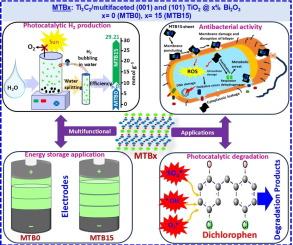
In this study, highly porous Z-scheme Ti3C2@ 15 % Bi2O3 based Mxene with multifaceted (0 0 1) and (1 0 1) TiO2 (MTB15) was synthesized via solvothermal route. The characterization analysis indicated that the synthesized photocatalyst was featured with beneficial Ti3+ centers and oxygen vacancies (OVs). The integration of peroxymonosulfate (PMS, 0.15 mM) to the synthesized photocatalyst has significantly boosted the degradation of dichlorophen (DCP, 6.0 mg L−1) from 66.83 % (no PMS) to 98.69 % at 50 min of reaction time. The antibacterial properties of MTB15 have proven a significant reduction (1.13-log reduction) in Escherichia coli (E.coli) which is comparable to the 1.49-log reduction of the positive control. At a current density of 1 A/g, the synthesized MTB15 when applied as symmetrical supercapacitor cell (SSC) also showed unique electrochemical performance, having specific capacitance of 556.37F/g, energy density of 5.86W h kg−1, and power density of 137.00W kg−1. The H2 generation rate of MTB15 was 4.86 mmol/h g−1, which surpassed MTB0 by almost 5.85 times. Overall, the findings of this study explored the multifunctional behavior of MTB15 in terms of environmental remediation, energy storage, and generation and thus solving the real-world issues sustainably.
期刊介绍:
The Chemical Engineering Journal is an international research journal that invites contributions of original and novel fundamental research. It aims to provide an international platform for presenting original fundamental research, interpretative reviews, and discussions on new developments in chemical engineering. The journal welcomes papers that describe novel theory and its practical application, as well as those that demonstrate the transfer of techniques from other disciplines. It also welcomes reports on carefully conducted experimental work that is soundly interpreted. The main focus of the journal is on original and rigorous research results that have broad significance. The Catalysis section within the Chemical Engineering Journal focuses specifically on Experimental and Theoretical studies in the fields of heterogeneous catalysis, molecular catalysis, and biocatalysis. These studies have industrial impact on various sectors such as chemicals, energy, materials, foods, healthcare, and environmental protection.




 京公网安备 11010802042870号
京ICP备2023020795号-1
京公网安备 11010802042870号
京ICP备2023020795号-1

 分享
分享
 求助内容:
求助内容: 应助结果提醒方式:
 扫码关注我们
