Shanshan Zhang, Lijie Yu, Yi Lv, Tianyu Zeng, Haobo Hou, Jirong Lan
{"title":"多级活化碳化法从高铝粉煤灰中高效选择性回收铝的研究","authors":"Shanshan Zhang, Lijie Yu, Yi Lv, Tianyu Zeng, Haobo Hou, Jirong Lan","doi":"10.1016/j.cej.2025.160003","DOIUrl":null,"url":null,"abstract":"A method of calcination activation-chemical separation-carbonization precipitation was developed for selective recovery of Al from high-alumina fly ash (HAFA). Specifically, calcium carbide slag, CaF<sub>2</sub> and HAFA were used for mechanical mixing and calcination, and then, Al was leached with sodium carbonate solution, followed by the use of CaO to separation and removal of Si, the next step of filtration to remove the residue to obtain, and finally, the precipitation recovery of Al was realized by the passage of CO<sub>2</sub> into the solution. Consequently, the formation of soluble calcium aluminate (C<sub>12</sub>A<sub>7</sub>) and insoluble dicalcium silicate (C<sub>2</sub>S) is promoted, effectively achieving the separation of silicon and aluminum during the calcination process. Desiliconization and carbonation of the leaching solution yielded aluminum hydroxide with a conversion rate of 96.67 % and a purity of 98.40 %. Pilot-scale experiments achieve an overall aluminum extraction rate of over 80 % and an aluminum purity of 98 %. In addition, the process absorbs 0.564 tons of CO<sub>2</sub> per ton of Al(OH)<sub>3</sub> produced. This study highlights the feasibility of large-scale collaborative carbon sequestration and efficient HAFA resource treatment.","PeriodicalId":270,"journal":{"name":"Chemical Engineering Journal","volume":"23 1","pages":""},"PeriodicalIF":13.2000,"publicationDate":"2025-01-28","publicationTypes":"Journal Article","fieldsOfStudy":null,"isOpenAccess":false,"openAccessPdf":"","citationCount":"0","resultStr":"{\"title\":\"High efficiency selective recovery of Al from high-alumina fly ash by multistage activation and carbonation on-site application scale\",\"authors\":\"Shanshan Zhang, Lijie Yu, Yi Lv, Tianyu Zeng, Haobo Hou, Jirong Lan\",\"doi\":\"10.1016/j.cej.2025.160003\",\"DOIUrl\":null,\"url\":null,\"abstract\":\"A method of calcination activation-chemical separation-carbonization precipitation was developed for selective recovery of Al from high-alumina fly ash (HAFA). Specifically, calcium carbide slag, CaF<sub>2</sub> and HAFA were used for mechanical mixing and calcination, and then, Al was leached with sodium carbonate solution, followed by the use of CaO to separation and removal of Si, the next step of filtration to remove the residue to obtain, and finally, the precipitation recovery of Al was realized by the passage of CO<sub>2</sub> into the solution. Consequently, the formation of soluble calcium aluminate (C<sub>12</sub>A<sub>7</sub>) and insoluble dicalcium silicate (C<sub>2</sub>S) is promoted, effectively achieving the separation of silicon and aluminum during the calcination process. Desiliconization and carbonation of the leaching solution yielded aluminum hydroxide with a conversion rate of 96.67 % and a purity of 98.40 %. Pilot-scale experiments achieve an overall aluminum extraction rate of over 80 % and an aluminum purity of 98 %. In addition, the process absorbs 0.564 tons of CO<sub>2</sub> per ton of Al(OH)<sub>3</sub> produced. This study highlights the feasibility of large-scale collaborative carbon sequestration and efficient HAFA resource treatment.\",\"PeriodicalId\":270,\"journal\":{\"name\":\"Chemical Engineering Journal\",\"volume\":\"23 1\",\"pages\":\"\"},\"PeriodicalIF\":13.2000,\"publicationDate\":\"2025-01-28\",\"publicationTypes\":\"Journal Article\",\"fieldsOfStudy\":null,\"isOpenAccess\":false,\"openAccessPdf\":\"\",\"citationCount\":\"0\",\"resultStr\":null,\"platform\":\"Semanticscholar\",\"paperid\":null,\"PeriodicalName\":\"Chemical Engineering Journal\",\"FirstCategoryId\":\"5\",\"ListUrlMain\":\"https://doi.org/10.1016/j.cej.2025.160003\",\"RegionNum\":1,\"RegionCategory\":\"工程技术\",\"ArticlePicture\":[],\"TitleCN\":null,\"AbstractTextCN\":null,\"PMCID\":null,\"EPubDate\":\"\",\"PubModel\":\"\",\"JCR\":\"Q1\",\"JCRName\":\"ENGINEERING, CHEMICAL\",\"Score\":null,\"Total\":0}","platform":"Semanticscholar","paperid":null,"PeriodicalName":"Chemical Engineering Journal","FirstCategoryId":"5","ListUrlMain":"https://doi.org/10.1016/j.cej.2025.160003","RegionNum":1,"RegionCategory":"工程技术","ArticlePicture":[],"TitleCN":null,"AbstractTextCN":null,"PMCID":null,"EPubDate":"","PubModel":"","JCR":"Q1","JCRName":"ENGINEERING, CHEMICAL","Score":null,"Total":0}
High efficiency selective recovery of Al from high-alumina fly ash by multistage activation and carbonation on-site application scale
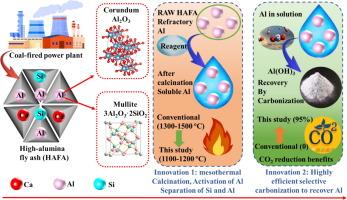
A method of calcination activation-chemical separation-carbonization precipitation was developed for selective recovery of Al from high-alumina fly ash (HAFA). Specifically, calcium carbide slag, CaF2 and HAFA were used for mechanical mixing and calcination, and then, Al was leached with sodium carbonate solution, followed by the use of CaO to separation and removal of Si, the next step of filtration to remove the residue to obtain, and finally, the precipitation recovery of Al was realized by the passage of CO2 into the solution. Consequently, the formation of soluble calcium aluminate (C12A7) and insoluble dicalcium silicate (C2S) is promoted, effectively achieving the separation of silicon and aluminum during the calcination process. Desiliconization and carbonation of the leaching solution yielded aluminum hydroxide with a conversion rate of 96.67 % and a purity of 98.40 %. Pilot-scale experiments achieve an overall aluminum extraction rate of over 80 % and an aluminum purity of 98 %. In addition, the process absorbs 0.564 tons of CO2 per ton of Al(OH)3 produced. This study highlights the feasibility of large-scale collaborative carbon sequestration and efficient HAFA resource treatment.
期刊介绍:
The Chemical Engineering Journal is an international research journal that invites contributions of original and novel fundamental research. It aims to provide an international platform for presenting original fundamental research, interpretative reviews, and discussions on new developments in chemical engineering. The journal welcomes papers that describe novel theory and its practical application, as well as those that demonstrate the transfer of techniques from other disciplines. It also welcomes reports on carefully conducted experimental work that is soundly interpreted. The main focus of the journal is on original and rigorous research results that have broad significance. The Catalysis section within the Chemical Engineering Journal focuses specifically on Experimental and Theoretical studies in the fields of heterogeneous catalysis, molecular catalysis, and biocatalysis. These studies have industrial impact on various sectors such as chemicals, energy, materials, foods, healthcare, and environmental protection.




 京公网安备 11010802042870号
京ICP备2023020795号-1
京公网安备 11010802042870号
京ICP备2023020795号-1

 分享
分享
 求助内容:
求助内容: 应助结果提醒方式:
 扫码关注我们
