Alexander N. Selikhov, Yulia V. Nelyubina, Rinat R. Aysin and Alexander A. Trifonov
{"title":"低配位醇氧钾-芳烃的有效捕集剂:氮氮非共价键在C-H键金属化底物活化中的作用","authors":"Alexander N. Selikhov, Yulia V. Nelyubina, Rinat R. Aysin and Alexander A. Trifonov","doi":"10.1039/D4DT03326D","DOIUrl":null,"url":null,"abstract":"<p >Metalation of bulky tris(2-(piperidin-1-yl-methyl)phenyl)methanol [(C<small><sub>5</sub></small>H<small><sub>10</sub></small>N)CH<small><sub>2</sub></small>C<small><sub>6</sub></small>H<small><sub>4</sub></small>-<em>o</em>]<small><sub>3</sub></small>COH with (Me<small><sub>3</sub></small>Si)<small><sub>2</sub></small>NK in Et<small><sub>2</sub></small>O results in a dimeric potassium alkoxide {[(C<small><sub>5</sub></small>H<small><sub>10</sub></small>N)CH<small><sub>2</sub></small>C<small><sub>6</sub></small>H<small><sub>4</sub></small>-<em>o</em>]<small><sub>3</sub></small>C(μ<small><sup>2</sup></small>-O)K(Et<small><sub>2</sub></small>O)}<small><sub>2</sub></small> (<strong>1</strong>). The Et<small><sub>2</sub></small>O molecule can be removed from the K<small><sup>+</sup></small> coordination sphere affording coordinatively unsaturated alkoxide species which readily traps π-donor molecules. In the presence of excess arene, the reactions result in η<small><sup><em>n</em></sup></small>–π-complexes, retaining in the crystal state a dimeric core {[(C<small><sub>5</sub></small>H<small><sub>10</sub></small>N)CH<small><sub>2</sub></small>C<small><sub>6</sub></small>H<small><sub>4</sub></small>-<em>o</em>]<small><sub>3</sub></small>C(μ<small><sup>2</sup></small>-O)K(η<small><sup><em>n</em></sup></small>-arene)}<small><sub>2</sub></small> (arene = C<small><sub>6</sub></small>H<small><sub>6</sub></small> (<strong>2</strong>), CH<small><sub>3</sub></small>C<small><sub>6</sub></small>H<small><sub>5</sub></small> (<strong>3</strong>), C<small><sub>10</sub></small>H<small><sub>8</sub></small> (<strong>4</strong>)). With C<small><sub>6</sub></small>H<small><sub>5</sub></small>OMe and C<small><sub>6</sub></small>H<small><sub>5</sub></small>NMe<small><sub>2</sub></small> molecules containing competing n- and π-donating sites, the reactions proceed differently: the former coordinates to K<small><sup>+</sup></small> through an oxygen lone pair resulting in {[(C<small><sub>5</sub></small>H<small><sub>10</sub></small>N)CH<small><sub>2</sub></small>C<small><sub>6</sub></small>H<small><sub>4</sub></small>-<em>o</em>]<small><sub>3</sub></small>C(μ<small><sup>2</sup></small>-O)K(κ<small><sup>1</sup></small>-O(Me)C<small><sub>6</sub></small>H<small><sub>5</sub></small>)}<small><sub>2</sub></small> (<strong>5</strong>) while for the latter, π-arene interaction turns out to be preferable, yielding {[(C<small><sub>5</sub></small>H<small><sub>10</sub></small>N)CH<small><sub>2</sub></small>C<small><sub>6</sub></small>H<small><sub>4</sub></small>-<em>o</em>]<small><sub>3</sub></small>C(μ<small><sup>2</sup></small>-O)K(η<small><sup>2</sup></small>-C<small><sub>6</sub></small>H<small><sub>5</sub></small>NMe<small><sub>2</sub></small>)}<small><sub>2</sub></small> (<strong>6</strong>). The reactions with equimolar amounts of benzene or thiophene afford coordination polymers [{[(C<small><sub>5</sub></small>H<small><sub>10</sub></small>N)CH<small><sub>2</sub></small>C<small><sub>6</sub></small>H<small><sub>4</sub></small>-<em>o</em>]<small><sub>3</sub></small>C(μ<small><sup>2</sup></small>-O)K}<small><sub>2</sub></small>(μ-C<small><sub>6</sub></small>H<small><sub>6</sub></small>)]<small><sub><em>n</em></sub></small> (<strong>7</strong>) and [{[(C<small><sub>5</sub></small>H<small><sub>10</sub></small>N)CH<small><sub>2</sub></small>C<small><sub>6</sub></small>H<small><sub>4</sub></small>-<em>o</em>]<small><sub>3</sub></small>C(μ<small><sup>2</sup></small>-O)K}<small><sub>2</sub></small>(μ-C<small><sub>4</sub></small>H<small><sub>4</sub></small>S)]<small><sub><em>n</em></sub></small> (<strong>8</strong>), in which benzene and thiophene molecules are μ-bridging two K<small><sup>+</sup></small> ions. The treatment of {[(C<small><sub>5</sub></small>H<small><sub>10</sub></small>N)CH<small><sub>2</sub></small>C<small><sub>6</sub></small>H<small><sub>4</sub></small>-<em>o</em>]<small><sub>3</sub></small>C(μ<small><sup>2</sup></small>-O)K(η<small><sup>2</sup></small>-CH<small><sub>3</sub></small>C<small><sub>6</sub></small>H<small><sub>5</sub></small>))}<small><sub>2</sub></small> with Me<small><sub>3</sub></small>SiCH<small><sub>2</sub></small>Li or <em>n</em>-BuLi (1.2 eq.) in hexane at 20 °C results in the facile metalation of the Me group of toluene, forming [PhCH<small><sub>2</sub></small>K]<small><sub><em>n</em></sub></small> and lithium alkoxide. This model reaction provides a deeper insight into the probable mechanism of metalation of CH bonds under Lochmann–Schlosser superbasic conditions, and the role and the nature of the synergistic effect of two metals. The calculations and QTAIM analysis were performed for <strong>1–8</strong> and model molecules as well.</p>","PeriodicalId":71,"journal":{"name":"Dalton Transactions","volume":" 11","pages":" 4503-4517"},"PeriodicalIF":3.3000,"publicationDate":"2025-01-28","publicationTypes":"Journal Article","fieldsOfStudy":null,"isOpenAccess":false,"openAccessPdf":"","citationCount":"0","resultStr":"{\"title\":\"Low-coordinate potassium alkoxide – an efficient trap for arenes: the role of ηn non-covalent bonding in substrate activation for C–H bond metalation†\",\"authors\":\"Alexander N. Selikhov, Yulia V. Nelyubina, Rinat R. Aysin and Alexander A. Trifonov\",\"doi\":\"10.1039/D4DT03326D\",\"DOIUrl\":null,\"url\":null,\"abstract\":\"<p >Metalation of bulky tris(2-(piperidin-1-yl-methyl)phenyl)methanol [(C<small><sub>5</sub></small>H<small><sub>10</sub></small>N)CH<small><sub>2</sub></small>C<small><sub>6</sub></small>H<small><sub>4</sub></small>-<em>o</em>]<small><sub>3</sub></small>COH with (Me<small><sub>3</sub></small>Si)<small><sub>2</sub></small>NK in Et<small><sub>2</sub></small>O results in a dimeric potassium alkoxide {[(C<small><sub>5</sub></small>H<small><sub>10</sub></small>N)CH<small><sub>2</sub></small>C<small><sub>6</sub></small>H<small><sub>4</sub></small>-<em>o</em>]<small><sub>3</sub></small>C(μ<small><sup>2</sup></small>-O)K(Et<small><sub>2</sub></small>O)}<small><sub>2</sub></small> (<strong>1</strong>). The Et<small><sub>2</sub></small>O molecule can be removed from the K<small><sup>+</sup></small> coordination sphere affording coordinatively unsaturated alkoxide species which readily traps π-donor molecules. In the presence of excess arene, the reactions result in η<small><sup><em>n</em></sup></small>–π-complexes, retaining in the crystal state a dimeric core {[(C<small><sub>5</sub></small>H<small><sub>10</sub></small>N)CH<small><sub>2</sub></small>C<small><sub>6</sub></small>H<small><sub>4</sub></small>-<em>o</em>]<small><sub>3</sub></small>C(μ<small><sup>2</sup></small>-O)K(η<small><sup><em>n</em></sup></small>-arene)}<small><sub>2</sub></small> (arene = C<small><sub>6</sub></small>H<small><sub>6</sub></small> (<strong>2</strong>), CH<small><sub>3</sub></small>C<small><sub>6</sub></small>H<small><sub>5</sub></small> (<strong>3</strong>), C<small><sub>10</sub></small>H<small><sub>8</sub></small> (<strong>4</strong>)). With C<small><sub>6</sub></small>H<small><sub>5</sub></small>OMe and C<small><sub>6</sub></small>H<small><sub>5</sub></small>NMe<small><sub>2</sub></small> molecules containing competing n- and π-donating sites, the reactions proceed differently: the former coordinates to K<small><sup>+</sup></small> through an oxygen lone pair resulting in {[(C<small><sub>5</sub></small>H<small><sub>10</sub></small>N)CH<small><sub>2</sub></small>C<small><sub>6</sub></small>H<small><sub>4</sub></small>-<em>o</em>]<small><sub>3</sub></small>C(μ<small><sup>2</sup></small>-O)K(κ<small><sup>1</sup></small>-O(Me)C<small><sub>6</sub></small>H<small><sub>5</sub></small>)}<small><sub>2</sub></small> (<strong>5</strong>) while for the latter, π-arene interaction turns out to be preferable, yielding {[(C<small><sub>5</sub></small>H<small><sub>10</sub></small>N)CH<small><sub>2</sub></small>C<small><sub>6</sub></small>H<small><sub>4</sub></small>-<em>o</em>]<small><sub>3</sub></small>C(μ<small><sup>2</sup></small>-O)K(η<small><sup>2</sup></small>-C<small><sub>6</sub></small>H<small><sub>5</sub></small>NMe<small><sub>2</sub></small>)}<small><sub>2</sub></small> (<strong>6</strong>). The reactions with equimolar amounts of benzene or thiophene afford coordination polymers [{[(C<small><sub>5</sub></small>H<small><sub>10</sub></small>N)CH<small><sub>2</sub></small>C<small><sub>6</sub></small>H<small><sub>4</sub></small>-<em>o</em>]<small><sub>3</sub></small>C(μ<small><sup>2</sup></small>-O)K}<small><sub>2</sub></small>(μ-C<small><sub>6</sub></small>H<small><sub>6</sub></small>)]<small><sub><em>n</em></sub></small> (<strong>7</strong>) and [{[(C<small><sub>5</sub></small>H<small><sub>10</sub></small>N)CH<small><sub>2</sub></small>C<small><sub>6</sub></small>H<small><sub>4</sub></small>-<em>o</em>]<small><sub>3</sub></small>C(μ<small><sup>2</sup></small>-O)K}<small><sub>2</sub></small>(μ-C<small><sub>4</sub></small>H<small><sub>4</sub></small>S)]<small><sub><em>n</em></sub></small> (<strong>8</strong>), in which benzene and thiophene molecules are μ-bridging two K<small><sup>+</sup></small> ions. The treatment of {[(C<small><sub>5</sub></small>H<small><sub>10</sub></small>N)CH<small><sub>2</sub></small>C<small><sub>6</sub></small>H<small><sub>4</sub></small>-<em>o</em>]<small><sub>3</sub></small>C(μ<small><sup>2</sup></small>-O)K(η<small><sup>2</sup></small>-CH<small><sub>3</sub></small>C<small><sub>6</sub></small>H<small><sub>5</sub></small>))}<small><sub>2</sub></small> with Me<small><sub>3</sub></small>SiCH<small><sub>2</sub></small>Li or <em>n</em>-BuLi (1.2 eq.) in hexane at 20 °C results in the facile metalation of the Me group of toluene, forming [PhCH<small><sub>2</sub></small>K]<small><sub><em>n</em></sub></small> and lithium alkoxide. This model reaction provides a deeper insight into the probable mechanism of metalation of CH bonds under Lochmann–Schlosser superbasic conditions, and the role and the nature of the synergistic effect of two metals. The calculations and QTAIM analysis were performed for <strong>1–8</strong> and model molecules as well.</p>\",\"PeriodicalId\":71,\"journal\":{\"name\":\"Dalton Transactions\",\"volume\":\" 11\",\"pages\":\" 4503-4517\"},\"PeriodicalIF\":3.3000,\"publicationDate\":\"2025-01-28\",\"publicationTypes\":\"Journal Article\",\"fieldsOfStudy\":null,\"isOpenAccess\":false,\"openAccessPdf\":\"\",\"citationCount\":\"0\",\"resultStr\":null,\"platform\":\"Semanticscholar\",\"paperid\":null,\"PeriodicalName\":\"Dalton Transactions\",\"FirstCategoryId\":\"92\",\"ListUrlMain\":\"https://pubs.rsc.org/en/content/articlelanding/2025/dt/d4dt03326d\",\"RegionNum\":3,\"RegionCategory\":\"化学\",\"ArticlePicture\":[],\"TitleCN\":null,\"AbstractTextCN\":null,\"PMCID\":null,\"EPubDate\":\"\",\"PubModel\":\"\",\"JCR\":\"Q2\",\"JCRName\":\"CHEMISTRY, INORGANIC & NUCLEAR\",\"Score\":null,\"Total\":0}","platform":"Semanticscholar","paperid":null,"PeriodicalName":"Dalton Transactions","FirstCategoryId":"92","ListUrlMain":"https://pubs.rsc.org/en/content/articlelanding/2025/dt/d4dt03326d","RegionNum":3,"RegionCategory":"化学","ArticlePicture":[],"TitleCN":null,"AbstractTextCN":null,"PMCID":null,"EPubDate":"","PubModel":"","JCR":"Q2","JCRName":"CHEMISTRY, INORGANIC & NUCLEAR","Score":null,"Total":0}
Low-coordinate potassium alkoxide – an efficient trap for arenes: the role of ηn non-covalent bonding in substrate activation for C–H bond metalation†
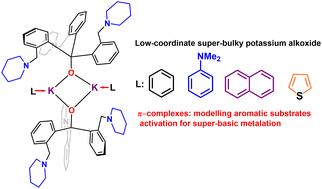
Metalation of bulky tris(2-(piperidin-1-yl-methyl)phenyl)methanol [(C5H10N)CH2C6H4-o]3COH with (Me3Si)2NK in Et2O results in a dimeric potassium alkoxide {[(C5H10N)CH2C6H4-o]3C(μ2-O)K(Et2O)}2 (1). The Et2O molecule can be removed from the K+ coordination sphere affording coordinatively unsaturated alkoxide species which readily traps π-donor molecules. In the presence of excess arene, the reactions result in ηn–π-complexes, retaining in the crystal state a dimeric core {[(C5H10N)CH2C6H4-o]3C(μ2-O)K(ηn-arene)}2 (arene = C6H6 (2), CH3C6H5 (3), C10H8 (4)). With C6H5OMe and C6H5NMe2 molecules containing competing n- and π-donating sites, the reactions proceed differently: the former coordinates to K+ through an oxygen lone pair resulting in {[(C5H10N)CH2C6H4-o]3C(μ2-O)K(κ1-O(Me)C6H5)}2 (5) while for the latter, π-arene interaction turns out to be preferable, yielding {[(C5H10N)CH2C6H4-o]3C(μ2-O)K(η2-C6H5NMe2)}2 (6). The reactions with equimolar amounts of benzene or thiophene afford coordination polymers [{[(C5H10N)CH2C6H4-o]3C(μ2-O)K}2(μ-C6H6)]n (7) and [{[(C5H10N)CH2C6H4-o]3C(μ2-O)K}2(μ-C4H4S)]n (8), in which benzene and thiophene molecules are μ-bridging two K+ ions. The treatment of {[(C5H10N)CH2C6H4-o]3C(μ2-O)K(η2-CH3C6H5))}2 with Me3SiCH2Li or n-BuLi (1.2 eq.) in hexane at 20 °C results in the facile metalation of the Me group of toluene, forming [PhCH2K]n and lithium alkoxide. This model reaction provides a deeper insight into the probable mechanism of metalation of CH bonds under Lochmann–Schlosser superbasic conditions, and the role and the nature of the synergistic effect of two metals. The calculations and QTAIM analysis were performed for 1–8 and model molecules as well.
期刊介绍:
Dalton Transactions is a journal for all areas of inorganic chemistry, which encompasses the organometallic, bioinorganic and materials chemistry of the elements, with applications including synthesis, catalysis, energy conversion/storage, electrical devices and medicine. Dalton Transactions welcomes high-quality, original submissions in all of these areas and more, where the advancement of knowledge in inorganic chemistry is significant.




 京公网安备 11010802042870号
京ICP备2023020795号-1
京公网安备 11010802042870号
京ICP备2023020795号-1

 分享
分享
 求助内容:
求助内容: 应助结果提醒方式:
 扫码关注我们
