{"title":"甲氧基喹啉非富勒烯受体对效率超过19%的有机太阳能电池的中心核心调控","authors":"Huijuan Bi, Dingding Qiu, Hao Zhang, Caixuan Wang, Mengying Wu, Xinya Ran, Jianqi Zhang, Yuheng Wang, Ailing Tang, Xinyang Miao, Zhixiang Wei, Kun Lu","doi":"10.1016/j.cej.2025.159972","DOIUrl":null,"url":null,"abstract":"The power conversion efficiency (PCE) of organic solar cells (OSCs) is intricately linked to the molecular design strategy of non-fullerene acceptors (NFAs). Researchers frequently modificated the end group and side chain in prior investigations. The central core of quinoxaline (Qx) possesses abundant modification sites, and the alkoxy groups exhibit high electron-accepting capability based on its <em>meta</em>-substitution. In this work, we designed and synthesized three small molecule acceptors (SMAs) with a phenyl substituted with an alkoxy group on their central core of quinoxaline, named Qx-B1, Qx-B2, and Qx-B3, respectively. The molecular backbones of these substances share similarities, yet the substitution points of methoxy groups are different, which significantly affect absorption, energy levels, electrostatic potentials, and molecular stacking of acceptors. As a result, the PM6:Qx-B2 device possessed excellent crystallinity and uniform morphology in the blend film, indicating outstanding charge transport and collection characteristics. This resulted in a high short-circuit current density (<em>J</em><sub>SC</sub>) of 25.97 mA cm<sup>−2</sup> and fill factor (FF) of 77.17 %, contributing to its champion PCE of 17.88 %. Furthermore, by using ternary and interface engineering strategies, when 15 wt% of BTP-eC9 was doped into the PM6:Qx-B2 two-component device as a guest acceptor, the 2PACz as the hole transparent layer, the device achieved a PCE of 19.25 %. This work investigates Qx-based asymmetric NFAs with three different methoxy substitution positions, suggesting a research direction for alkoxy substitution in the central core.","PeriodicalId":270,"journal":{"name":"Chemical Engineering Journal","volume":"206 1","pages":""},"PeriodicalIF":13.2000,"publicationDate":"2025-01-27","publicationTypes":"Journal Article","fieldsOfStudy":null,"isOpenAccess":false,"openAccessPdf":"","citationCount":"0","resultStr":"{\"title\":\"Central core regulation by methoxy in quinoxaline-based non-fullerene acceptors for over 19% efficiency organic solar cells\",\"authors\":\"Huijuan Bi, Dingding Qiu, Hao Zhang, Caixuan Wang, Mengying Wu, Xinya Ran, Jianqi Zhang, Yuheng Wang, Ailing Tang, Xinyang Miao, Zhixiang Wei, Kun Lu\",\"doi\":\"10.1016/j.cej.2025.159972\",\"DOIUrl\":null,\"url\":null,\"abstract\":\"The power conversion efficiency (PCE) of organic solar cells (OSCs) is intricately linked to the molecular design strategy of non-fullerene acceptors (NFAs). Researchers frequently modificated the end group and side chain in prior investigations. The central core of quinoxaline (Qx) possesses abundant modification sites, and the alkoxy groups exhibit high electron-accepting capability based on its <em>meta</em>-substitution. In this work, we designed and synthesized three small molecule acceptors (SMAs) with a phenyl substituted with an alkoxy group on their central core of quinoxaline, named Qx-B1, Qx-B2, and Qx-B3, respectively. The molecular backbones of these substances share similarities, yet the substitution points of methoxy groups are different, which significantly affect absorption, energy levels, electrostatic potentials, and molecular stacking of acceptors. As a result, the PM6:Qx-B2 device possessed excellent crystallinity and uniform morphology in the blend film, indicating outstanding charge transport and collection characteristics. This resulted in a high short-circuit current density (<em>J</em><sub>SC</sub>) of 25.97 mA cm<sup>−2</sup> and fill factor (FF) of 77.17 %, contributing to its champion PCE of 17.88 %. Furthermore, by using ternary and interface engineering strategies, when 15 wt% of BTP-eC9 was doped into the PM6:Qx-B2 two-component device as a guest acceptor, the 2PACz as the hole transparent layer, the device achieved a PCE of 19.25 %. This work investigates Qx-based asymmetric NFAs with three different methoxy substitution positions, suggesting a research direction for alkoxy substitution in the central core.\",\"PeriodicalId\":270,\"journal\":{\"name\":\"Chemical Engineering Journal\",\"volume\":\"206 1\",\"pages\":\"\"},\"PeriodicalIF\":13.2000,\"publicationDate\":\"2025-01-27\",\"publicationTypes\":\"Journal Article\",\"fieldsOfStudy\":null,\"isOpenAccess\":false,\"openAccessPdf\":\"\",\"citationCount\":\"0\",\"resultStr\":null,\"platform\":\"Semanticscholar\",\"paperid\":null,\"PeriodicalName\":\"Chemical Engineering Journal\",\"FirstCategoryId\":\"5\",\"ListUrlMain\":\"https://doi.org/10.1016/j.cej.2025.159972\",\"RegionNum\":1,\"RegionCategory\":\"工程技术\",\"ArticlePicture\":[],\"TitleCN\":null,\"AbstractTextCN\":null,\"PMCID\":null,\"EPubDate\":\"\",\"PubModel\":\"\",\"JCR\":\"Q1\",\"JCRName\":\"ENGINEERING, CHEMICAL\",\"Score\":null,\"Total\":0}","platform":"Semanticscholar","paperid":null,"PeriodicalName":"Chemical Engineering Journal","FirstCategoryId":"5","ListUrlMain":"https://doi.org/10.1016/j.cej.2025.159972","RegionNum":1,"RegionCategory":"工程技术","ArticlePicture":[],"TitleCN":null,"AbstractTextCN":null,"PMCID":null,"EPubDate":"","PubModel":"","JCR":"Q1","JCRName":"ENGINEERING, CHEMICAL","Score":null,"Total":0}
引用次数: 0
摘要
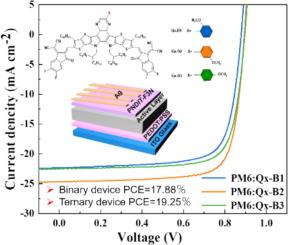
有机太阳能电池(OSCs)的功率转换效率(PCE)与非富勒烯受体(nfa)的分子设计策略有着复杂的联系。在先前的研究中,研究人员经常修改端基和侧链。喹诺啉(Qx)的中心核具有丰富的修饰位点,其烷氧基由于其元取代而表现出较高的电子接受能力。在这项工作中,我们设计并合成了三种以苯基取代烷氧基的小分子受体(sma),分别命名为Qx-B1, Qx-B2和Qx-B3。这些物质的分子骨架具有相似性,但甲氧基取代点不同,这对受体的吸收、能级、静电势和分子堆积有显著影响。结果表明,PM6:Qx-B2器件在共混膜中具有优异的结晶度和均匀的形貌,具有出色的电荷输运和收集特性。这导致了25.97 mA cm−2的高短路电流密度(JSC)和77.17 %的填充因子(FF),使其PCE达到17.88 %的冠军。此外,通过三元和界面工程策略,将15 wt%的BTP-eC9作为客体受体掺杂到PM6:Qx-B2双组分器件中,2PACz作为空穴透明层,器件的PCE达到19.25 %。本文研究了基于qx的三种不同甲氧基取代位置的不对称nfa,为中心核心的烷氧基取代提供了研究方向。
Central core regulation by methoxy in quinoxaline-based non-fullerene acceptors for over 19% efficiency organic solar cells
The power conversion efficiency (PCE) of organic solar cells (OSCs) is intricately linked to the molecular design strategy of non-fullerene acceptors (NFAs). Researchers frequently modificated the end group and side chain in prior investigations. The central core of quinoxaline (Qx) possesses abundant modification sites, and the alkoxy groups exhibit high electron-accepting capability based on its meta-substitution. In this work, we designed and synthesized three small molecule acceptors (SMAs) with a phenyl substituted with an alkoxy group on their central core of quinoxaline, named Qx-B1, Qx-B2, and Qx-B3, respectively. The molecular backbones of these substances share similarities, yet the substitution points of methoxy groups are different, which significantly affect absorption, energy levels, electrostatic potentials, and molecular stacking of acceptors. As a result, the PM6:Qx-B2 device possessed excellent crystallinity and uniform morphology in the blend film, indicating outstanding charge transport and collection characteristics. This resulted in a high short-circuit current density (JSC) of 25.97 mA cm−2 and fill factor (FF) of 77.17 %, contributing to its champion PCE of 17.88 %. Furthermore, by using ternary and interface engineering strategies, when 15 wt% of BTP-eC9 was doped into the PM6:Qx-B2 two-component device as a guest acceptor, the 2PACz as the hole transparent layer, the device achieved a PCE of 19.25 %. This work investigates Qx-based asymmetric NFAs with three different methoxy substitution positions, suggesting a research direction for alkoxy substitution in the central core.
期刊介绍:
The Chemical Engineering Journal is an international research journal that invites contributions of original and novel fundamental research. It aims to provide an international platform for presenting original fundamental research, interpretative reviews, and discussions on new developments in chemical engineering. The journal welcomes papers that describe novel theory and its practical application, as well as those that demonstrate the transfer of techniques from other disciplines. It also welcomes reports on carefully conducted experimental work that is soundly interpreted. The main focus of the journal is on original and rigorous research results that have broad significance. The Catalysis section within the Chemical Engineering Journal focuses specifically on Experimental and Theoretical studies in the fields of heterogeneous catalysis, molecular catalysis, and biocatalysis. These studies have industrial impact on various sectors such as chemicals, energy, materials, foods, healthcare, and environmental protection.




 京公网安备 11010802042870号
京ICP备2023020795号-1
京公网安备 11010802042870号
京ICP备2023020795号-1

 分享
分享
 求助内容:
求助内容: 应助结果提醒方式:
 扫码关注我们
