Kaylen R. Meeks , Juan Ji , Gary K. Scott , Ashley C. Campbell , Jay C. Nix , Ada Tadeo , Lisa M. Ellerby , Christopher C. Benz , John J. Tanner
{"title":"s -但-3-yn-2-甘氨酸作为黄嘌呤脱氢酶共价灭活剂的生化、结构和细胞特性。","authors":"Kaylen R. Meeks , Juan Ji , Gary K. Scott , Ashley C. Campbell , Jay C. Nix , Ada Tadeo , Lisa M. Ellerby , Christopher C. Benz , John J. Tanner","doi":"10.1016/j.abb.2025.110319","DOIUrl":null,"url":null,"abstract":"<div><div>The mitochondrial flavoenzymes proline dehydrogenase (PRODH) and hydroxyproline dehydrogenase (PRODH2) catalyze the first steps of proline and hydroxyproline catabolism, respectively. The enzymes are targets for chemical probe development because of their roles in cancer cell metabolism (PRODH) and primary hyperoxaluria (PRODH2). Mechanism-based inactivators of PRODH target the FAD by covalently modifying the N5 atom, with N-propargylglycine (NPPG) being the current best-in-class of this type of probe. Here we investigated a close analog of NPPG, but-3-yn-2-ylglycine (B32G), distinguished by having a methyl group adjacent to the ethynyl group of the propargyl warhead. UV–visible spectroscopy shows that a bacterial PRODH catalyzes the oxidation of the S-enantiomer of B32G, a necessary first step in mechanism-based inactivation. In contrast, the enzyme does not react with the R-enantiomer. Enzyme activity assays show that S–B32G inhibits bacterial PRODH in a time-dependent manner consistent with covalent inactivation; however, the inactivation efficiency is ∼600-times lower than NPPG. We generated the crystal structure of PRODH inactivated by S–B32G at 1.68 Å resolution and found that inactivation induces a covalent link between the FAD N5 and the ε-nitrogen of an active site lysine, confirming that S–B32G follows the same mechanism as NPPG. Despite its lower inactivation efficiency at the purified bacterial enzyme, S–B32G exhibited comparable activity to NPPG against PRODH and PRODH2 in human cells and mouse livers. Molecular modeling is used to rationalize the stereospecificity of B32G.</div></div>","PeriodicalId":8174,"journal":{"name":"Archives of biochemistry and biophysics","volume":"765 ","pages":"Article 110319"},"PeriodicalIF":3.0000,"publicationDate":"2025-03-01","publicationTypes":"Journal Article","fieldsOfStudy":null,"isOpenAccess":false,"openAccessPdf":"","citationCount":"0","resultStr":"{\"title\":\"Biochemical, structural, and cellular characterization of S-but-3-yn-2-ylglycine as a mechanism-based covalent inactivator of the flavoenzyme proline dehydrogenase\",\"authors\":\"Kaylen R. Meeks , Juan Ji , Gary K. Scott , Ashley C. Campbell , Jay C. Nix , Ada Tadeo , Lisa M. Ellerby , Christopher C. Benz , John J. Tanner\",\"doi\":\"10.1016/j.abb.2025.110319\",\"DOIUrl\":null,\"url\":null,\"abstract\":\"<div><div>The mitochondrial flavoenzymes proline dehydrogenase (PRODH) and hydroxyproline dehydrogenase (PRODH2) catalyze the first steps of proline and hydroxyproline catabolism, respectively. The enzymes are targets for chemical probe development because of their roles in cancer cell metabolism (PRODH) and primary hyperoxaluria (PRODH2). Mechanism-based inactivators of PRODH target the FAD by covalently modifying the N5 atom, with N-propargylglycine (NPPG) being the current best-in-class of this type of probe. Here we investigated a close analog of NPPG, but-3-yn-2-ylglycine (B32G), distinguished by having a methyl group adjacent to the ethynyl group of the propargyl warhead. UV–visible spectroscopy shows that a bacterial PRODH catalyzes the oxidation of the S-enantiomer of B32G, a necessary first step in mechanism-based inactivation. In contrast, the enzyme does not react with the R-enantiomer. Enzyme activity assays show that S–B32G inhibits bacterial PRODH in a time-dependent manner consistent with covalent inactivation; however, the inactivation efficiency is ∼600-times lower than NPPG. We generated the crystal structure of PRODH inactivated by S–B32G at 1.68 Å resolution and found that inactivation induces a covalent link between the FAD N5 and the ε-nitrogen of an active site lysine, confirming that S–B32G follows the same mechanism as NPPG. Despite its lower inactivation efficiency at the purified bacterial enzyme, S–B32G exhibited comparable activity to NPPG against PRODH and PRODH2 in human cells and mouse livers. Molecular modeling is used to rationalize the stereospecificity of B32G.</div></div>\",\"PeriodicalId\":8174,\"journal\":{\"name\":\"Archives of biochemistry and biophysics\",\"volume\":\"765 \",\"pages\":\"Article 110319\"},\"PeriodicalIF\":3.0000,\"publicationDate\":\"2025-03-01\",\"publicationTypes\":\"Journal Article\",\"fieldsOfStudy\":null,\"isOpenAccess\":false,\"openAccessPdf\":\"\",\"citationCount\":\"0\",\"resultStr\":null,\"platform\":\"Semanticscholar\",\"paperid\":null,\"PeriodicalName\":\"Archives of biochemistry and biophysics\",\"FirstCategoryId\":\"99\",\"ListUrlMain\":\"https://www.sciencedirect.com/science/article/pii/S0003986125000323\",\"RegionNum\":3,\"RegionCategory\":\"生物学\",\"ArticlePicture\":[],\"TitleCN\":null,\"AbstractTextCN\":null,\"PMCID\":null,\"EPubDate\":\"2025/1/25 0:00:00\",\"PubModel\":\"Epub\",\"JCR\":\"Q2\",\"JCRName\":\"BIOCHEMISTRY & MOLECULAR BIOLOGY\",\"Score\":null,\"Total\":0}","platform":"Semanticscholar","paperid":null,"PeriodicalName":"Archives of biochemistry and biophysics","FirstCategoryId":"99","ListUrlMain":"https://www.sciencedirect.com/science/article/pii/S0003986125000323","RegionNum":3,"RegionCategory":"生物学","ArticlePicture":[],"TitleCN":null,"AbstractTextCN":null,"PMCID":null,"EPubDate":"2025/1/25 0:00:00","PubModel":"Epub","JCR":"Q2","JCRName":"BIOCHEMISTRY & MOLECULAR BIOLOGY","Score":null,"Total":0}
引用次数: 0
摘要
线粒体黄酶脯氨酸脱氢酶(PRODH)和羟脯氨酸脱氢酶(PRODH2)分别催化脯氨酸和羟脯氨酸分解代谢的第一步。这些酶是化学探针开发的目标,因为它们在癌细胞代谢(PRODH)和原发性高草酸尿(PRODH2)中起作用。基于机制的PRODH灭活剂通过共价修饰N5原子靶向FAD,其中n-丙基甘氨酸(NPPG)是目前同类探针中最好的。在这里,我们研究了NPPG的类似物,但是-3- yn2 -ylglycine (B32G),其区别在于丙炔战斗部的乙基附近有一个甲基。紫外可见光谱显示,细菌PRODH催化B32G s -对映体的氧化,这是基于机制失活的必要第一步。相反,酶不与r -对映体反应。酶活性测定表明,S-B32G抑制细菌PRODH具有时间依赖性,与共价失活一致;然而,它的失活效率比NPPG低约600倍。我们以1.68 Å的分辨率生成了S-B32G失活后的PRODH晶体结构,发现失活诱导了FAD N5与活性位点赖氨酸的ε-氮之间的共价连接,证实了S-B32G与NPPG遵循相同的机制。尽管S-B32G对纯化细菌酶的失活效率较低,但在人细胞和小鼠肝脏中,S-B32G对PRODH和PRODH2的活性与NPPG相当。采用分子模拟方法合理化B32G的立体特异性。
Biochemical, structural, and cellular characterization of S-but-3-yn-2-ylglycine as a mechanism-based covalent inactivator of the flavoenzyme proline dehydrogenase
The mitochondrial flavoenzymes proline dehydrogenase (PRODH) and hydroxyproline dehydrogenase (PRODH2) catalyze the first steps of proline and hydroxyproline catabolism, respectively. The enzymes are targets for chemical probe development because of their roles in cancer cell metabolism (PRODH) and primary hyperoxaluria (PRODH2). Mechanism-based inactivators of PRODH target the FAD by covalently modifying the N5 atom, with N-propargylglycine (NPPG) being the current best-in-class of this type of probe. Here we investigated a close analog of NPPG, but-3-yn-2-ylglycine (B32G), distinguished by having a methyl group adjacent to the ethynyl group of the propargyl warhead. UV–visible spectroscopy shows that a bacterial PRODH catalyzes the oxidation of the S-enantiomer of B32G, a necessary first step in mechanism-based inactivation. In contrast, the enzyme does not react with the R-enantiomer. Enzyme activity assays show that S–B32G inhibits bacterial PRODH in a time-dependent manner consistent with covalent inactivation; however, the inactivation efficiency is ∼600-times lower than NPPG. We generated the crystal structure of PRODH inactivated by S–B32G at 1.68 Å resolution and found that inactivation induces a covalent link between the FAD N5 and the ε-nitrogen of an active site lysine, confirming that S–B32G follows the same mechanism as NPPG. Despite its lower inactivation efficiency at the purified bacterial enzyme, S–B32G exhibited comparable activity to NPPG against PRODH and PRODH2 in human cells and mouse livers. Molecular modeling is used to rationalize the stereospecificity of B32G.
期刊介绍:
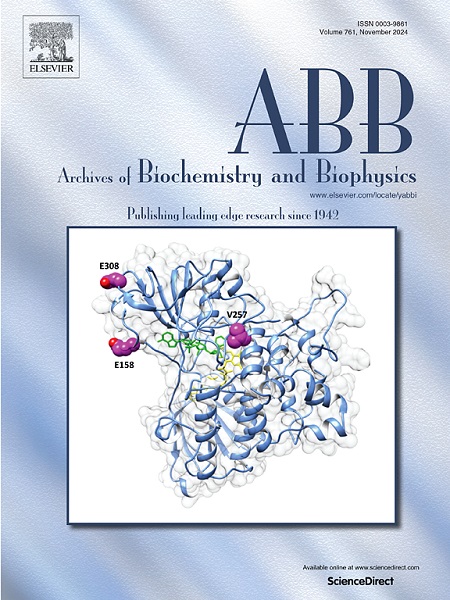
Archives of Biochemistry and Biophysics publishes quality original articles and reviews in the developing areas of biochemistry and biophysics.
Research Areas Include:
• Enzyme and protein structure, function, regulation. Folding, turnover, and post-translational processing
• Biological oxidations, free radical reactions, redox signaling, oxygenases, P450 reactions
• Signal transduction, receptors, membrane transport, intracellular signals. Cellular and integrated metabolism.





 京公网安备 11010802042870号
京ICP备2023020795号-1
京公网安备 11010802042870号
京ICP备2023020795号-1

 分享
分享
 求助内容:
求助内容: 应助结果提醒方式:
 扫码关注我们
