Takeru Kondo , Hiroaki Kakinuma , Sara Ambo , Koki Otake , Yumi Sato , Hiroshi Egusa
{"title":"双固化树脂-水泥固化方式对牙龈细胞毒性及炎症反应的影响。","authors":"Takeru Kondo , Hiroaki Kakinuma , Sara Ambo , Koki Otake , Yumi Sato , Hiroshi Egusa","doi":"10.1016/j.jds.2024.04.019","DOIUrl":null,"url":null,"abstract":"<div><h3>Background/purpose</h3><div>Dual-cure resin-cements are used for various dental restorations. However, whether the curing modes of these resin-cements influence gingival inflammation remains unclear. Hence, herein, we evaluated the effects of dual-cure resin-cement curing modes on gingival cytotoxicity and inflammatory responses.</div></div><div><h3>Materials and methods</h3><div>Specimens were prepared using two dual-cure resin-cements—RelyX Unicem 2 (RU) and G-CEM ONE (GO)—by light-cure or self-cure modes. Degree of conversion (DC) and monomer elution of the resin-cements were measured using Fourier-transform infrared spectroscopy and high-performance liquid chromatography, respectively. Human gingival fibroblasts (GFs) and macrophages were cultured on resin-cements, and inflammatory cytokine levels, intracellular reactive oxygen species (ROS) generation, and mitogen-activated protein (MAP) kinase activation were evaluated.</div></div><div><h3>Results</h3><div>Light-cured (LC) resin-cements exhibited significantly higher DC and lower monomer elution than did self-cured (SC) resin-cements. Triethyleneglycol dimethacrylate (TEGDMA) and urethane dimethacrylate (UDMA) were substantially eluted from RU and GO, respectively. Neither LC resin-cement exhibited cytotoxicity and enhanced pro-inflammatory cytokine expression in GFs and macrophages. However, both SC resin-cements significantly decreased cell numbers and promoted cellular inflammatory responses. SC generated higher intracellular ROS levels compared to that seen with LC, and different patterns of MAP kinase activation were observed between SC–RU and SC–GO.</div></div><div><h3>Conclusion</h3><div>Compared with LC dual-cure resin-cements, SC dual-cure resin-cements show stronger cytotoxicity and elicit greater inflammatory responses in gingival cells owing to residual monomers (e.g., TEGDMA and UDMA) by activating MAP kinases in GFs and macrophages. Clinicians should ensure adequate light irradiation during prosthesis cementation and make efforts to remove the excess cement.</div></div>","PeriodicalId":15583,"journal":{"name":"Journal of Dental Sciences","volume":"20 1","pages":"Pages 586-595"},"PeriodicalIF":3.1000,"publicationDate":"2025-01-01","publicationTypes":"Journal Article","fieldsOfStudy":null,"isOpenAccess":false,"openAccessPdf":"https://www.ncbi.nlm.nih.gov/pmc/articles/PMC11762211/pdf/","citationCount":"0","resultStr":"{\"title\":\"Influence of dual-cure resin-cement curing modes on gingival cytotoxicity and inflammatory responses\",\"authors\":\"Takeru Kondo , Hiroaki Kakinuma , Sara Ambo , Koki Otake , Yumi Sato , Hiroshi Egusa\",\"doi\":\"10.1016/j.jds.2024.04.019\",\"DOIUrl\":null,\"url\":null,\"abstract\":\"<div><h3>Background/purpose</h3><div>Dual-cure resin-cements are used for various dental restorations. However, whether the curing modes of these resin-cements influence gingival inflammation remains unclear. Hence, herein, we evaluated the effects of dual-cure resin-cement curing modes on gingival cytotoxicity and inflammatory responses.</div></div><div><h3>Materials and methods</h3><div>Specimens were prepared using two dual-cure resin-cements—RelyX Unicem 2 (RU) and G-CEM ONE (GO)—by light-cure or self-cure modes. Degree of conversion (DC) and monomer elution of the resin-cements were measured using Fourier-transform infrared spectroscopy and high-performance liquid chromatography, respectively. Human gingival fibroblasts (GFs) and macrophages were cultured on resin-cements, and inflammatory cytokine levels, intracellular reactive oxygen species (ROS) generation, and mitogen-activated protein (MAP) kinase activation were evaluated.</div></div><div><h3>Results</h3><div>Light-cured (LC) resin-cements exhibited significantly higher DC and lower monomer elution than did self-cured (SC) resin-cements. Triethyleneglycol dimethacrylate (TEGDMA) and urethane dimethacrylate (UDMA) were substantially eluted from RU and GO, respectively. Neither LC resin-cement exhibited cytotoxicity and enhanced pro-inflammatory cytokine expression in GFs and macrophages. However, both SC resin-cements significantly decreased cell numbers and promoted cellular inflammatory responses. SC generated higher intracellular ROS levels compared to that seen with LC, and different patterns of MAP kinase activation were observed between SC–RU and SC–GO.</div></div><div><h3>Conclusion</h3><div>Compared with LC dual-cure resin-cements, SC dual-cure resin-cements show stronger cytotoxicity and elicit greater inflammatory responses in gingival cells owing to residual monomers (e.g., TEGDMA and UDMA) by activating MAP kinases in GFs and macrophages. Clinicians should ensure adequate light irradiation during prosthesis cementation and make efforts to remove the excess cement.</div></div>\",\"PeriodicalId\":15583,\"journal\":{\"name\":\"Journal of Dental Sciences\",\"volume\":\"20 1\",\"pages\":\"Pages 586-595\"},\"PeriodicalIF\":3.1000,\"publicationDate\":\"2025-01-01\",\"publicationTypes\":\"Journal Article\",\"fieldsOfStudy\":null,\"isOpenAccess\":false,\"openAccessPdf\":\"https://www.ncbi.nlm.nih.gov/pmc/articles/PMC11762211/pdf/\",\"citationCount\":\"0\",\"resultStr\":null,\"platform\":\"Semanticscholar\",\"paperid\":null,\"PeriodicalName\":\"Journal of Dental Sciences\",\"FirstCategoryId\":\"3\",\"ListUrlMain\":\"https://www.sciencedirect.com/science/article/pii/S199179022400134X\",\"RegionNum\":3,\"RegionCategory\":\"医学\",\"ArticlePicture\":[],\"TitleCN\":null,\"AbstractTextCN\":null,\"PMCID\":null,\"EPubDate\":\"2024/4/30 0:00:00\",\"PubModel\":\"Epub\",\"JCR\":\"Q1\",\"JCRName\":\"DENTISTRY, ORAL SURGERY & MEDICINE\",\"Score\":null,\"Total\":0}","platform":"Semanticscholar","paperid":null,"PeriodicalName":"Journal of Dental Sciences","FirstCategoryId":"3","ListUrlMain":"https://www.sciencedirect.com/science/article/pii/S199179022400134X","RegionNum":3,"RegionCategory":"医学","ArticlePicture":[],"TitleCN":null,"AbstractTextCN":null,"PMCID":null,"EPubDate":"2024/4/30 0:00:00","PubModel":"Epub","JCR":"Q1","JCRName":"DENTISTRY, ORAL SURGERY & MEDICINE","Score":null,"Total":0}
引用次数: 0
摘要
背景/目的:双固化树脂水泥用于各种牙体修复。然而,这些树脂胶结物的固化方式是否影响牙龈炎症尚不清楚。因此,在此,我们评估了双固化树脂-水泥固化模式对牙龈细胞毒性和炎症反应的影响。材料和方法:采用两种双固化树脂水泥- relyx Unicem 2 (RU)和G-CEM ONE (GO)-光固化或自固化方式制备标本。分别采用傅里叶变换红外光谱和高效液相色谱法测定树脂水泥的转化率和单体洗脱度。在树脂水泥上培养人牙龈成纤维细胞(GFs)和巨噬细胞,评估炎症细胞因子水平、细胞内活性氧(ROS)生成和丝裂原活化蛋白(MAP)激酶激活。结果:光固化(LC)树脂水泥比自固化(SC)树脂水泥表现出更高的DC和更低的单体洗脱。三乙二醇二甲基丙烯酸酯(TEGDMA)和聚氨酯二甲基丙烯酸酯(UDMA)分别从RU和GO中大量洗脱。LC树脂水泥在GFs和巨噬细胞中均未表现出细胞毒性和促炎细胞因子表达的增强。然而,两种SC树脂水泥都能显著减少细胞数量并促进细胞炎症反应。与LC相比,SC产生了更高的细胞内ROS水平,SC- ru和SC- go之间观察到不同的MAP激酶激活模式。结论:与LC双固化树脂水泥相比,SC双固化树脂水泥通过激活GFs和巨噬细胞中的MAP激酶,使残留的单体(如TEGDMA和UDMA)在牙龈细胞中表现出更强的细胞毒性,引起更大的炎症反应。临床医生应确保在假体骨水泥过程中有足够的光照,并努力去除多余的骨水泥。
Influence of dual-cure resin-cement curing modes on gingival cytotoxicity and inflammatory responses
Background/purpose
Dual-cure resin-cements are used for various dental restorations. However, whether the curing modes of these resin-cements influence gingival inflammation remains unclear. Hence, herein, we evaluated the effects of dual-cure resin-cement curing modes on gingival cytotoxicity and inflammatory responses.
Materials and methods
Specimens were prepared using two dual-cure resin-cements—RelyX Unicem 2 (RU) and G-CEM ONE (GO)—by light-cure or self-cure modes. Degree of conversion (DC) and monomer elution of the resin-cements were measured using Fourier-transform infrared spectroscopy and high-performance liquid chromatography, respectively. Human gingival fibroblasts (GFs) and macrophages were cultured on resin-cements, and inflammatory cytokine levels, intracellular reactive oxygen species (ROS) generation, and mitogen-activated protein (MAP) kinase activation were evaluated.
Results
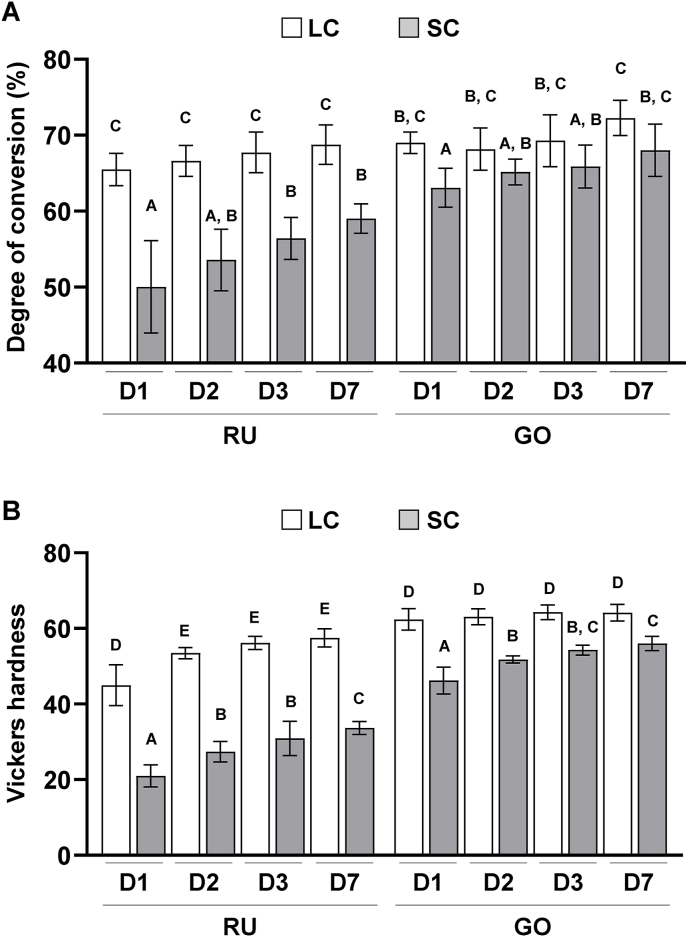
Light-cured (LC) resin-cements exhibited significantly higher DC and lower monomer elution than did self-cured (SC) resin-cements. Triethyleneglycol dimethacrylate (TEGDMA) and urethane dimethacrylate (UDMA) were substantially eluted from RU and GO, respectively. Neither LC resin-cement exhibited cytotoxicity and enhanced pro-inflammatory cytokine expression in GFs and macrophages. However, both SC resin-cements significantly decreased cell numbers and promoted cellular inflammatory responses. SC generated higher intracellular ROS levels compared to that seen with LC, and different patterns of MAP kinase activation were observed between SC–RU and SC–GO.
Conclusion
Compared with LC dual-cure resin-cements, SC dual-cure resin-cements show stronger cytotoxicity and elicit greater inflammatory responses in gingival cells owing to residual monomers (e.g., TEGDMA and UDMA) by activating MAP kinases in GFs and macrophages. Clinicians should ensure adequate light irradiation during prosthesis cementation and make efforts to remove the excess cement.
期刊介绍:
he Journal of Dental Sciences (JDS), published quarterly, is the official and open access publication of the Association for Dental Sciences of the Republic of China (ADS-ROC). The precedent journal of the JDS is the Chinese Dental Journal (CDJ) which had already been covered by MEDLINE in 1988. As the CDJ continued to prove its importance in the region, the ADS-ROC decided to move to the international community by publishing an English journal. Hence, the birth of the JDS in 2006. The JDS is indexed in the SCI Expanded since 2008. It is also indexed in Scopus, and EMCare, ScienceDirect, SIIC Data Bases.
The topics covered by the JDS include all fields of basic and clinical dentistry. Some manuscripts focusing on the study of certain endemic diseases such as dental caries and periodontal diseases in particular regions of any country as well as oral pre-cancers, oral cancers, and oral submucous fibrosis related to betel nut chewing habit are also considered for publication. Besides, the JDS also publishes articles about the efficacy of a new treatment modality on oral verrucous hyperplasia or early oral squamous cell carcinoma.






 京公网安备 11010802042870号
京ICP备2023020795号-1
京公网安备 11010802042870号
京ICP备2023020795号-1

 分享
分享
 求助内容:
求助内容: 应助结果提醒方式:
 扫码关注我们
