Alireza Malektojari MD , Zahra Javidfar , Sara Ghazizadeh MD , Shaghayegh Lahuti MD , Rahele Shokraei MD , Mohadeseh Zeinaee , Amirhosein Badele , Raziyeh Mirzadeh , Mitra Ashrafi MD , Fateme Afra , Mohammad Hamed Ersi , Marziyeh Heydari , Ava Ziaei MD , Zohreh Rezvani , Jasmine Mah MD, MSc , Dena Zeraatkar PhD , Shahin Abbaszadeh MD, AP , Tyler Pitre MD, MA
{"title":"抗炎药预防心脏手术后房颤的有效性:系统综述和网络荟萃分析。","authors":"Alireza Malektojari MD , Zahra Javidfar , Sara Ghazizadeh MD , Shaghayegh Lahuti MD , Rahele Shokraei MD , Mohadeseh Zeinaee , Amirhosein Badele , Raziyeh Mirzadeh , Mitra Ashrafi MD , Fateme Afra , Mohammad Hamed Ersi , Marziyeh Heydari , Ava Ziaei MD , Zohreh Rezvani , Jasmine Mah MD, MSc , Dena Zeraatkar PhD , Shahin Abbaszadeh MD, AP , Tyler Pitre MD, MA","doi":"10.1016/j.cjco.2024.10.008","DOIUrl":null,"url":null,"abstract":"<div><h3>Background</h3><div>Preventing postoperative atrial fibrillation (POAF) as one of the most significant complications of cardiovascular surgeries remains a major clinical challenge. We conducted a systematic review with network meta-analysis of randomized controlled trials, to identify the most effective and safe anti-inflammatory drugs to prevent new-onset POAF.</div></div><div><h3>Methods</h3><div>MEDLINE, Embase, Web of Science, and Cochrane Library were searched without language or publication-date restriction on August 8, 2022 (updated on August 8, 2023). We assessed the risk of bias of included trials using the Cochrane risk-of-bias 2.0 tool. We conducted a frequentist random-effects network meta-analysis in R, and we assessed the certainty of evidence using the Grading of Recommendations, Assessment, Development, and Evaluations (GRADE) approach.</div></div><div><h3>Results</h3><div>A total of 85 trials reported the incidence of new-onset POAF, including 18,981 patients. Use of nonsteroidal anti-inflammatory drugs (relative risk [RR] 0.37 [95% confidence interval [CI] 0.23-0.59]) and statins (RR 0.56 [95% CI 0.45-0.7]) potentially reduced the risk of POAF compared with placebo (both with a moderate certainty level). Use of fish oil in combination with vitamins C and E (RR 0.30 [95% CI 0.13-0.68]) may reduce the risk of POAF, compared with placebo (low level of certainty). Use of colchicine (RR 0.62 [95% CI 0.45- 0.85]), corticosteroids (RR 0.70 [95% CI 0.59-0.82]), and N-acetylcysteine (RR 0.69 [95% CI 0.49- 0.98]) may reduce the risk of POAF (all with a low level of certainty). None of the interventions had a significant effect on mortality rate or risk of serious adverse effects.</div></div><div><h3>Conclusions</h3><div>Use of nonsteroidal anti-inflammatory drugs and statins probably are effective in preventing new-onset POAF, with a moderate level of certainty, compared to placebo.</div></div>","PeriodicalId":36924,"journal":{"name":"CJC Open","volume":"7 1","pages":"Pages 35-45"},"PeriodicalIF":2.1000,"publicationDate":"2025-01-01","publicationTypes":"Journal Article","fieldsOfStudy":null,"isOpenAccess":false,"openAccessPdf":"https://www.ncbi.nlm.nih.gov/pmc/articles/PMC11763850/pdf/","citationCount":"0","resultStr":"{\"title\":\"Effectiveness of Anti-Inflammatory Agents to Prevent Atrial Fibrillation After Cardiac Surgery: A Systematic Review and Network Meta-Analysis\",\"authors\":\"Alireza Malektojari MD , Zahra Javidfar , Sara Ghazizadeh MD , Shaghayegh Lahuti MD , Rahele Shokraei MD , Mohadeseh Zeinaee , Amirhosein Badele , Raziyeh Mirzadeh , Mitra Ashrafi MD , Fateme Afra , Mohammad Hamed Ersi , Marziyeh Heydari , Ava Ziaei MD , Zohreh Rezvani , Jasmine Mah MD, MSc , Dena Zeraatkar PhD , Shahin Abbaszadeh MD, AP , Tyler Pitre MD, MA\",\"doi\":\"10.1016/j.cjco.2024.10.008\",\"DOIUrl\":null,\"url\":null,\"abstract\":\"<div><h3>Background</h3><div>Preventing postoperative atrial fibrillation (POAF) as one of the most significant complications of cardiovascular surgeries remains a major clinical challenge. We conducted a systematic review with network meta-analysis of randomized controlled trials, to identify the most effective and safe anti-inflammatory drugs to prevent new-onset POAF.</div></div><div><h3>Methods</h3><div>MEDLINE, Embase, Web of Science, and Cochrane Library were searched without language or publication-date restriction on August 8, 2022 (updated on August 8, 2023). We assessed the risk of bias of included trials using the Cochrane risk-of-bias 2.0 tool. We conducted a frequentist random-effects network meta-analysis in R, and we assessed the certainty of evidence using the Grading of Recommendations, Assessment, Development, and Evaluations (GRADE) approach.</div></div><div><h3>Results</h3><div>A total of 85 trials reported the incidence of new-onset POAF, including 18,981 patients. Use of nonsteroidal anti-inflammatory drugs (relative risk [RR] 0.37 [95% confidence interval [CI] 0.23-0.59]) and statins (RR 0.56 [95% CI 0.45-0.7]) potentially reduced the risk of POAF compared with placebo (both with a moderate certainty level). Use of fish oil in combination with vitamins C and E (RR 0.30 [95% CI 0.13-0.68]) may reduce the risk of POAF, compared with placebo (low level of certainty). Use of colchicine (RR 0.62 [95% CI 0.45- 0.85]), corticosteroids (RR 0.70 [95% CI 0.59-0.82]), and N-acetylcysteine (RR 0.69 [95% CI 0.49- 0.98]) may reduce the risk of POAF (all with a low level of certainty). None of the interventions had a significant effect on mortality rate or risk of serious adverse effects.</div></div><div><h3>Conclusions</h3><div>Use of nonsteroidal anti-inflammatory drugs and statins probably are effective in preventing new-onset POAF, with a moderate level of certainty, compared to placebo.</div></div>\",\"PeriodicalId\":36924,\"journal\":{\"name\":\"CJC Open\",\"volume\":\"7 1\",\"pages\":\"Pages 35-45\"},\"PeriodicalIF\":2.1000,\"publicationDate\":\"2025-01-01\",\"publicationTypes\":\"Journal Article\",\"fieldsOfStudy\":null,\"isOpenAccess\":false,\"openAccessPdf\":\"https://www.ncbi.nlm.nih.gov/pmc/articles/PMC11763850/pdf/\",\"citationCount\":\"0\",\"resultStr\":null,\"platform\":\"Semanticscholar\",\"paperid\":null,\"PeriodicalName\":\"CJC Open\",\"FirstCategoryId\":\"1085\",\"ListUrlMain\":\"https://www.sciencedirect.com/science/article/pii/S2589790X24005134\",\"RegionNum\":0,\"RegionCategory\":null,\"ArticlePicture\":[],\"TitleCN\":null,\"AbstractTextCN\":null,\"PMCID\":null,\"EPubDate\":\"2024/10/29 0:00:00\",\"PubModel\":\"Epub\",\"JCR\":\"Q2\",\"JCRName\":\"CARDIAC & CARDIOVASCULAR SYSTEMS\",\"Score\":null,\"Total\":0}","platform":"Semanticscholar","paperid":null,"PeriodicalName":"CJC Open","FirstCategoryId":"1085","ListUrlMain":"https://www.sciencedirect.com/science/article/pii/S2589790X24005134","RegionNum":0,"RegionCategory":null,"ArticlePicture":[],"TitleCN":null,"AbstractTextCN":null,"PMCID":null,"EPubDate":"2024/10/29 0:00:00","PubModel":"Epub","JCR":"Q2","JCRName":"CARDIAC & CARDIOVASCULAR SYSTEMS","Score":null,"Total":0}
引用次数: 0
摘要
背景:预防术后心房颤动(POAF)作为心血管手术最重要的并发症之一仍然是一个主要的临床挑战。我们通过随机对照试验的网络荟萃分析进行了系统评价,以确定预防新发POAF最有效和安全的抗炎药物。方法:于2022年8月8日(更新于2023年8月8日)检索MEDLINE、Embase、Web of Science和Cochrane Library,无语言和出版日期限制。我们使用Cochrane风险偏倚2.0工具评估纳入试验的偏倚风险。我们在R中进行了频率随机效应网络荟萃分析,并使用推荐、评估、发展和评估分级(GRADE)方法评估了证据的确定性。结果:共有85项试验报告了新发POAF的发病率,包括18981例患者。使用非甾体类抗炎药(相对危险度[RR] 0.37[95%可信区间[CI] 0.23-0.59])和他汀类药物(相对危险度[RR] 0.56[95%可信区间[CI] 0.45-0.7])与安慰剂相比,可能降低POAF的风险(两者都具有中等确定性水平)。与安慰剂相比,鱼油与维生素C和维生素E联合使用(RR 0.30 [95% CI 0.13-0.68])可能降低POAF的风险(低确定性水平)。使用秋水仙碱(RR 0.62 [95% CI 0.45- 0.85])、皮质类固醇(RR 0.70 [95% CI 0.59-0.82])和n -乙酰半胱氨酸(RR 0.69 [95% CI 0.49- 0.98])可能降低POAF的风险(均具有低水平的确定性)。没有一项干预措施对死亡率或严重不良反应的风险有显著影响。结论:与安慰剂相比,使用非甾体抗炎药和他汀类药物可能对预防新发POAF有效,具有中等程度的确定性。
Effectiveness of Anti-Inflammatory Agents to Prevent Atrial Fibrillation After Cardiac Surgery: A Systematic Review and Network Meta-Analysis
Background
Preventing postoperative atrial fibrillation (POAF) as one of the most significant complications of cardiovascular surgeries remains a major clinical challenge. We conducted a systematic review with network meta-analysis of randomized controlled trials, to identify the most effective and safe anti-inflammatory drugs to prevent new-onset POAF.
Methods
MEDLINE, Embase, Web of Science, and Cochrane Library were searched without language or publication-date restriction on August 8, 2022 (updated on August 8, 2023). We assessed the risk of bias of included trials using the Cochrane risk-of-bias 2.0 tool. We conducted a frequentist random-effects network meta-analysis in R, and we assessed the certainty of evidence using the Grading of Recommendations, Assessment, Development, and Evaluations (GRADE) approach.
Results
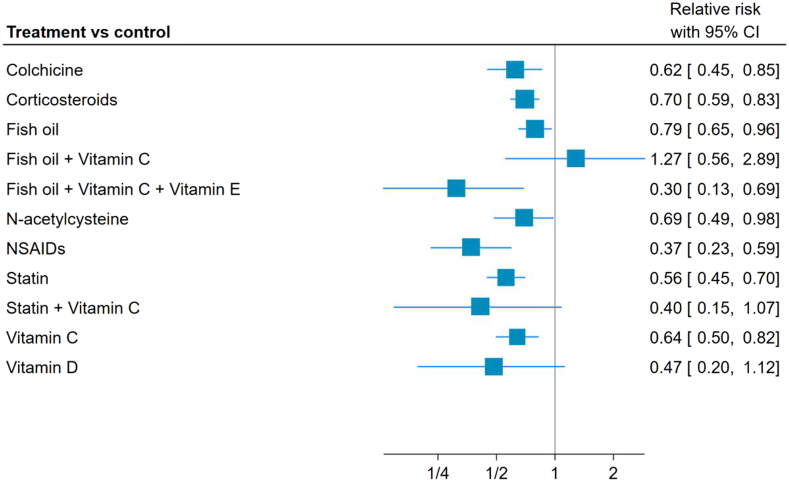
A total of 85 trials reported the incidence of new-onset POAF, including 18,981 patients. Use of nonsteroidal anti-inflammatory drugs (relative risk [RR] 0.37 [95% confidence interval [CI] 0.23-0.59]) and statins (RR 0.56 [95% CI 0.45-0.7]) potentially reduced the risk of POAF compared with placebo (both with a moderate certainty level). Use of fish oil in combination with vitamins C and E (RR 0.30 [95% CI 0.13-0.68]) may reduce the risk of POAF, compared with placebo (low level of certainty). Use of colchicine (RR 0.62 [95% CI 0.45- 0.85]), corticosteroids (RR 0.70 [95% CI 0.59-0.82]), and N-acetylcysteine (RR 0.69 [95% CI 0.49- 0.98]) may reduce the risk of POAF (all with a low level of certainty). None of the interventions had a significant effect on mortality rate or risk of serious adverse effects.
Conclusions
Use of nonsteroidal anti-inflammatory drugs and statins probably are effective in preventing new-onset POAF, with a moderate level of certainty, compared to placebo.







 京公网安备 11010802042870号
京ICP备2023020795号-1
京公网安备 11010802042870号
京ICP备2023020795号-1

 分享
分享
 求助内容:
求助内容: 应助结果提醒方式:
 扫码关注我们
