Yi Zheng, Jing Li, Andy Yiu-Chau Tam, Timothy Tin-Yan Lee, Yinghu Peng, James Chung-Wai Cheung, Duo Wai-Chi Wong, Ming Ni
{"title":"锁骨骨折固定的有限元建模:系统范围综述。","authors":"Yi Zheng, Jing Li, Andy Yiu-Chau Tam, Timothy Tin-Yan Lee, Yinghu Peng, James Chung-Wai Cheung, Duo Wai-Chi Wong, Ming Ni","doi":"10.1007/s11517-025-03294-1","DOIUrl":null,"url":null,"abstract":"<p><p>Finite element analysis has become indispensable for biomechanical research on clavicle fractures. This review summarized evidence regarding configurations and applications of finite element analysis in clavicle fracture fixation. Seventeen articles involving 22 clavicles were synthesized from CINAHL, Embase, IEEE Xplore, PubMed, Scopus, and Web of Science databases. Most studies investigated midshaft transverse closed fractures by reconstructing intact models from CT scans and simulating fractures through gap creation. Common loading schemes included axial compression, distal torsion, and inferior bending. The primary objective was comparing different implant designs/placements on construct stiffness, von Mises stress, and fracture site micro-motion. Our review suggested a preference for plate fixation, particularly with anterior placement, for midshaft transverse fractures. However, limited fracture types studied constrain comprehensive recommendations. Additionally, the review highlighted discrepancies between finite element and clinical studies, emphasizing the need for improved modeling of physiological conditions. Future research should focus on developing a comprehensive database of finite element models to test various implant options and placements under common loading schemes, bridging the gap between biomechanical simulations and clinical outcomes.</p>","PeriodicalId":49840,"journal":{"name":"Medical & Biological Engineering & Computing","volume":" ","pages":"1585-1607"},"PeriodicalIF":3.1000,"publicationDate":"2025-06-01","publicationTypes":"Journal Article","fieldsOfStudy":null,"isOpenAccess":false,"openAccessPdf":"https://www.ncbi.nlm.nih.gov/pmc/articles/PMC12106152/pdf/","citationCount":"0","resultStr":"{\"title\":\"Finite element modeling of clavicle fracture fixations: a systematic scoping review.\",\"authors\":\"Yi Zheng, Jing Li, Andy Yiu-Chau Tam, Timothy Tin-Yan Lee, Yinghu Peng, James Chung-Wai Cheung, Duo Wai-Chi Wong, Ming Ni\",\"doi\":\"10.1007/s11517-025-03294-1\",\"DOIUrl\":null,\"url\":null,\"abstract\":\"<p><p>Finite element analysis has become indispensable for biomechanical research on clavicle fractures. This review summarized evidence regarding configurations and applications of finite element analysis in clavicle fracture fixation. Seventeen articles involving 22 clavicles were synthesized from CINAHL, Embase, IEEE Xplore, PubMed, Scopus, and Web of Science databases. Most studies investigated midshaft transverse closed fractures by reconstructing intact models from CT scans and simulating fractures through gap creation. Common loading schemes included axial compression, distal torsion, and inferior bending. The primary objective was comparing different implant designs/placements on construct stiffness, von Mises stress, and fracture site micro-motion. Our review suggested a preference for plate fixation, particularly with anterior placement, for midshaft transverse fractures. However, limited fracture types studied constrain comprehensive recommendations. Additionally, the review highlighted discrepancies between finite element and clinical studies, emphasizing the need for improved modeling of physiological conditions. Future research should focus on developing a comprehensive database of finite element models to test various implant options and placements under common loading schemes, bridging the gap between biomechanical simulations and clinical outcomes.</p>\",\"PeriodicalId\":49840,\"journal\":{\"name\":\"Medical & Biological Engineering & Computing\",\"volume\":\" \",\"pages\":\"1585-1607\"},\"PeriodicalIF\":3.1000,\"publicationDate\":\"2025-06-01\",\"publicationTypes\":\"Journal Article\",\"fieldsOfStudy\":null,\"isOpenAccess\":false,\"openAccessPdf\":\"https://www.ncbi.nlm.nih.gov/pmc/articles/PMC12106152/pdf/\",\"citationCount\":\"0\",\"resultStr\":null,\"platform\":\"Semanticscholar\",\"paperid\":null,\"PeriodicalName\":\"Medical & Biological Engineering & Computing\",\"FirstCategoryId\":\"5\",\"ListUrlMain\":\"https://doi.org/10.1007/s11517-025-03294-1\",\"RegionNum\":4,\"RegionCategory\":\"医学\",\"ArticlePicture\":[],\"TitleCN\":null,\"AbstractTextCN\":null,\"PMCID\":null,\"EPubDate\":\"2025/1/28 0:00:00\",\"PubModel\":\"Epub\",\"JCR\":\"Q2\",\"JCRName\":\"COMPUTER SCIENCE, INTERDISCIPLINARY APPLICATIONS\",\"Score\":null,\"Total\":0}","platform":"Semanticscholar","paperid":null,"PeriodicalName":"Medical & Biological Engineering & Computing","FirstCategoryId":"5","ListUrlMain":"https://doi.org/10.1007/s11517-025-03294-1","RegionNum":4,"RegionCategory":"医学","ArticlePicture":[],"TitleCN":null,"AbstractTextCN":null,"PMCID":null,"EPubDate":"2025/1/28 0:00:00","PubModel":"Epub","JCR":"Q2","JCRName":"COMPUTER SCIENCE, INTERDISCIPLINARY APPLICATIONS","Score":null,"Total":0}
引用次数: 0
摘要
在锁骨骨折的生物力学研究中,有限元分析已成为不可缺少的手段。本文综述了有关有限元分析在锁骨骨折固定中的配置和应用的证据。我们从CINAHL、Embase、IEEE explore、PubMed、Scopus、Web of Science等数据库中合成了17篇涉及22个锁骨的文章。大多数研究通过CT扫描重建完整的模型,并通过间隙形成模拟裂缝,来研究中轴横向封闭裂缝。常见的加载方案包括轴向压缩、远端扭转和下弯。主要目的是比较不同的种植体设计/放置对结构刚度、von Mises应力和骨折部位微运动的影响。我们的综述表明,对于中轴横向骨折,首选钢板固定,特别是前路置入。然而,有限的骨折类型研究限制了全面的建议。此外,该综述强调了有限元和临床研究之间的差异,强调了改进生理条件建模的必要性。未来的研究应侧重于开发一个全面的有限元模型数据库,以测试各种种植体选择和常见加载方案下的放置位置,弥合生物力学模拟和临床结果之间的差距。
Finite element modeling of clavicle fracture fixations: a systematic scoping review.
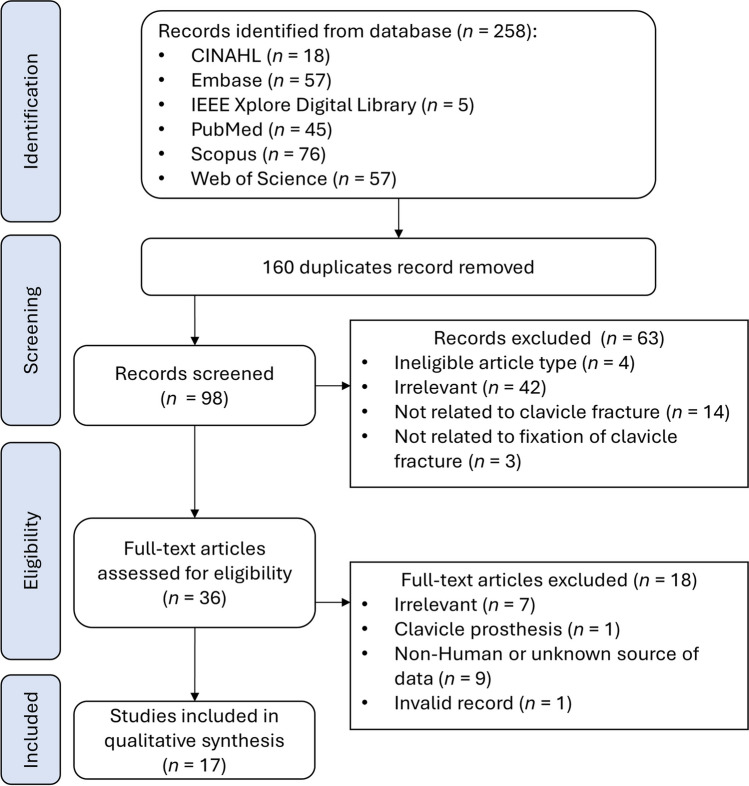
Finite element analysis has become indispensable for biomechanical research on clavicle fractures. This review summarized evidence regarding configurations and applications of finite element analysis in clavicle fracture fixation. Seventeen articles involving 22 clavicles were synthesized from CINAHL, Embase, IEEE Xplore, PubMed, Scopus, and Web of Science databases. Most studies investigated midshaft transverse closed fractures by reconstructing intact models from CT scans and simulating fractures through gap creation. Common loading schemes included axial compression, distal torsion, and inferior bending. The primary objective was comparing different implant designs/placements on construct stiffness, von Mises stress, and fracture site micro-motion. Our review suggested a preference for plate fixation, particularly with anterior placement, for midshaft transverse fractures. However, limited fracture types studied constrain comprehensive recommendations. Additionally, the review highlighted discrepancies between finite element and clinical studies, emphasizing the need for improved modeling of physiological conditions. Future research should focus on developing a comprehensive database of finite element models to test various implant options and placements under common loading schemes, bridging the gap between biomechanical simulations and clinical outcomes.
期刊介绍:
Founded in 1963, Medical & Biological Engineering & Computing (MBEC) continues to serve the biomedical engineering community, covering the entire spectrum of biomedical and clinical engineering. The journal presents exciting and vital experimental and theoretical developments in biomedical science and technology, and reports on advances in computer-based methodologies in these multidisciplinary subjects. The journal also incorporates new and evolving technologies including cellular engineering and molecular imaging.
MBEC publishes original research articles as well as reviews and technical notes. Its Rapid Communications category focuses on material of immediate value to the readership, while the Controversies section provides a forum to exchange views on selected issues, stimulating a vigorous and informed debate in this exciting and high profile field.
MBEC is an official journal of the International Federation of Medical and Biological Engineering (IFMBE).






 京公网安备 11010802042870号
京ICP备2023020795号-1
京公网安备 11010802042870号
京ICP备2023020795号-1

 分享
分享
 求助内容:
求助内容: 应助结果提醒方式:
 扫码关注我们
