{"title":"鹿蹄草酸改良剂通过抑制基因水平转化缓解了农业土壤中抗生素抗性基因的污染","authors":"Mengying Shao, Xiaohan Ma, Min Zhang, Yuxin Li, Liuqingqing Liu, Jiamin Wang, Wei Meng, Cuizhu Sun, Hao Zheng, Xianxiang Luo, Fengmin Li","doi":"10.1016/j.cej.2025.160070","DOIUrl":null,"url":null,"abstract":"Pyroligneous acids (PAs) amendments could reduce soil antibiotic resistance genes (ARGs) pollution, but their impacts on horizontal transformation of extracellular ARGs (eARGs) remain unclear. Here, a wood residues derived PA was selected to investigate its effect on ARG dissemination via transformation using a soil microcosm experiment and an <em>in vitro</em> transformation system. The PA application effectively decreased the abundances of representative ARGs and mobile genetic elements, demonstrating that the weakened horizontal gene transfer alleviated ARG pollution in the soil. PA showed an amount-dependent inhibition on the transformation as well as the three distilled fractions and chemical components, proving that their important roles in inhibiting eARG transformation. The relatively low-amount (1 μL mL<sup>−1</sup>) of PA suppressed the transformation mainly by destroying the plasmid pBR322 structure, while the high-amount (10–100 μL mL<sup>−1</sup>) of PA inhibited the transformation due to the inactivation of recipient <em>Escherichia coli</em> DH5α by inducing oxidative stress and destroying cell membrane, and damages of plasmid by reducing eARGs abundance and broking the base deoxyribose, and phosphate skeletons. These findings expand the understanding of PA amendments mitigating ARG pollution in agricultural soils via inhibiting horizontal gene transformation, and also provide a practical strategy to remediate soil ARG pollution.","PeriodicalId":270,"journal":{"name":"Chemical Engineering Journal","volume":"7 1","pages":""},"PeriodicalIF":13.2000,"publicationDate":"2025-01-28","publicationTypes":"Journal Article","fieldsOfStudy":null,"isOpenAccess":false,"openAccessPdf":"","citationCount":"0","resultStr":"{\"title\":\"Pyroligneous acid amendments alleviated antibiotic resistance genes pollution in agricultural soil via inhibiting horizontal gene transformation\",\"authors\":\"Mengying Shao, Xiaohan Ma, Min Zhang, Yuxin Li, Liuqingqing Liu, Jiamin Wang, Wei Meng, Cuizhu Sun, Hao Zheng, Xianxiang Luo, Fengmin Li\",\"doi\":\"10.1016/j.cej.2025.160070\",\"DOIUrl\":null,\"url\":null,\"abstract\":\"Pyroligneous acids (PAs) amendments could reduce soil antibiotic resistance genes (ARGs) pollution, but their impacts on horizontal transformation of extracellular ARGs (eARGs) remain unclear. Here, a wood residues derived PA was selected to investigate its effect on ARG dissemination via transformation using a soil microcosm experiment and an <em>in vitro</em> transformation system. The PA application effectively decreased the abundances of representative ARGs and mobile genetic elements, demonstrating that the weakened horizontal gene transfer alleviated ARG pollution in the soil. PA showed an amount-dependent inhibition on the transformation as well as the three distilled fractions and chemical components, proving that their important roles in inhibiting eARG transformation. The relatively low-amount (1 μL mL<sup>−1</sup>) of PA suppressed the transformation mainly by destroying the plasmid pBR322 structure, while the high-amount (10–100 μL mL<sup>−1</sup>) of PA inhibited the transformation due to the inactivation of recipient <em>Escherichia coli</em> DH5α by inducing oxidative stress and destroying cell membrane, and damages of plasmid by reducing eARGs abundance and broking the base deoxyribose, and phosphate skeletons. These findings expand the understanding of PA amendments mitigating ARG pollution in agricultural soils via inhibiting horizontal gene transformation, and also provide a practical strategy to remediate soil ARG pollution.\",\"PeriodicalId\":270,\"journal\":{\"name\":\"Chemical Engineering Journal\",\"volume\":\"7 1\",\"pages\":\"\"},\"PeriodicalIF\":13.2000,\"publicationDate\":\"2025-01-28\",\"publicationTypes\":\"Journal Article\",\"fieldsOfStudy\":null,\"isOpenAccess\":false,\"openAccessPdf\":\"\",\"citationCount\":\"0\",\"resultStr\":null,\"platform\":\"Semanticscholar\",\"paperid\":null,\"PeriodicalName\":\"Chemical Engineering Journal\",\"FirstCategoryId\":\"5\",\"ListUrlMain\":\"https://doi.org/10.1016/j.cej.2025.160070\",\"RegionNum\":1,\"RegionCategory\":\"工程技术\",\"ArticlePicture\":[],\"TitleCN\":null,\"AbstractTextCN\":null,\"PMCID\":null,\"EPubDate\":\"\",\"PubModel\":\"\",\"JCR\":\"Q1\",\"JCRName\":\"ENGINEERING, CHEMICAL\",\"Score\":null,\"Total\":0}","platform":"Semanticscholar","paperid":null,"PeriodicalName":"Chemical Engineering Journal","FirstCategoryId":"5","ListUrlMain":"https://doi.org/10.1016/j.cej.2025.160070","RegionNum":1,"RegionCategory":"工程技术","ArticlePicture":[],"TitleCN":null,"AbstractTextCN":null,"PMCID":null,"EPubDate":"","PubModel":"","JCR":"Q1","JCRName":"ENGINEERING, CHEMICAL","Score":null,"Total":0}
Pyroligneous acid amendments alleviated antibiotic resistance genes pollution in agricultural soil via inhibiting horizontal gene transformation
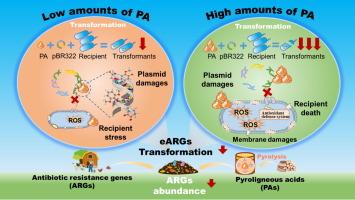
Pyroligneous acids (PAs) amendments could reduce soil antibiotic resistance genes (ARGs) pollution, but their impacts on horizontal transformation of extracellular ARGs (eARGs) remain unclear. Here, a wood residues derived PA was selected to investigate its effect on ARG dissemination via transformation using a soil microcosm experiment and an in vitro transformation system. The PA application effectively decreased the abundances of representative ARGs and mobile genetic elements, demonstrating that the weakened horizontal gene transfer alleviated ARG pollution in the soil. PA showed an amount-dependent inhibition on the transformation as well as the three distilled fractions and chemical components, proving that their important roles in inhibiting eARG transformation. The relatively low-amount (1 μL mL−1) of PA suppressed the transformation mainly by destroying the plasmid pBR322 structure, while the high-amount (10–100 μL mL−1) of PA inhibited the transformation due to the inactivation of recipient Escherichia coli DH5α by inducing oxidative stress and destroying cell membrane, and damages of plasmid by reducing eARGs abundance and broking the base deoxyribose, and phosphate skeletons. These findings expand the understanding of PA amendments mitigating ARG pollution in agricultural soils via inhibiting horizontal gene transformation, and also provide a practical strategy to remediate soil ARG pollution.
期刊介绍:
The Chemical Engineering Journal is an international research journal that invites contributions of original and novel fundamental research. It aims to provide an international platform for presenting original fundamental research, interpretative reviews, and discussions on new developments in chemical engineering. The journal welcomes papers that describe novel theory and its practical application, as well as those that demonstrate the transfer of techniques from other disciplines. It also welcomes reports on carefully conducted experimental work that is soundly interpreted. The main focus of the journal is on original and rigorous research results that have broad significance. The Catalysis section within the Chemical Engineering Journal focuses specifically on Experimental and Theoretical studies in the fields of heterogeneous catalysis, molecular catalysis, and biocatalysis. These studies have industrial impact on various sectors such as chemicals, energy, materials, foods, healthcare, and environmental protection.




 京公网安备 11010802042870号
京ICP备2023020795号-1
京公网安备 11010802042870号
京ICP备2023020795号-1

 分享
分享
 求助内容:
求助内容: 应助结果提醒方式:
 扫码关注我们
