Youngwon Kong , Hitomi Kawahara , Ryohei Kikuchi , Noboru Ohta , Albert Mufundirwa , Tomoyasu Hirai , Kan Hatakeyama-Sato , Yuta Nabae , Teruaki Hayakawa
{"title":"用于控制周期纳米结构的聚(4-乙烯基吡啶)-嵌段聚(2,2,2-三氟甲基丙烯酸乙酯)的合成和表征","authors":"Youngwon Kong , Hitomi Kawahara , Ryohei Kikuchi , Noboru Ohta , Albert Mufundirwa , Tomoyasu Hirai , Kan Hatakeyama-Sato , Yuta Nabae , Teruaki Hayakawa","doi":"10.1016/j.polymer.2025.128098","DOIUrl":null,"url":null,"abstract":"<div><div>Designing appropriate molecular structures is essential for employing the microphase-separated structures of block copolymers in a wide range of applications. This study selected poly(4-vinylpyridine)-<em>block</em>-poly(2,2,2-trifluoroethyl methacrylate) (P4VP-<em>b</em>-PTFEMA) owing to its strong repulsive interactions originating from the fluorine in PTFEMA and its compatibility with additives through P4VP. Thirty distinct P4VP-<em>b</em>-PTFEMA block copolymers with varying compositions were synthesized using reversible addition-fragmentation chain-transfer polymerization. <em>d</em>-spacings of 8.9–59.7 nm were obtained, highlighting the successful preparation of microphase-separated structures with various sizes. Additionally, the introduction of resol as a cross-linking agent, which selectively interacts with P4VP, significantly changed the microphase-separated structures. The findings of this study provide valuable insights into controlling and manipulating block copolymer structures, which has important implications for future applications.</div></div>","PeriodicalId":405,"journal":{"name":"Polymer","volume":"320 ","pages":"Article 128098"},"PeriodicalIF":5.1000,"publicationDate":"2025-02-21","publicationTypes":"Journal Article","fieldsOfStudy":null,"isOpenAccess":false,"openAccessPdf":"","citationCount":"0","resultStr":"{\"title\":\"Synthesis and characterization of poly(4-vinylpyridine)-block-poly(2,2,2-trifluoroethyl methacrylate) for manipulating periodic nanostructured architectures\",\"authors\":\"Youngwon Kong , Hitomi Kawahara , Ryohei Kikuchi , Noboru Ohta , Albert Mufundirwa , Tomoyasu Hirai , Kan Hatakeyama-Sato , Yuta Nabae , Teruaki Hayakawa\",\"doi\":\"10.1016/j.polymer.2025.128098\",\"DOIUrl\":null,\"url\":null,\"abstract\":\"<div><div>Designing appropriate molecular structures is essential for employing the microphase-separated structures of block copolymers in a wide range of applications. This study selected poly(4-vinylpyridine)-<em>block</em>-poly(2,2,2-trifluoroethyl methacrylate) (P4VP-<em>b</em>-PTFEMA) owing to its strong repulsive interactions originating from the fluorine in PTFEMA and its compatibility with additives through P4VP. Thirty distinct P4VP-<em>b</em>-PTFEMA block copolymers with varying compositions were synthesized using reversible addition-fragmentation chain-transfer polymerization. <em>d</em>-spacings of 8.9–59.7 nm were obtained, highlighting the successful preparation of microphase-separated structures with various sizes. Additionally, the introduction of resol as a cross-linking agent, which selectively interacts with P4VP, significantly changed the microphase-separated structures. The findings of this study provide valuable insights into controlling and manipulating block copolymer structures, which has important implications for future applications.</div></div>\",\"PeriodicalId\":405,\"journal\":{\"name\":\"Polymer\",\"volume\":\"320 \",\"pages\":\"Article 128098\"},\"PeriodicalIF\":5.1000,\"publicationDate\":\"2025-02-21\",\"publicationTypes\":\"Journal Article\",\"fieldsOfStudy\":null,\"isOpenAccess\":false,\"openAccessPdf\":\"\",\"citationCount\":\"0\",\"resultStr\":null,\"platform\":\"Semanticscholar\",\"paperid\":null,\"PeriodicalName\":\"Polymer\",\"FirstCategoryId\":\"92\",\"ListUrlMain\":\"https://www.sciencedirect.com/science/article/pii/S0032386125000849\",\"RegionNum\":2,\"RegionCategory\":\"化学\",\"ArticlePicture\":[],\"TitleCN\":null,\"AbstractTextCN\":null,\"PMCID\":null,\"EPubDate\":\"2025/1/28 0:00:00\",\"PubModel\":\"Epub\",\"JCR\":\"Q2\",\"JCRName\":\"POLYMER SCIENCE\",\"Score\":null,\"Total\":0}","platform":"Semanticscholar","paperid":null,"PeriodicalName":"Polymer","FirstCategoryId":"92","ListUrlMain":"https://www.sciencedirect.com/science/article/pii/S0032386125000849","RegionNum":2,"RegionCategory":"化学","ArticlePicture":[],"TitleCN":null,"AbstractTextCN":null,"PMCID":null,"EPubDate":"2025/1/28 0:00:00","PubModel":"Epub","JCR":"Q2","JCRName":"POLYMER SCIENCE","Score":null,"Total":0}
Synthesis and characterization of poly(4-vinylpyridine)-block-poly(2,2,2-trifluoroethyl methacrylate) for manipulating periodic nanostructured architectures
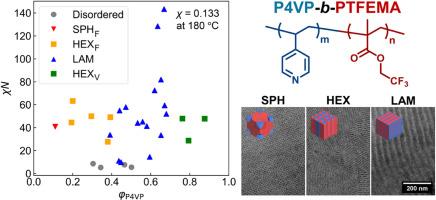
Designing appropriate molecular structures is essential for employing the microphase-separated structures of block copolymers in a wide range of applications. This study selected poly(4-vinylpyridine)-block-poly(2,2,2-trifluoroethyl methacrylate) (P4VP-b-PTFEMA) owing to its strong repulsive interactions originating from the fluorine in PTFEMA and its compatibility with additives through P4VP. Thirty distinct P4VP-b-PTFEMA block copolymers with varying compositions were synthesized using reversible addition-fragmentation chain-transfer polymerization. d-spacings of 8.9–59.7 nm were obtained, highlighting the successful preparation of microphase-separated structures with various sizes. Additionally, the introduction of resol as a cross-linking agent, which selectively interacts with P4VP, significantly changed the microphase-separated structures. The findings of this study provide valuable insights into controlling and manipulating block copolymer structures, which has important implications for future applications.
期刊介绍:
Polymer is an interdisciplinary journal dedicated to publishing innovative and significant advances in Polymer Physics, Chemistry and Technology. We welcome submissions on polymer hybrids, nanocomposites, characterisation and self-assembly. Polymer also publishes work on the technological application of polymers in energy and optoelectronics.
The main scope is covered but not limited to the following core areas:
Polymer Materials
Nanocomposites and hybrid nanomaterials
Polymer blends, films, fibres, networks and porous materials
Physical Characterization
Characterisation, modelling and simulation* of molecular and materials properties in bulk, solution, and thin films
Polymer Engineering
Advanced multiscale processing methods
Polymer Synthesis, Modification and Self-assembly
Including designer polymer architectures, mechanisms and kinetics, and supramolecular polymerization
Technological Applications
Polymers for energy generation and storage
Polymer membranes for separation technology
Polymers for opto- and microelectronics.





 京公网安备 11010802042870号
京ICP备2023020795号-1
京公网安备 11010802042870号
京ICP备2023020795号-1

 分享
分享
 求助内容:
求助内容: 应助结果提醒方式:
 扫码关注我们
