Xuan Yang, Zesen Yu, Hedong Jiang, Huanhuan Guo, Jian Sun, Jiake Li, Hua Zhu, Yanxiang Wang and Pingchun Guo
{"title":"可逆热致变色Co-MOF在智能窗中的应用","authors":"Xuan Yang, Zesen Yu, Hedong Jiang, Huanhuan Guo, Jian Sun, Jiake Li, Hua Zhu, Yanxiang Wang and Pingchun Guo","doi":"10.1039/D4DT03423F","DOIUrl":null,"url":null,"abstract":"<p >Metal–organic frameworks (MOFs) are promising candidates for thermochromic materials. In this study, a hydrogen-bonded 3D porous metal–organic framework, Co-BTC (Co<small><sub>3</sub></small>(BTC)<small><sub>2</sub></small>·12H<small><sub>2</sub></small>O, BTC = 1,3,5-benzenetricarboxylate), exhibited a pink color at room temperature, attributed to the d–d transition of Co<small><sup>2+</sup></small> ions within the framework, and displayed reversible thermochromic behavior due to alterations in the coordination environment of Co<small><sup>2+</sup></small> ions. Additionally, Co-BTC/PVB thermochromic film was successfully designed and fabricated as a smart window with a monolayer structure. The window exhibited reversible thermochromic behavior comparable to Co-BTC, with visible transmittance modulation of 10.73%, near-infrared transmittance modulation of 25.87%, and solar transmittance modulation of 12.63%. Compared to a pure PVB window, the smart window reduced indoor temperatures by 5.7 °C in field tests, indicating a significant energy-saving effect. This research presents a potential application for the rational design of MOFs in the development of advanced smart windows.</p>","PeriodicalId":71,"journal":{"name":"Dalton Transactions","volume":" 10","pages":" 4303-4311"},"PeriodicalIF":3.3000,"publicationDate":"2025-01-29","publicationTypes":"Journal Article","fieldsOfStudy":null,"isOpenAccess":false,"openAccessPdf":"","citationCount":"0","resultStr":"{\"title\":\"Application of a reversible thermochromic Co-MOF in smart windows†\",\"authors\":\"Xuan Yang, Zesen Yu, Hedong Jiang, Huanhuan Guo, Jian Sun, Jiake Li, Hua Zhu, Yanxiang Wang and Pingchun Guo\",\"doi\":\"10.1039/D4DT03423F\",\"DOIUrl\":null,\"url\":null,\"abstract\":\"<p >Metal–organic frameworks (MOFs) are promising candidates for thermochromic materials. In this study, a hydrogen-bonded 3D porous metal–organic framework, Co-BTC (Co<small><sub>3</sub></small>(BTC)<small><sub>2</sub></small>·12H<small><sub>2</sub></small>O, BTC = 1,3,5-benzenetricarboxylate), exhibited a pink color at room temperature, attributed to the d–d transition of Co<small><sup>2+</sup></small> ions within the framework, and displayed reversible thermochromic behavior due to alterations in the coordination environment of Co<small><sup>2+</sup></small> ions. Additionally, Co-BTC/PVB thermochromic film was successfully designed and fabricated as a smart window with a monolayer structure. The window exhibited reversible thermochromic behavior comparable to Co-BTC, with visible transmittance modulation of 10.73%, near-infrared transmittance modulation of 25.87%, and solar transmittance modulation of 12.63%. Compared to a pure PVB window, the smart window reduced indoor temperatures by 5.7 °C in field tests, indicating a significant energy-saving effect. This research presents a potential application for the rational design of MOFs in the development of advanced smart windows.</p>\",\"PeriodicalId\":71,\"journal\":{\"name\":\"Dalton Transactions\",\"volume\":\" 10\",\"pages\":\" 4303-4311\"},\"PeriodicalIF\":3.3000,\"publicationDate\":\"2025-01-29\",\"publicationTypes\":\"Journal Article\",\"fieldsOfStudy\":null,\"isOpenAccess\":false,\"openAccessPdf\":\"\",\"citationCount\":\"0\",\"resultStr\":null,\"platform\":\"Semanticscholar\",\"paperid\":null,\"PeriodicalName\":\"Dalton Transactions\",\"FirstCategoryId\":\"92\",\"ListUrlMain\":\"https://pubs.rsc.org/en/content/articlelanding/2025/dt/d4dt03423f\",\"RegionNum\":3,\"RegionCategory\":\"化学\",\"ArticlePicture\":[],\"TitleCN\":null,\"AbstractTextCN\":null,\"PMCID\":null,\"EPubDate\":\"\",\"PubModel\":\"\",\"JCR\":\"Q2\",\"JCRName\":\"CHEMISTRY, INORGANIC & NUCLEAR\",\"Score\":null,\"Total\":0}","platform":"Semanticscholar","paperid":null,"PeriodicalName":"Dalton Transactions","FirstCategoryId":"92","ListUrlMain":"https://pubs.rsc.org/en/content/articlelanding/2025/dt/d4dt03423f","RegionNum":3,"RegionCategory":"化学","ArticlePicture":[],"TitleCN":null,"AbstractTextCN":null,"PMCID":null,"EPubDate":"","PubModel":"","JCR":"Q2","JCRName":"CHEMISTRY, INORGANIC & NUCLEAR","Score":null,"Total":0}
Application of a reversible thermochromic Co-MOF in smart windows†
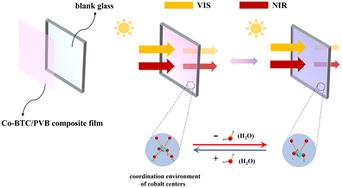
Metal–organic frameworks (MOFs) are promising candidates for thermochromic materials. In this study, a hydrogen-bonded 3D porous metal–organic framework, Co-BTC (Co3(BTC)2·12H2O, BTC = 1,3,5-benzenetricarboxylate), exhibited a pink color at room temperature, attributed to the d–d transition of Co2+ ions within the framework, and displayed reversible thermochromic behavior due to alterations in the coordination environment of Co2+ ions. Additionally, Co-BTC/PVB thermochromic film was successfully designed and fabricated as a smart window with a monolayer structure. The window exhibited reversible thermochromic behavior comparable to Co-BTC, with visible transmittance modulation of 10.73%, near-infrared transmittance modulation of 25.87%, and solar transmittance modulation of 12.63%. Compared to a pure PVB window, the smart window reduced indoor temperatures by 5.7 °C in field tests, indicating a significant energy-saving effect. This research presents a potential application for the rational design of MOFs in the development of advanced smart windows.
期刊介绍:
Dalton Transactions is a journal for all areas of inorganic chemistry, which encompasses the organometallic, bioinorganic and materials chemistry of the elements, with applications including synthesis, catalysis, energy conversion/storage, electrical devices and medicine. Dalton Transactions welcomes high-quality, original submissions in all of these areas and more, where the advancement of knowledge in inorganic chemistry is significant.




 京公网安备 11010802042870号
京ICP备2023020795号-1
京公网安备 11010802042870号
京ICP备2023020795号-1

 分享
分享
 求助内容:
求助内容: 应助结果提醒方式:
 扫码关注我们
