André C. A. Siqueira, G. Palacios, Jessica E. Q. Bautista, Anderson M. Amaral, Albert S. Reyna, Edilson L. Falcão-Filho, Cid B. de Araújo
{"title":"细丝和多丝复制对称性断裂的观察","authors":"André C. A. Siqueira, G. Palacios, Jessica E. Q. Bautista, Anderson M. Amaral, Albert S. Reyna, Edilson L. Falcão-Filho, Cid B. de Araújo","doi":"10.1515/nanoph-2024-0592","DOIUrl":null,"url":null,"abstract":"We report the experimental observation and characterization of Replica Symmetry Breaking (RSB) manifestation while analyzing the transverse intensity profile of laser pulses in filamentation experiments using sapphire crystal and distilled water, excited by a femtosecond laser centered at 800 nm. The RSB arises from the competition between self-focusing and plasma defocusing, subject to local fluctuations in the nonlinear refractive index generated by plasma via multiphoton excitation, which subsequently promotes frustration among modes. Our results confirm the existence of glassy-like photonic states not only in multifilamentation, as previously reported [<jats:italic>W. Ettoumi, J. Kasparian, and J. Wolf, “Spin-glass model governs laser multiple filamentation,” Phys. Rev. Lett., vol. 115, no. 3, pp. 033902, 2015</jats:italic>], but also in the generation of a single filament and in filamentation accompanied by conical emission. These findings improve the understanding of statistical nonlinear optics by establishing connections with magnetism and highlighting the glassy-like behavior of light in the context of ultrafast optical phenomena.","PeriodicalId":19027,"journal":{"name":"Nanophotonics","volume":"74 1","pages":""},"PeriodicalIF":6.6000,"publicationDate":"2025-01-30","publicationTypes":"Journal Article","fieldsOfStudy":null,"isOpenAccess":false,"openAccessPdf":"","citationCount":"0","resultStr":"{\"title\":\"Observation of replica symmetry breaking in filamentation and multifilamentation\",\"authors\":\"André C. A. Siqueira, G. Palacios, Jessica E. Q. Bautista, Anderson M. Amaral, Albert S. Reyna, Edilson L. Falcão-Filho, Cid B. de Araújo\",\"doi\":\"10.1515/nanoph-2024-0592\",\"DOIUrl\":null,\"url\":null,\"abstract\":\"We report the experimental observation and characterization of Replica Symmetry Breaking (RSB) manifestation while analyzing the transverse intensity profile of laser pulses in filamentation experiments using sapphire crystal and distilled water, excited by a femtosecond laser centered at 800 nm. The RSB arises from the competition between self-focusing and plasma defocusing, subject to local fluctuations in the nonlinear refractive index generated by plasma via multiphoton excitation, which subsequently promotes frustration among modes. Our results confirm the existence of glassy-like photonic states not only in multifilamentation, as previously reported [<jats:italic>W. Ettoumi, J. Kasparian, and J. Wolf, “Spin-glass model governs laser multiple filamentation,” Phys. Rev. Lett., vol. 115, no. 3, pp. 033902, 2015</jats:italic>], but also in the generation of a single filament and in filamentation accompanied by conical emission. These findings improve the understanding of statistical nonlinear optics by establishing connections with magnetism and highlighting the glassy-like behavior of light in the context of ultrafast optical phenomena.\",\"PeriodicalId\":19027,\"journal\":{\"name\":\"Nanophotonics\",\"volume\":\"74 1\",\"pages\":\"\"},\"PeriodicalIF\":6.6000,\"publicationDate\":\"2025-01-30\",\"publicationTypes\":\"Journal Article\",\"fieldsOfStudy\":null,\"isOpenAccess\":false,\"openAccessPdf\":\"\",\"citationCount\":\"0\",\"resultStr\":null,\"platform\":\"Semanticscholar\",\"paperid\":null,\"PeriodicalName\":\"Nanophotonics\",\"FirstCategoryId\":\"101\",\"ListUrlMain\":\"https://doi.org/10.1515/nanoph-2024-0592\",\"RegionNum\":2,\"RegionCategory\":\"物理与天体物理\",\"ArticlePicture\":[],\"TitleCN\":null,\"AbstractTextCN\":null,\"PMCID\":null,\"EPubDate\":\"\",\"PubModel\":\"\",\"JCR\":\"Q1\",\"JCRName\":\"MATERIALS SCIENCE, MULTIDISCIPLINARY\",\"Score\":null,\"Total\":0}","platform":"Semanticscholar","paperid":null,"PeriodicalName":"Nanophotonics","FirstCategoryId":"101","ListUrlMain":"https://doi.org/10.1515/nanoph-2024-0592","RegionNum":2,"RegionCategory":"物理与天体物理","ArticlePicture":[],"TitleCN":null,"AbstractTextCN":null,"PMCID":null,"EPubDate":"","PubModel":"","JCR":"Q1","JCRName":"MATERIALS SCIENCE, MULTIDISCIPLINARY","Score":null,"Total":0}
引用次数: 0
摘要
本文报道了以蓝宝石晶体和蒸馏水为材料,以800 nm为中心的飞秒激光激发激光成丝实验中激光脉冲的横向强度分布,并对RSB现象进行了实验观察和表征。RSB产生于自聚焦和等离子体离焦之间的竞争,受到等离子体通过多光子激发产生的非线性折射率的局部波动的影响,随后促进了模式之间的挫折。我们的结果证实了玻璃状光子态的存在,不仅在多丝化中,如先前报道的[W。Ettoumi, J. Kasparian和J. Wolf,“自旋玻璃模型控制激光多丝化”,物理学。启。,第115卷,第115期。[3], pp. 033902, 2015],但也在单灯丝的产生和灯丝伴随锥形发射。这些发现通过建立与磁性的联系以及在超快光学现象背景下突出光的玻璃样行为,提高了对统计非线性光学的理解。
Observation of replica symmetry breaking in filamentation and multifilamentation
We report the experimental observation and characterization of Replica Symmetry Breaking (RSB) manifestation while analyzing the transverse intensity profile of laser pulses in filamentation experiments using sapphire crystal and distilled water, excited by a femtosecond laser centered at 800 nm. The RSB arises from the competition between self-focusing and plasma defocusing, subject to local fluctuations in the nonlinear refractive index generated by plasma via multiphoton excitation, which subsequently promotes frustration among modes. Our results confirm the existence of glassy-like photonic states not only in multifilamentation, as previously reported [W. Ettoumi, J. Kasparian, and J. Wolf, “Spin-glass model governs laser multiple filamentation,” Phys. Rev. Lett., vol. 115, no. 3, pp. 033902, 2015], but also in the generation of a single filament and in filamentation accompanied by conical emission. These findings improve the understanding of statistical nonlinear optics by establishing connections with magnetism and highlighting the glassy-like behavior of light in the context of ultrafast optical phenomena.
期刊介绍:
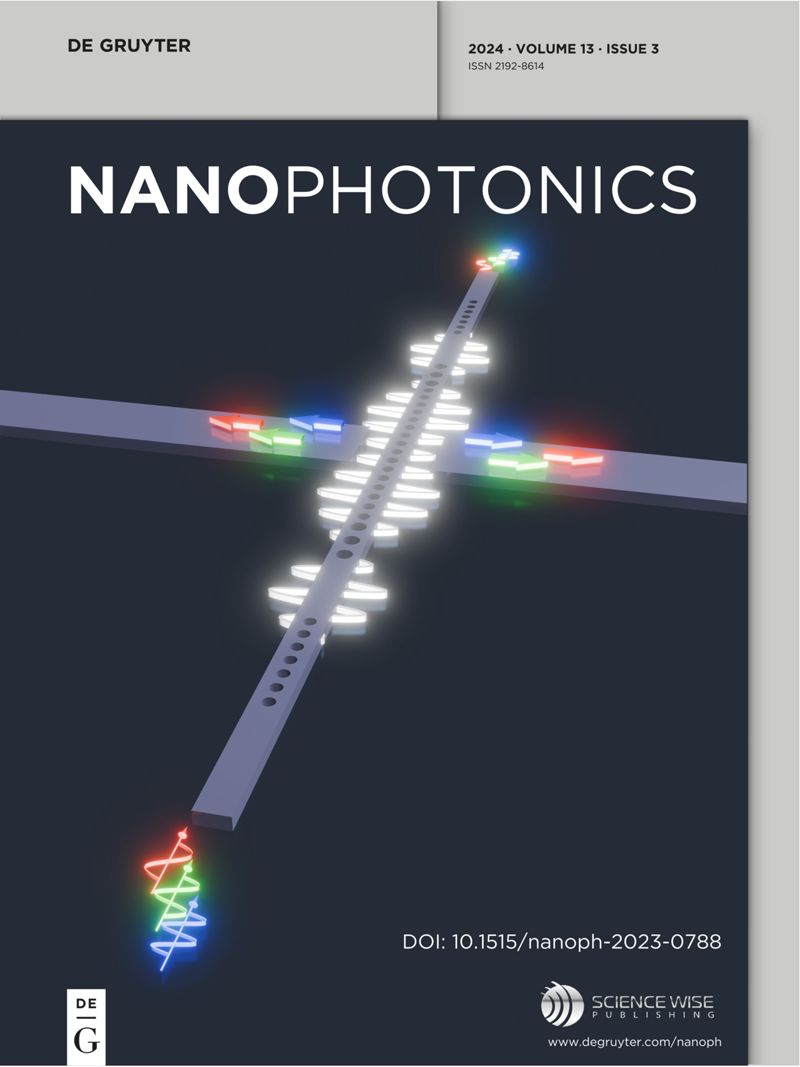
Nanophotonics, published in collaboration with Sciencewise, is a prestigious journal that showcases recent international research results, notable advancements in the field, and innovative applications. It is regarded as one of the leading publications in the realm of nanophotonics and encompasses a range of article types including research articles, selectively invited reviews, letters, and perspectives.
The journal specifically delves into the study of photon interaction with nano-structures, such as carbon nano-tubes, nano metal particles, nano crystals, semiconductor nano dots, photonic crystals, tissue, and DNA. It offers comprehensive coverage of the most up-to-date discoveries, making it an essential resource for physicists, engineers, and material scientists.




 京公网安备 11010802042870号
京ICP备2023020795号-1
京公网安备 11010802042870号
京ICP备2023020795号-1

 分享
分享
 求助内容:
求助内容: 应助结果提醒方式:
 扫码关注我们
