Yining Zhang, Jiameng Yu, Hongsheng Shi, Shuanghong Wang, Yinjie Lv, Yue Zhang, Qiong Yuan, Jinjiang Liang, Tianyi Gao, Ran Wei, Xin Chen, Luyao Wang, Yi Yu, Wei Liu
{"title":"用于固态锂金属电池的纤维增强超薄固体聚合物电解质","authors":"Yining Zhang, Jiameng Yu, Hongsheng Shi, Shuanghong Wang, Yinjie Lv, Yue Zhang, Qiong Yuan, Jinjiang Liang, Tianyi Gao, Ran Wei, Xin Chen, Luyao Wang, Yi Yu, Wei Liu","doi":"10.1002/adfm.202421054","DOIUrl":null,"url":null,"abstract":"<p>Reducing the thickness of solid polymer electrolytes can help to enhance the energy density for solid-state batteries. However, ultrathin electrolytes still face difficulties in preparation methods, mechanical properties, and interface instability. Herein, a free-standing, scalable, and ultrathin solid polymer electrolyte with a thickness of 10 µm is reported. It is achieved through in situ thermal curing after filling a porous electrospun polyacrylonitrile fiber membrane with poly(ethylene glycol) diacrylate-based electrolyte. Impressively, it contributes to a high ionic conductivity of 8.8 × 10<sup>−4</sup> S cm<sup>−1</sup> at room temperature. The membrane can not only provide good mechanical strength but also offer a Li<sub>3</sub>N-enriched solid electrolyte interphase, thereby stabilizing the lithium metal anode. The pouch cell pairing the ultrathin electrolyte with Li foil and LiNi<sub>0.8</sub>Co<sub>0.1</sub>Mn<sub>0.1</sub>O<sub>2</sub> cathode of high mass loading can realize a gravimetric/volumetric energy density of 380 Wh kg<sup>−1</sup> and 936 Wh L<sup>−1</sup>. This investigation provides new insights into the potential of fiber-reinforced membranes for high-performance solid-state batteries.</p>","PeriodicalId":112,"journal":{"name":"Advanced Functional Materials","volume":"35 25","pages":""},"PeriodicalIF":19.0000,"publicationDate":"2025-01-29","publicationTypes":"Journal Article","fieldsOfStudy":null,"isOpenAccess":false,"openAccessPdf":"","citationCount":"0","resultStr":"{\"title\":\"Fiber-Reinforced Ultrathin Solid Polymer Electrolyte for Solid-State Lithium-Metal Batteries\",\"authors\":\"Yining Zhang, Jiameng Yu, Hongsheng Shi, Shuanghong Wang, Yinjie Lv, Yue Zhang, Qiong Yuan, Jinjiang Liang, Tianyi Gao, Ran Wei, Xin Chen, Luyao Wang, Yi Yu, Wei Liu\",\"doi\":\"10.1002/adfm.202421054\",\"DOIUrl\":null,\"url\":null,\"abstract\":\"<p>Reducing the thickness of solid polymer electrolytes can help to enhance the energy density for solid-state batteries. However, ultrathin electrolytes still face difficulties in preparation methods, mechanical properties, and interface instability. Herein, a free-standing, scalable, and ultrathin solid polymer electrolyte with a thickness of 10 µm is reported. It is achieved through in situ thermal curing after filling a porous electrospun polyacrylonitrile fiber membrane with poly(ethylene glycol) diacrylate-based electrolyte. Impressively, it contributes to a high ionic conductivity of 8.8 × 10<sup>−4</sup> S cm<sup>−1</sup> at room temperature. The membrane can not only provide good mechanical strength but also offer a Li<sub>3</sub>N-enriched solid electrolyte interphase, thereby stabilizing the lithium metal anode. The pouch cell pairing the ultrathin electrolyte with Li foil and LiNi<sub>0.8</sub>Co<sub>0.1</sub>Mn<sub>0.1</sub>O<sub>2</sub> cathode of high mass loading can realize a gravimetric/volumetric energy density of 380 Wh kg<sup>−1</sup> and 936 Wh L<sup>−1</sup>. This investigation provides new insights into the potential of fiber-reinforced membranes for high-performance solid-state batteries.</p>\",\"PeriodicalId\":112,\"journal\":{\"name\":\"Advanced Functional Materials\",\"volume\":\"35 25\",\"pages\":\"\"},\"PeriodicalIF\":19.0000,\"publicationDate\":\"2025-01-29\",\"publicationTypes\":\"Journal Article\",\"fieldsOfStudy\":null,\"isOpenAccess\":false,\"openAccessPdf\":\"\",\"citationCount\":\"0\",\"resultStr\":null,\"platform\":\"Semanticscholar\",\"paperid\":null,\"PeriodicalName\":\"Advanced Functional Materials\",\"FirstCategoryId\":\"88\",\"ListUrlMain\":\"https://advanced.onlinelibrary.wiley.com/doi/10.1002/adfm.202421054\",\"RegionNum\":1,\"RegionCategory\":\"材料科学\",\"ArticlePicture\":[],\"TitleCN\":null,\"AbstractTextCN\":null,\"PMCID\":null,\"EPubDate\":\"\",\"PubModel\":\"\",\"JCR\":\"Q1\",\"JCRName\":\"CHEMISTRY, MULTIDISCIPLINARY\",\"Score\":null,\"Total\":0}","platform":"Semanticscholar","paperid":null,"PeriodicalName":"Advanced Functional Materials","FirstCategoryId":"88","ListUrlMain":"https://advanced.onlinelibrary.wiley.com/doi/10.1002/adfm.202421054","RegionNum":1,"RegionCategory":"材料科学","ArticlePicture":[],"TitleCN":null,"AbstractTextCN":null,"PMCID":null,"EPubDate":"","PubModel":"","JCR":"Q1","JCRName":"CHEMISTRY, MULTIDISCIPLINARY","Score":null,"Total":0}
引用次数: 0
摘要
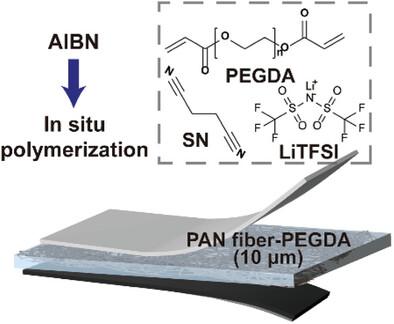
减少固体聚合物电解质的厚度有助于提高固态电池的能量密度。然而,超薄电解质在制备方法、力学性能和界面不稳定性等方面仍面临困难。本文报道了一种独立的、可扩展的、厚度为10微米的超薄固体聚合物电解质。它是通过用聚乙二醇二丙烯酸酯基电解质填充多孔静电纺聚丙烯腈纤维膜后的原位热固化实现的。令人印象深刻的是,它有助于在室温下8.8 × 10⁻⁴ S cm−1的高离子电导率。该膜不仅具有良好的机械强度,而且还提供了富含Li3N的固体电解质界面,从而稳定了锂金属阳极。将超薄电解质与锂箔和高质量负载的LiNi0.8Co0.1Mn0.1O2阴极相结合,可实现380 Wh kg−1和936 Wh L−1的重量/体积能量密度。这项研究为高性能固态电池中纤维增强膜的潜力提供了新的见解。
Fiber-Reinforced Ultrathin Solid Polymer Electrolyte for Solid-State Lithium-Metal Batteries
Reducing the thickness of solid polymer electrolytes can help to enhance the energy density for solid-state batteries. However, ultrathin electrolytes still face difficulties in preparation methods, mechanical properties, and interface instability. Herein, a free-standing, scalable, and ultrathin solid polymer electrolyte with a thickness of 10 µm is reported. It is achieved through in situ thermal curing after filling a porous electrospun polyacrylonitrile fiber membrane with poly(ethylene glycol) diacrylate-based electrolyte. Impressively, it contributes to a high ionic conductivity of 8.8 × 10⁻⁴ S cm−1 at room temperature. The membrane can not only provide good mechanical strength but also offer a Li3N-enriched solid electrolyte interphase, thereby stabilizing the lithium metal anode. The pouch cell pairing the ultrathin electrolyte with Li foil and LiNi0.8Co0.1Mn0.1O2 cathode of high mass loading can realize a gravimetric/volumetric energy density of 380 Wh kg−1 and 936 Wh L−1. This investigation provides new insights into the potential of fiber-reinforced membranes for high-performance solid-state batteries.
期刊介绍:
Firmly established as a top-tier materials science journal, Advanced Functional Materials reports breakthrough research in all aspects of materials science, including nanotechnology, chemistry, physics, and biology every week.
Advanced Functional Materials is known for its rapid and fair peer review, quality content, and high impact, making it the first choice of the international materials science community.






 京公网安备 11010802042870号
京ICP备2023020795号-1
京公网安备 11010802042870号
京ICP备2023020795号-1

 分享
分享
 求助内容:
求助内容: 应助结果提醒方式:
 扫码关注我们
