Qin-Fang Zhang, Rui-Mo Zhao, Yu Lei, Xiao-Li Tian, Yue Hu, Lan Zhang, Ji Zhang
{"title":"基于肉桂醛的ros反应聚合基因载体的高效基因传递和肿瘤细胞生长抑制。","authors":"Qin-Fang Zhang, Rui-Mo Zhao, Yu Lei, Xiao-Li Tian, Yue Hu, Lan Zhang, Ji Zhang","doi":"10.1021/acs.biomac.4c01731","DOIUrl":null,"url":null,"abstract":"<div><div>Reactive oxygen species (ROS)-sensitive polymers are extensively used in cancer therapies. However, the ROS levels in the tumor microenvironment are often insufficient to trigger an adequate therapeutic response. Herein, we report a cinnamaldehyde (<strong>CA</strong>)-based ROS-responsive cationic polymer (<strong>PCA</strong>) and demonstrate its high efficiency in gene delivery and tumor cell growth inhibition. <strong>CA</strong> could be released from the polymer via a ROS-sensitive thioacetal bond by endogenous ROS. The released <strong>CA</strong> successively induced more ROS accumulation through GSH depletion, and the positive feedback helped <strong>PCA</strong> to achieve self-accelerating degradation. Results proved that <strong>PCA</strong>/p53 complexes were efficient in depleting GSH, upregulating ROS levels, and gene transfection. Besides, <strong>PCA</strong> was also shown to be effective in delivering the therapeutic gene p53. More importantly, <strong>PCA</strong>/p53 complexes could significantly induce tumor cell growth suppression by a synergistic effect of <strong>PCA</strong> and p53, providing valuable insights into the design of self-amplifying ROS-responsive polymeric gene vectors.</div></div><div><div><span><figure><span><img><ol><li><span><span>Download: <span>Download high-res image (89KB)</span></span></span></li><li><span><span>Download: <span>Download full-size image</span></span></span></li></ol></span></figure></span></div></div>","PeriodicalId":30,"journal":{"name":"Biomacromolecules","volume":"26 2","pages":"Pages 1362-1371"},"PeriodicalIF":5.4000,"publicationDate":"2025-02-10","publicationTypes":"Journal Article","fieldsOfStudy":null,"isOpenAccess":false,"openAccessPdf":"","citationCount":"0","resultStr":"{\"title\":\"Cinnamaldehyde-Based ROS-Responsive Polymeric Gene Vectors for Efficient Gene Delivery and Tumor Cell Growth Inhibition\",\"authors\":\"Qin-Fang Zhang, Rui-Mo Zhao, Yu Lei, Xiao-Li Tian, Yue Hu, Lan Zhang, Ji Zhang\",\"doi\":\"10.1021/acs.biomac.4c01731\",\"DOIUrl\":null,\"url\":null,\"abstract\":\"<div><div>Reactive oxygen species (ROS)-sensitive polymers are extensively used in cancer therapies. However, the ROS levels in the tumor microenvironment are often insufficient to trigger an adequate therapeutic response. Herein, we report a cinnamaldehyde (<strong>CA</strong>)-based ROS-responsive cationic polymer (<strong>PCA</strong>) and demonstrate its high efficiency in gene delivery and tumor cell growth inhibition. <strong>CA</strong> could be released from the polymer via a ROS-sensitive thioacetal bond by endogenous ROS. The released <strong>CA</strong> successively induced more ROS accumulation through GSH depletion, and the positive feedback helped <strong>PCA</strong> to achieve self-accelerating degradation. Results proved that <strong>PCA</strong>/p53 complexes were efficient in depleting GSH, upregulating ROS levels, and gene transfection. Besides, <strong>PCA</strong> was also shown to be effective in delivering the therapeutic gene p53. More importantly, <strong>PCA</strong>/p53 complexes could significantly induce tumor cell growth suppression by a synergistic effect of <strong>PCA</strong> and p53, providing valuable insights into the design of self-amplifying ROS-responsive polymeric gene vectors.</div></div><div><div><span><figure><span><img><ol><li><span><span>Download: <span>Download high-res image (89KB)</span></span></span></li><li><span><span>Download: <span>Download full-size image</span></span></span></li></ol></span></figure></span></div></div>\",\"PeriodicalId\":30,\"journal\":{\"name\":\"Biomacromolecules\",\"volume\":\"26 2\",\"pages\":\"Pages 1362-1371\"},\"PeriodicalIF\":5.4000,\"publicationDate\":\"2025-02-10\",\"publicationTypes\":\"Journal Article\",\"fieldsOfStudy\":null,\"isOpenAccess\":false,\"openAccessPdf\":\"\",\"citationCount\":\"0\",\"resultStr\":null,\"platform\":\"Semanticscholar\",\"paperid\":null,\"PeriodicalName\":\"Biomacromolecules\",\"FirstCategoryId\":\"92\",\"ListUrlMain\":\"https://www.sciencedirect.com/org/science/article/pii/S1525779725000698\",\"RegionNum\":2,\"RegionCategory\":\"化学\",\"ArticlePicture\":[],\"TitleCN\":null,\"AbstractTextCN\":null,\"PMCID\":null,\"EPubDate\":\"2025/1/29 0:00:00\",\"PubModel\":\"Epub\",\"JCR\":\"Q1\",\"JCRName\":\"BIOCHEMISTRY & MOLECULAR BIOLOGY\",\"Score\":null,\"Total\":0}","platform":"Semanticscholar","paperid":null,"PeriodicalName":"Biomacromolecules","FirstCategoryId":"92","ListUrlMain":"https://www.sciencedirect.com/org/science/article/pii/S1525779725000698","RegionNum":2,"RegionCategory":"化学","ArticlePicture":[],"TitleCN":null,"AbstractTextCN":null,"PMCID":null,"EPubDate":"2025/1/29 0:00:00","PubModel":"Epub","JCR":"Q1","JCRName":"BIOCHEMISTRY & MOLECULAR BIOLOGY","Score":null,"Total":0}
Cinnamaldehyde-Based ROS-Responsive Polymeric Gene Vectors for Efficient Gene Delivery and Tumor Cell Growth Inhibition
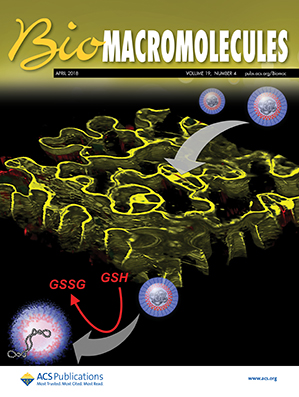
Reactive oxygen species (ROS)-sensitive polymers are extensively used in cancer therapies. However, the ROS levels in the tumor microenvironment are often insufficient to trigger an adequate therapeutic response. Herein, we report a cinnamaldehyde (CA)-based ROS-responsive cationic polymer (PCA) and demonstrate its high efficiency in gene delivery and tumor cell growth inhibition. CA could be released from the polymer via a ROS-sensitive thioacetal bond by endogenous ROS. The released CA successively induced more ROS accumulation through GSH depletion, and the positive feedback helped PCA to achieve self-accelerating degradation. Results proved that PCA/p53 complexes were efficient in depleting GSH, upregulating ROS levels, and gene transfection. Besides, PCA was also shown to be effective in delivering the therapeutic gene p53. More importantly, PCA/p53 complexes could significantly induce tumor cell growth suppression by a synergistic effect of PCA and p53, providing valuable insights into the design of self-amplifying ROS-responsive polymeric gene vectors.
期刊介绍:
Biomacromolecules is a leading forum for the dissemination of cutting-edge research at the interface of polymer science and biology. Submissions to Biomacromolecules should contain strong elements of innovation in terms of macromolecular design, synthesis and characterization, or in the application of polymer materials to biology and medicine.
Topics covered by Biomacromolecules include, but are not exclusively limited to: sustainable polymers, polymers based on natural and renewable resources, degradable polymers, polymer conjugates, polymeric drugs, polymers in biocatalysis, biomacromolecular assembly, biomimetic polymers, polymer-biomineral hybrids, biomimetic-polymer processing, polymer recycling, bioactive polymer surfaces, original polymer design for biomedical applications such as immunotherapy, drug delivery, gene delivery, antimicrobial applications, diagnostic imaging and biosensing, polymers in tissue engineering and regenerative medicine, polymeric scaffolds and hydrogels for cell culture and delivery.




 京公网安备 11010802042870号
京ICP备2023020795号-1
京公网安备 11010802042870号
京ICP备2023020795号-1

 分享
分享
 求助内容:
求助内容: 应助结果提醒方式:
 扫码关注我们
