Junfeng Liu , Liying Zhang , Haodi Ma, Haoyang Sun, Shu-ai Ge, Jieyi Liu, Shengdi Fan, Chunshan Quan
{"title":"季铵壳聚糖功能化介孔二氧化硅纳米颗粒:一种治疗细胞内MRSA感染的有前途的靶向药物递送系统。","authors":"Junfeng Liu , Liying Zhang , Haodi Ma, Haoyang Sun, Shu-ai Ge, Jieyi Liu, Shengdi Fan, Chunshan Quan","doi":"10.1016/j.carbpol.2024.123184","DOIUrl":null,"url":null,"abstract":"<div><div>The limited membrane permeability and bacterial resistance pose significant challenges in the management of intracellular drug-resistant bacterial infections. To overcome this issue, we developed a bacterial-targeted drug delivery system based on quaternary ammonium chitosan-modified mesoporous silica nanoparticles (MSN-NH<sub>2</sub>-CFP@HACC) for the treatment of intracellular Methicillin-resistant <em>Staphylococcus aureus</em> (MRSA) infections. This system utilizes amino-functionalized mesoporous silica nanoparticles to efficiently load cefoperazone (CFP), and the nanoparticles' surface is coated with 2-hydroxypropyltrimethyl ammonium chloride chitosan (HACC) to target bacteria and enhance macrophage uptake. The findings indicate that MSN-NH<sub>2</sub>-CFP@HACC nanoparticles are efficiently internalized by macrophages, demonstrate accelerated drug release in acidic environments, and exhibit enhanced antibacterial properties, effectively suppressing the proliferation and intracellular escape of MRSA. Moreover, HACC enhances the bacterial capture ability of the nanoparticles and reduces resistance by disrupting bacterial membrane structures and inhibiting bacterial β-lactamase activity. In a murine model of MRSA bacteremia, MSN-NH<sub>2</sub>-CFP@HACC exhibited remarkable antibacterial efficacy and significantly attenuated severe inflammatory responses. In conclusion, MSN-NH<sub>2</sub>-CFP@HACC represent a promising antibiotic delivery system with exceptional antibacterial efficacy and favorable biocompatibility, thus presenting a novel strategy for addressing intracellular drug-resistant bacterial infections and demonstrating significant potential for clinical application.</div></div>","PeriodicalId":261,"journal":{"name":"Carbohydrate Polymers","volume":"352 ","pages":"Article 123184"},"PeriodicalIF":13.2000,"publicationDate":"2025-03-15","publicationTypes":"Journal Article","fieldsOfStudy":null,"isOpenAccess":false,"openAccessPdf":"","citationCount":"0","resultStr":"{\"title\":\"Quaternary ammonium chitosan-functionalized mesoporous silica nanoparticles: A promising targeted drug delivery system for the treatment of intracellular MRSA infection\",\"authors\":\"Junfeng Liu , Liying Zhang , Haodi Ma, Haoyang Sun, Shu-ai Ge, Jieyi Liu, Shengdi Fan, Chunshan Quan\",\"doi\":\"10.1016/j.carbpol.2024.123184\",\"DOIUrl\":null,\"url\":null,\"abstract\":\"<div><div>The limited membrane permeability and bacterial resistance pose significant challenges in the management of intracellular drug-resistant bacterial infections. To overcome this issue, we developed a bacterial-targeted drug delivery system based on quaternary ammonium chitosan-modified mesoporous silica nanoparticles (MSN-NH<sub>2</sub>-CFP@HACC) for the treatment of intracellular Methicillin-resistant <em>Staphylococcus aureus</em> (MRSA) infections. This system utilizes amino-functionalized mesoporous silica nanoparticles to efficiently load cefoperazone (CFP), and the nanoparticles' surface is coated with 2-hydroxypropyltrimethyl ammonium chloride chitosan (HACC) to target bacteria and enhance macrophage uptake. The findings indicate that MSN-NH<sub>2</sub>-CFP@HACC nanoparticles are efficiently internalized by macrophages, demonstrate accelerated drug release in acidic environments, and exhibit enhanced antibacterial properties, effectively suppressing the proliferation and intracellular escape of MRSA. Moreover, HACC enhances the bacterial capture ability of the nanoparticles and reduces resistance by disrupting bacterial membrane structures and inhibiting bacterial β-lactamase activity. In a murine model of MRSA bacteremia, MSN-NH<sub>2</sub>-CFP@HACC exhibited remarkable antibacterial efficacy and significantly attenuated severe inflammatory responses. In conclusion, MSN-NH<sub>2</sub>-CFP@HACC represent a promising antibiotic delivery system with exceptional antibacterial efficacy and favorable biocompatibility, thus presenting a novel strategy for addressing intracellular drug-resistant bacterial infections and demonstrating significant potential for clinical application.</div></div>\",\"PeriodicalId\":261,\"journal\":{\"name\":\"Carbohydrate Polymers\",\"volume\":\"352 \",\"pages\":\"Article 123184\"},\"PeriodicalIF\":13.2000,\"publicationDate\":\"2025-03-15\",\"publicationTypes\":\"Journal Article\",\"fieldsOfStudy\":null,\"isOpenAccess\":false,\"openAccessPdf\":\"\",\"citationCount\":\"0\",\"resultStr\":null,\"platform\":\"Semanticscholar\",\"paperid\":null,\"PeriodicalName\":\"Carbohydrate Polymers\",\"FirstCategoryId\":\"92\",\"ListUrlMain\":\"https://www.sciencedirect.com/science/article/pii/S0144861724014103\",\"RegionNum\":1,\"RegionCategory\":\"化学\",\"ArticlePicture\":[],\"TitleCN\":null,\"AbstractTextCN\":null,\"PMCID\":null,\"EPubDate\":\"2024/12/24 0:00:00\",\"PubModel\":\"Epub\",\"JCR\":\"Q1\",\"JCRName\":\"CHEMISTRY, APPLIED\",\"Score\":null,\"Total\":0}","platform":"Semanticscholar","paperid":null,"PeriodicalName":"Carbohydrate Polymers","FirstCategoryId":"92","ListUrlMain":"https://www.sciencedirect.com/science/article/pii/S0144861724014103","RegionNum":1,"RegionCategory":"化学","ArticlePicture":[],"TitleCN":null,"AbstractTextCN":null,"PMCID":null,"EPubDate":"2024/12/24 0:00:00","PubModel":"Epub","JCR":"Q1","JCRName":"CHEMISTRY, APPLIED","Score":null,"Total":0}
Quaternary ammonium chitosan-functionalized mesoporous silica nanoparticles: A promising targeted drug delivery system for the treatment of intracellular MRSA infection
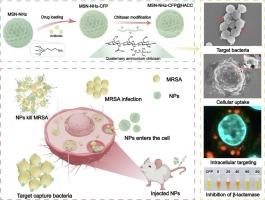
The limited membrane permeability and bacterial resistance pose significant challenges in the management of intracellular drug-resistant bacterial infections. To overcome this issue, we developed a bacterial-targeted drug delivery system based on quaternary ammonium chitosan-modified mesoporous silica nanoparticles (MSN-NH2-CFP@HACC) for the treatment of intracellular Methicillin-resistant Staphylococcus aureus (MRSA) infections. This system utilizes amino-functionalized mesoporous silica nanoparticles to efficiently load cefoperazone (CFP), and the nanoparticles' surface is coated with 2-hydroxypropyltrimethyl ammonium chloride chitosan (HACC) to target bacteria and enhance macrophage uptake. The findings indicate that MSN-NH2-CFP@HACC nanoparticles are efficiently internalized by macrophages, demonstrate accelerated drug release in acidic environments, and exhibit enhanced antibacterial properties, effectively suppressing the proliferation and intracellular escape of MRSA. Moreover, HACC enhances the bacterial capture ability of the nanoparticles and reduces resistance by disrupting bacterial membrane structures and inhibiting bacterial β-lactamase activity. In a murine model of MRSA bacteremia, MSN-NH2-CFP@HACC exhibited remarkable antibacterial efficacy and significantly attenuated severe inflammatory responses. In conclusion, MSN-NH2-CFP@HACC represent a promising antibiotic delivery system with exceptional antibacterial efficacy and favorable biocompatibility, thus presenting a novel strategy for addressing intracellular drug-resistant bacterial infections and demonstrating significant potential for clinical application.
期刊介绍:
Carbohydrate Polymers stands as a prominent journal in the glycoscience field, dedicated to exploring and harnessing the potential of polysaccharides with applications spanning bioenergy, bioplastics, biomaterials, biorefining, chemistry, drug delivery, food, health, nanotechnology, packaging, paper, pharmaceuticals, medicine, oil recovery, textiles, tissue engineering, wood, and various aspects of glycoscience.
The journal emphasizes the central role of well-characterized carbohydrate polymers, highlighting their significance as the primary focus rather than a peripheral topic. Each paper must prominently feature at least one named carbohydrate polymer, evident in both citation and title, with a commitment to innovative research that advances scientific knowledge.




 京公网安备 11010802042870号
京ICP备2023020795号-1
京公网安备 11010802042870号
京ICP备2023020795号-1

 分享
分享
 求助内容:
求助内容: 应助结果提醒方式:
 扫码关注我们
