{"title":"探讨SPECT/CT-SUV在监测177lu - psma靶向放射性核素治疗中的意义:一项系统综述。","authors":"Tahani O Alkahtani","doi":"10.1186/s12880-025-01571-x","DOIUrl":null,"url":null,"abstract":"<p><strong>Background: </strong>Quantitative molecular imaging via single-photon emission computed tomography-derived standardised uptake value (SPECT/CT-SUV) is used to assess the response of metastatic castration-resistant prostate cancer (mCRPC) patients to targeted radionuclide therapy (TRT) with [<sup>177</sup>Lu]Lu-PSMA. This imaging technique determines the radiopharmaceutical distribution and internal dosimetry in patients who receive TRT. However, there is limited evidence regarding the role of image quantification in monitoring changes induced by [<sup>177</sup>Lu]Lu-PSMA. This systematic examines the role of quantitative SPECT/CT-SUV during [<sup>177</sup>Lu]Lu-PSMA TRT and assesses whether SUV changes correlate with quantitative imaging and biomarkers.</p><p><strong>Methods: </strong>A systematic review was conducted in accordance with the PRISMA guidelines. The MEDLINE/PubMed databases were searched from January 2016 to July 2024 to identify relevant articles. The inclusion criterion was the use of quantitative SPECT/CT-SUV during [<sup>177</sup>Lu]Lu-PSMA TRT for patients with mCRPC. The records were screened to determine their eligibility. The abstracts of 62 records were screened, and 28 were excluded because they were not relevant; the full texts of 34 original papers were retrieved and assessed for eligibility.</p><p><strong>Results: </strong>A total of five studies were included in this systematic review (two prospective studies and three retrospective studies). The sample sizes of the studies ranged from 6 to 73 patients. The highest number of lesions analysed was 144. Three studies reported the SPECT/CT-SUV following cycle 1, and only one study reported the correlation with pretherapy PET/CT (r = 0.9, p = 0.005). SPECT/CT-SUV changes between the first two to three cycles were reported in one study. None of the studies reported the SPECT/CT-SUV for normal organs. One study reported correlations between SPECT/CT-derived SUV and PET/CT-derived SUV in target and nontarget tissues.</p><p><strong>Conclusion: </strong>Quantitative SPECT/CT-SUV can be used to predict responses to subsequent PSMA-TRT cycles. Disease burden and tumour heterogeneity are the leading causes of TRT individualisation.</p>","PeriodicalId":9020,"journal":{"name":"BMC Medical Imaging","volume":"25 1","pages":"28"},"PeriodicalIF":3.9000,"publicationDate":"2025-01-28","publicationTypes":"Journal Article","fieldsOfStudy":null,"isOpenAccess":false,"openAccessPdf":"https://www.ncbi.nlm.nih.gov/pmc/articles/PMC11776189/pdf/","citationCount":"0","resultStr":"{\"title\":\"Investigating the significance of SPECT/CT-SUV for monitoring <sup>177</sup>Lu-PSMA-targeted radionuclide therapy: a systematic review.\",\"authors\":\"Tahani O Alkahtani\",\"doi\":\"10.1186/s12880-025-01571-x\",\"DOIUrl\":null,\"url\":null,\"abstract\":\"<p><strong>Background: </strong>Quantitative molecular imaging via single-photon emission computed tomography-derived standardised uptake value (SPECT/CT-SUV) is used to assess the response of metastatic castration-resistant prostate cancer (mCRPC) patients to targeted radionuclide therapy (TRT) with [<sup>177</sup>Lu]Lu-PSMA. This imaging technique determines the radiopharmaceutical distribution and internal dosimetry in patients who receive TRT. However, there is limited evidence regarding the role of image quantification in monitoring changes induced by [<sup>177</sup>Lu]Lu-PSMA. This systematic examines the role of quantitative SPECT/CT-SUV during [<sup>177</sup>Lu]Lu-PSMA TRT and assesses whether SUV changes correlate with quantitative imaging and biomarkers.</p><p><strong>Methods: </strong>A systematic review was conducted in accordance with the PRISMA guidelines. The MEDLINE/PubMed databases were searched from January 2016 to July 2024 to identify relevant articles. The inclusion criterion was the use of quantitative SPECT/CT-SUV during [<sup>177</sup>Lu]Lu-PSMA TRT for patients with mCRPC. The records were screened to determine their eligibility. The abstracts of 62 records were screened, and 28 were excluded because they were not relevant; the full texts of 34 original papers were retrieved and assessed for eligibility.</p><p><strong>Results: </strong>A total of five studies were included in this systematic review (two prospective studies and three retrospective studies). The sample sizes of the studies ranged from 6 to 73 patients. The highest number of lesions analysed was 144. Three studies reported the SPECT/CT-SUV following cycle 1, and only one study reported the correlation with pretherapy PET/CT (r = 0.9, p = 0.005). SPECT/CT-SUV changes between the first two to three cycles were reported in one study. None of the studies reported the SPECT/CT-SUV for normal organs. One study reported correlations between SPECT/CT-derived SUV and PET/CT-derived SUV in target and nontarget tissues.</p><p><strong>Conclusion: </strong>Quantitative SPECT/CT-SUV can be used to predict responses to subsequent PSMA-TRT cycles. Disease burden and tumour heterogeneity are the leading causes of TRT individualisation.</p>\",\"PeriodicalId\":9020,\"journal\":{\"name\":\"BMC Medical Imaging\",\"volume\":\"25 1\",\"pages\":\"28\"},\"PeriodicalIF\":3.9000,\"publicationDate\":\"2025-01-28\",\"publicationTypes\":\"Journal Article\",\"fieldsOfStudy\":null,\"isOpenAccess\":false,\"openAccessPdf\":\"https://www.ncbi.nlm.nih.gov/pmc/articles/PMC11776189/pdf/\",\"citationCount\":\"0\",\"resultStr\":null,\"platform\":\"Semanticscholar\",\"paperid\":null,\"PeriodicalName\":\"BMC Medical Imaging\",\"FirstCategoryId\":\"3\",\"ListUrlMain\":\"https://doi.org/10.1186/s12880-025-01571-x\",\"RegionNum\":3,\"RegionCategory\":\"医学\",\"ArticlePicture\":[],\"TitleCN\":null,\"AbstractTextCN\":null,\"PMCID\":null,\"EPubDate\":\"\",\"PubModel\":\"\",\"JCR\":\"Q2\",\"JCRName\":\"RADIOLOGY, NUCLEAR MEDICINE & MEDICAL IMAGING\",\"Score\":null,\"Total\":0}","platform":"Semanticscholar","paperid":null,"PeriodicalName":"BMC Medical Imaging","FirstCategoryId":"3","ListUrlMain":"https://doi.org/10.1186/s12880-025-01571-x","RegionNum":3,"RegionCategory":"医学","ArticlePicture":[],"TitleCN":null,"AbstractTextCN":null,"PMCID":null,"EPubDate":"","PubModel":"","JCR":"Q2","JCRName":"RADIOLOGY, NUCLEAR MEDICINE & MEDICAL IMAGING","Score":null,"Total":0}
Investigating the significance of SPECT/CT-SUV for monitoring 177Lu-PSMA-targeted radionuclide therapy: a systematic review.
Background: Quantitative molecular imaging via single-photon emission computed tomography-derived standardised uptake value (SPECT/CT-SUV) is used to assess the response of metastatic castration-resistant prostate cancer (mCRPC) patients to targeted radionuclide therapy (TRT) with [177Lu]Lu-PSMA. This imaging technique determines the radiopharmaceutical distribution and internal dosimetry in patients who receive TRT. However, there is limited evidence regarding the role of image quantification in monitoring changes induced by [177Lu]Lu-PSMA. This systematic examines the role of quantitative SPECT/CT-SUV during [177Lu]Lu-PSMA TRT and assesses whether SUV changes correlate with quantitative imaging and biomarkers.
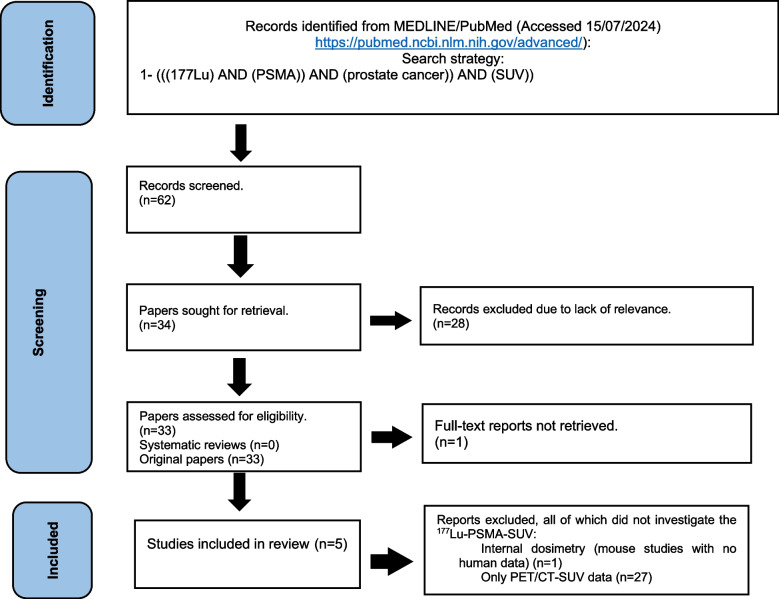
Methods: A systematic review was conducted in accordance with the PRISMA guidelines. The MEDLINE/PubMed databases were searched from January 2016 to July 2024 to identify relevant articles. The inclusion criterion was the use of quantitative SPECT/CT-SUV during [177Lu]Lu-PSMA TRT for patients with mCRPC. The records were screened to determine their eligibility. The abstracts of 62 records were screened, and 28 were excluded because they were not relevant; the full texts of 34 original papers were retrieved and assessed for eligibility.
Results: A total of five studies were included in this systematic review (two prospective studies and three retrospective studies). The sample sizes of the studies ranged from 6 to 73 patients. The highest number of lesions analysed was 144. Three studies reported the SPECT/CT-SUV following cycle 1, and only one study reported the correlation with pretherapy PET/CT (r = 0.9, p = 0.005). SPECT/CT-SUV changes between the first two to three cycles were reported in one study. None of the studies reported the SPECT/CT-SUV for normal organs. One study reported correlations between SPECT/CT-derived SUV and PET/CT-derived SUV in target and nontarget tissues.
Conclusion: Quantitative SPECT/CT-SUV can be used to predict responses to subsequent PSMA-TRT cycles. Disease burden and tumour heterogeneity are the leading causes of TRT individualisation.
期刊介绍:
BMC Medical Imaging is an open access journal publishing original peer-reviewed research articles in the development, evaluation, and use of imaging techniques and image processing tools to diagnose and manage disease.




 京公网安备 11010802042870号
京ICP备2023020795号-1
京公网安备 11010802042870号
京ICP备2023020795号-1

 分享
分享
 求助内容:
求助内容: 应助结果提醒方式:
 扫码关注我们
