Xiaoxi Pang, Yang Han, Elise Tressier, Nurin Abdul Aziz, Lorenzo Pellis, Thomas House, Ian Hall
{"title":"时变再生数估计:室室模型与广义加性模型的融合。","authors":"Xiaoxi Pang, Yang Han, Elise Tressier, Nurin Abdul Aziz, Lorenzo Pellis, Thomas House, Ian Hall","doi":"10.1098/rsif.2024.0518","DOIUrl":null,"url":null,"abstract":"<p><p>The reproduction number, the mean number of secondary cases infected by each primary case, gives an indication of the effort required to control the disease. Beyond the well-known <i>basic</i> reproduction number, there are two natural extensions, namely the <i>control</i> and <i>effective</i> reproduction numbers. As behaviour, population immunity and viral characteristics can change with time, these reproduction numbers can vary over time. Real-world data can be complex, so in this work we consider a generalized additive model to smooth surveillance data through the explicit incorporation of day-of-the-week effects, to provide a simple measure of the time-varying growth rate associated with the data. Converting the resulting spline into an estimator for both the control and effective reproduction numbers requires assumptions on a model structure, which we here assume to be a compartmental model. The reproduction numbers calculated are based on both simulated and real-world data, and are compared with estimates from an already existing tool. The derived method for estimating the time-varying reproduction number is effective, efficient and comparable with other methods. It provides a useful alternative approach, which can be included as part of a toolbox of models, that is particularly apt at smoothing out day-of-the-week effects in surveillance.</p>","PeriodicalId":17488,"journal":{"name":"Journal of The Royal Society Interface","volume":"22 222","pages":"20240518"},"PeriodicalIF":3.4000,"publicationDate":"2025-01-01","publicationTypes":"Journal Article","fieldsOfStudy":null,"isOpenAccess":false,"openAccessPdf":"https://www.ncbi.nlm.nih.gov/pmc/articles/PMC11776018/pdf/","citationCount":"0","resultStr":"{\"title\":\"Time-varying reproduction number estimation: fusing compartmental models with generalized additive models.\",\"authors\":\"Xiaoxi Pang, Yang Han, Elise Tressier, Nurin Abdul Aziz, Lorenzo Pellis, Thomas House, Ian Hall\",\"doi\":\"10.1098/rsif.2024.0518\",\"DOIUrl\":null,\"url\":null,\"abstract\":\"<p><p>The reproduction number, the mean number of secondary cases infected by each primary case, gives an indication of the effort required to control the disease. Beyond the well-known <i>basic</i> reproduction number, there are two natural extensions, namely the <i>control</i> and <i>effective</i> reproduction numbers. As behaviour, population immunity and viral characteristics can change with time, these reproduction numbers can vary over time. Real-world data can be complex, so in this work we consider a generalized additive model to smooth surveillance data through the explicit incorporation of day-of-the-week effects, to provide a simple measure of the time-varying growth rate associated with the data. Converting the resulting spline into an estimator for both the control and effective reproduction numbers requires assumptions on a model structure, which we here assume to be a compartmental model. The reproduction numbers calculated are based on both simulated and real-world data, and are compared with estimates from an already existing tool. The derived method for estimating the time-varying reproduction number is effective, efficient and comparable with other methods. It provides a useful alternative approach, which can be included as part of a toolbox of models, that is particularly apt at smoothing out day-of-the-week effects in surveillance.</p>\",\"PeriodicalId\":17488,\"journal\":{\"name\":\"Journal of The Royal Society Interface\",\"volume\":\"22 222\",\"pages\":\"20240518\"},\"PeriodicalIF\":3.4000,\"publicationDate\":\"2025-01-01\",\"publicationTypes\":\"Journal Article\",\"fieldsOfStudy\":null,\"isOpenAccess\":false,\"openAccessPdf\":\"https://www.ncbi.nlm.nih.gov/pmc/articles/PMC11776018/pdf/\",\"citationCount\":\"0\",\"resultStr\":null,\"platform\":\"Semanticscholar\",\"paperid\":null,\"PeriodicalName\":\"Journal of The Royal Society Interface\",\"FirstCategoryId\":\"103\",\"ListUrlMain\":\"https://doi.org/10.1098/rsif.2024.0518\",\"RegionNum\":2,\"RegionCategory\":\"综合性期刊\",\"ArticlePicture\":[],\"TitleCN\":null,\"AbstractTextCN\":null,\"PMCID\":null,\"EPubDate\":\"2025/1/29 0:00:00\",\"PubModel\":\"Epub\",\"JCR\":\"Q1\",\"JCRName\":\"MULTIDISCIPLINARY SCIENCES\",\"Score\":null,\"Total\":0}","platform":"Semanticscholar","paperid":null,"PeriodicalName":"Journal of The Royal Society Interface","FirstCategoryId":"103","ListUrlMain":"https://doi.org/10.1098/rsif.2024.0518","RegionNum":2,"RegionCategory":"综合性期刊","ArticlePicture":[],"TitleCN":null,"AbstractTextCN":null,"PMCID":null,"EPubDate":"2025/1/29 0:00:00","PubModel":"Epub","JCR":"Q1","JCRName":"MULTIDISCIPLINARY SCIENCES","Score":null,"Total":0}
Time-varying reproduction number estimation: fusing compartmental models with generalized additive models.
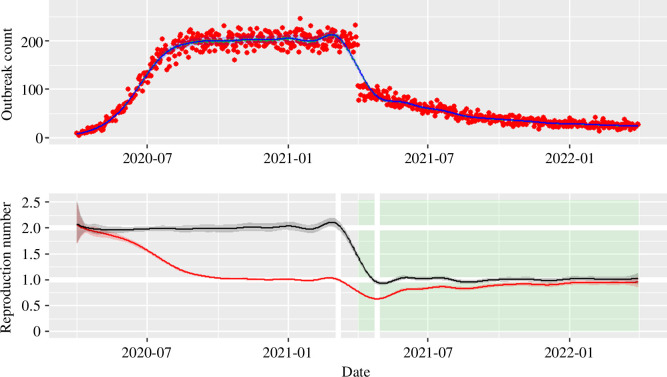
The reproduction number, the mean number of secondary cases infected by each primary case, gives an indication of the effort required to control the disease. Beyond the well-known basic reproduction number, there are two natural extensions, namely the control and effective reproduction numbers. As behaviour, population immunity and viral characteristics can change with time, these reproduction numbers can vary over time. Real-world data can be complex, so in this work we consider a generalized additive model to smooth surveillance data through the explicit incorporation of day-of-the-week effects, to provide a simple measure of the time-varying growth rate associated with the data. Converting the resulting spline into an estimator for both the control and effective reproduction numbers requires assumptions on a model structure, which we here assume to be a compartmental model. The reproduction numbers calculated are based on both simulated and real-world data, and are compared with estimates from an already existing tool. The derived method for estimating the time-varying reproduction number is effective, efficient and comparable with other methods. It provides a useful alternative approach, which can be included as part of a toolbox of models, that is particularly apt at smoothing out day-of-the-week effects in surveillance.
期刊介绍:
J. R. Soc. Interface welcomes articles of high quality research at the interface of the physical and life sciences. It provides a high-quality forum to publish rapidly and interact across this boundary in two main ways: J. R. Soc. Interface publishes research applying chemistry, engineering, materials science, mathematics and physics to the biological and medical sciences; it also highlights discoveries in the life sciences of relevance to the physical sciences. Both sides of the interface are considered equally and it is one of the only journals to cover this exciting new territory. J. R. Soc. Interface welcomes contributions on a diverse range of topics, including but not limited to; biocomplexity, bioengineering, bioinformatics, biomaterials, biomechanics, bionanoscience, biophysics, chemical biology, computer science (as applied to the life sciences), medical physics, synthetic biology, systems biology, theoretical biology and tissue engineering.






 京公网安备 11010802042870号
京ICP备2023020795号-1
京公网安备 11010802042870号
京ICP备2023020795号-1

 分享
分享
 求助内容:
求助内容: 应助结果提醒方式:
 扫码关注我们
